March 30, 2025
The 5 E-Numbers Every Muslim Should Avoid (Beyond E471)
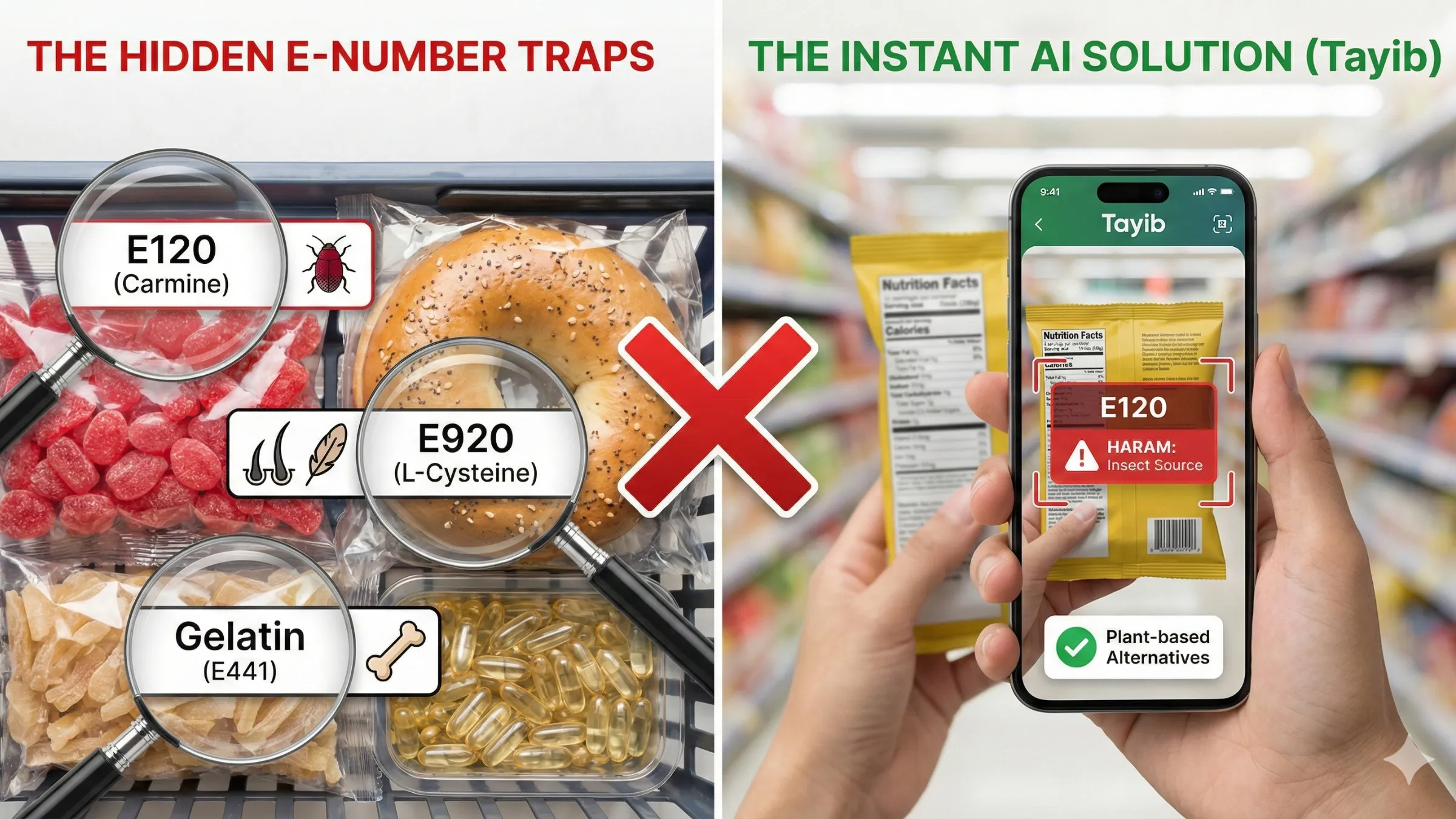
If you grew up in a Muslim household, you know the drill. You pick up a snack, check the back of the packet, and scan for E471.
If you see it, you usually panic and put the item back.
For decades, E471 (Mono- and diglycerides of fatty acids) has been the “boogeyman” of Halal grocery shopping.
But here is the truth: E471 is often perfectly plant-based and Halal. It is just a “maybe.”
While you are busy worrying about E471, you might be missing additives that are far worse. We are talking about ingredients derived from crushed insects, human hair, and pig bones.
As part of our Ultimate Guide to Halal Ingredients, we are exposing the real dangers in your food. Here are the 5 E-numbers that are significantly riskier than E471.
1. E120 (Carmine / Cochineal) 🐞
The Source: Crushed Insects. Found In: Red candies, strawberry yogurts, juices, and cosmetics.
This is the big one. E120 is a bright red food dye. It is made by boiling and crushing thousands of pregnant female cochineal beetles.
The Verdict: According to the majority of Islamic scholars (including the Hanafi, Shafi’i, and Hanbali schools), consuming insects is forbidden. This makes E120 strictly Haram.
The Trap: Brands often label it as “Natural Red 4” or “Cochineal Extract” to sound appealing. “Natural” just means it comes from a bug, not a lab. Due to severe allergy risks, the FDA requires companies to declare it on labels, making it easier to spot if you know the names.
Read our deep dive: Is E120 Halal? The Shocking Truth About Carmine.
2. E920 (L-Cysteine) 💇♂️
The Source: Human Hair or Duck Feathers. Found In: Bagels, pizza crusts, mass-produced bread, and donuts.
L-Cysteine is an amino acid. Bakeries use it as a “dough conditioner” to make commercial bread soft, stretchy, and fast to bake.
The Verdict: While synthetic versions exist, the absolute cheapest source of L-Cysteine is human hair gathered from barbershops, or dissolved duck feathers. Consuming human byproducts is strictly Haram in Islam.
The Trap: A product with E920 might be labeled “Vegetarian” because no animal was slaughtered to get the hair or feathers.
Always check your bakery items. See our guide on Is E471 Halal? to understand other bread risks.
3. E542 (Edible Bone Phosphate) 🦴
The Source: Animal Bones (Often Pork or Cattle). Found In: Anti-caking agents in dry powders, supplements, and processed cheeses.
This additive prevents dry powders from clumping together in humid environments. It is literally made from the crushed bones of animals.
The Verdict: Unless the source is explicitly stated as Zabiha Halal beef, there is a massive probability it comes from pork bones or unslaughtered cattle. Recognized bodies like HMC UK warn against bone-derived additives without certification. This makes E542 Haram or highly Mushbooh.
4. E441 (Gelatin) 🐖
The Source: Skin and Bones of Pigs or Cattle. Found In: Gummies, marshmallows, mousses, and medicine capsules.
Technically, Gelatin’s official code is E441. However, you will rarely see the code on a label today because manufacturers simply write the word “Gelatin.”
The Verdict: In Western supermarkets, commercial gelatin is overwhelmingly derived from Pork. This makes it completely Haram. If it comes from beef, it is usually non-Zabiha, which is also Haram.
The Trap: “Kosher” gelatin is often beef-based, but not slaughtered according to Islamic law. You must look for certified “Halal Beef Gelatin” or plant-based alternatives like Pectin.
Want to know which sweets are safe? Read our Complete Guide to Popular Brands & Fast Food.
5. E904 (Shellac) 🍬
The Source: Insect Secretion (Lac beetle) mixed with Alcohol. Found In: Shiny coatings on chocolates, jelly beans, and pills.
Shellac is also known as “Confectioner’s Glaze.” It is a resin secreted by the female lac bug on tree branches. It gives your favorite chocolate-covered nuts that beautiful shine.
The Verdict: The resin itself is heavily debated. Some scholars say it is Halal (like honey). Others say it is Haram because bugs are crushed during scraping.
The Catch: The processing almost always involves dissolving the resin in ethanol (alcohol) before spraying it onto the food. This makes it a major grey area (Mushbooh). It is best to look for Carnauba Wax instead, which is 100% plant-based.
Stop Memorizing Codes. Start Scanning.
E471 is ambiguous, but E120, E920, and E542 are clear red flags.
The problem is that modern food science is confusing. Memorizing a list of numbers is exhausting. Manufacturers constantly switch between chemical names and E-numbers just to confuse you.
You do not need to be a chemist to protect your diet.
The safest way to shop is to use Tayib. Our AI Halal scanner has every single E-number and complex additive built into its database. Just point your phone’s camera at the ingredient list. Tayib reads the text instantly and highlights exactly which additives are Haram or Mushbooh.
Tired of Playing E-Number Roulette?
Don't guess with your family's food. Tayib instantly detects insect dyes, human hair derivatives, and hidden pork in seconds. Your peace of mind is one tap away.
Download TayibFrequently Asked Questions: Haram E-Numbers
Is E471 always Haram?
No. E471 (Mono- and diglycerides) can be made from plant oils like soy or palm (Halal) or animal fats like pork (Haram). It is Mushbooh (doubtful). Look for a 'Suitable for Vegetarians' logo to ensure it is plant-based.
What is E120 and why is it Haram?
E120, also known as Carmine or Cochineal Extract, is a red dye made from crushed insects. The majority of Islamic scholars forbid consuming insects, making this dye Haram for most Muslims.
Does supermarket bread contain human hair?
It can. Mass-produced breads often use E920 (L-Cysteine) as a dough conditioner to make the bread soft. The cheapest commercial source for E920 is human hair or duck feathers, both of which are Haram.
Why don't I see E441 on ingredient labels?
E441 is the official E-number for Gelatin. However, food manufacturers know that consumers recognize the word 'Gelatin', so they use the word instead of the code. In the West, standard gelatin is mostly derived from pork.
Is E904 (Shellac) Halal?
Shellac (E904) is Mushbooh (doubtful). It is a bug secretion used to make candies shiny. While the secretion itself is debated, it is often dissolved in ethanol (alcohol) during the manufacturing process, making it risky for a Halal diet.
Are all 'E-Numbers' bad for Muslims?
No! The 'E' simply stands for Europe. Many E-numbers are completely natural and 100% Halal. For example, E300 is just Vitamin C, and E330 is Citric Acid from lemons.
What is E542 made of?
E542 is Edible Bone Phosphate. It is made from crushed animal bones, most commonly from cattle or pigs. Unless the product is specifically Halal-certified, you must assume the bones are not Zabiha, making it Haram.
How can I avoid Haram food colors?
Avoid E120 (Carmine) as it is insect-based. Synthetic artificial colors (like Red 40, Yellow 5, or E133) are petroleum-based and technically Halal, though they may have health drawbacks. Plant-based colors like beetroot extract are always the safest.
Is Kosher certification enough to guarantee an E-number is Halal?
Not always. While Kosher certification guarantees there is no pork or insect products (like E120), Kosher laws permit the consumption of alcohol. This means a Kosher product could contain flavorings or E-numbers dissolved in alcohol.
How does the Tayib app detect these ingredients?
Tayib uses an advanced OCR (Optical Character Recognition) AI. When you scan an ingredient list with your phone camera, it reads the text and instantly cross-references the words and E-numbers against our massive Halal database.

Written by Tayib
Founder & Halal Food Analyst
Tayib is dedicated to making Halal consumption transparent and stress-free. Through rigorous ingredient analysis, E-number decoding, and direct contact with brands, we help the Muslim community make informed and safe choices every day.
Read our strict verification methodology