December 1, 2025
Which Halal App is Best for Travel? (Why Barcodes Fail Abroad)
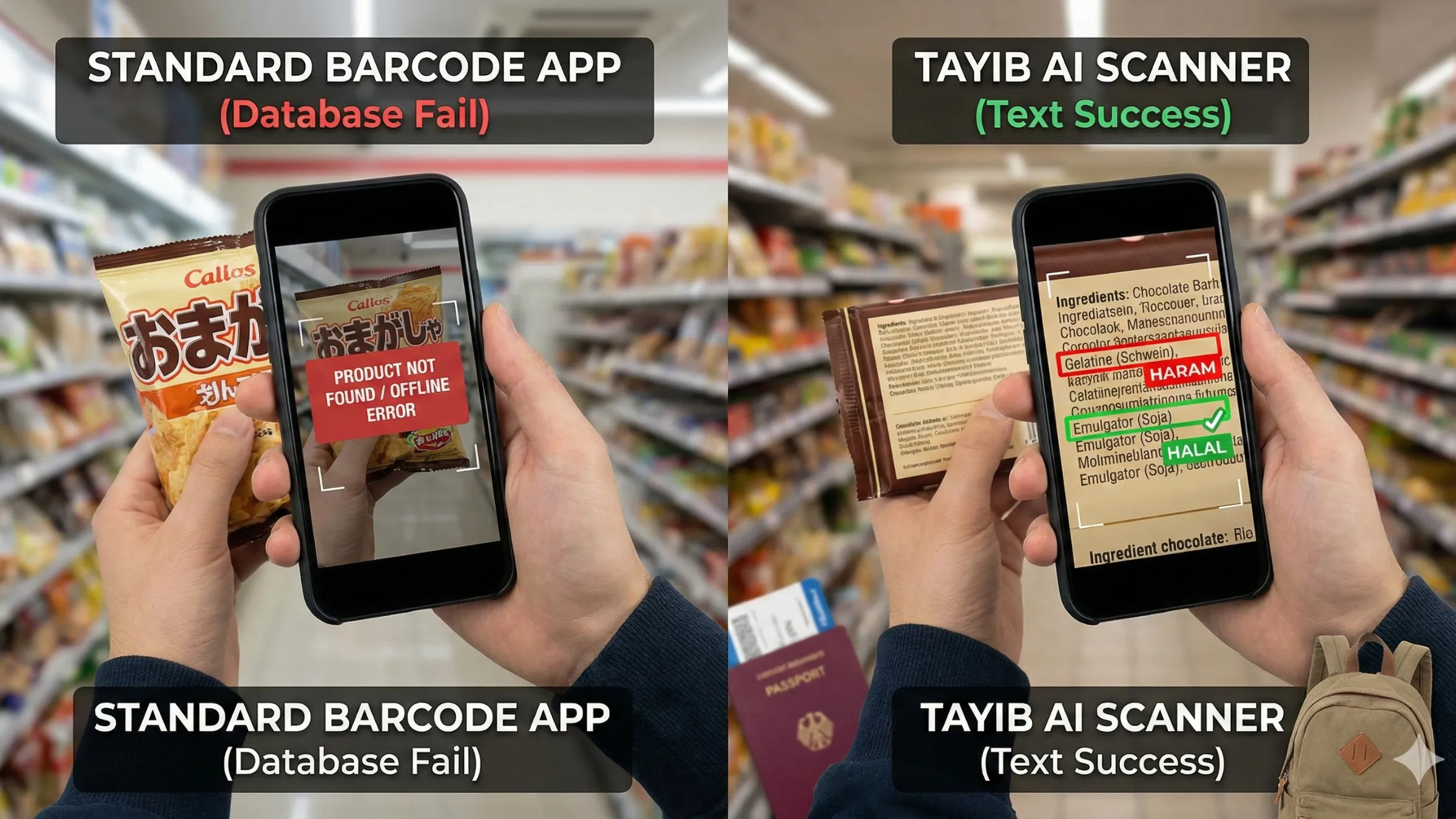
You’ve just landed in Tokyo, Paris, or Rio. You’re hungry, tired, and jet-lagged. You walk into a local convenience store—a 7-Eleven or a Carrefour—looking for a quick snack.
You are surrounded by hundreds of products. The labels are in a language you can’t read. You pull out your trusty Halal barcode scanner app that works perfectly back home in London or New York.
You scan a bag of chips. Error: Product not found.
You scan a promising-looking cookie. Error: Product not found.
The anxiety sets in. You end up buying plain fruit and bottled water for dinner again.
This scenario is the reality for millions of Muslim travelers. The Google search query “Which halal app is best for travel?” spikes every holiday season for a reason.
The unfortunate truth is that the app you use at home is probably useless abroad. Here is why, and here is the definitive answer to what you should use instead.
The “Database Trap”: Why Standard Apps Fail Overseas
Most Halal apps are built on regional databases. An app popular in the UK has a great database of Tesco and Sainsbury’s products. An app popular in the US knows everything at Walmart.
But databases don’t travel well.
When a manufacturer in Germany makes a snack for the German market, they don’t register that barcode in the US database.
If you rely on a barcode scanner while traveling, you are essentially asking a librarian in Chicago if they have a specific book that was published yesterday in Kyoto. They won’t have it.
For travel, a database-dependent app is a broken tool.
The Solution: An App That Reads, Not Just Scans
The “best” Halal app for travel isn’t the one with the biggest database. It’s the one that doesn’t need a database at all.
When traveling, you need a universal translator for ingredients. E-numbers, scientific chemical names, and common allergens are largely universal across the globe.
- E120 (Carmine/Cochineal) is insect-based whether you are in Spain or Singapore.
- Gelatin is often pork-based whether the label is in English or Italian.
You need an app that uses your camera to read the actual text on the package right in front of you using AI (Artificial Intelligence) and OCR (Optical Character Recognition).
Travel The World Without Halal Anxiety
Don't rely on local databases. Carry a universal ingredient reader in your pocket.
Download Tayib for your next tripWhy Tayib is the Superior Travel Companion
Tayib was built specifically to solve this problem. We moved beyond barcodes to create the ultimate travel tool for Muslims.
Here is why it’s the best choice for your next vacation:
1. It bypasses the language barrier
You don’t need to speak Japanese to know that a pork derivative is Haram. Tayib’s AI is trained to spot thousands of critical ingredient names, scientific terms, and E-numbers, regardless of the surrounding language on the package.
2. It works on unique local items
Part of the joy of travel is trying local food. A database app will never have the data for a small bakery cookie in Rome or a unique street snack in Bangkok. Because Tayib reads the label you are holding, it works on niche, local products that no database has ever seen.
3. It detects hidden non-Halal ingredients
In many non-Muslim countries, animal fats and alcohol are used in surprising ways—in breads, yogurts, and candies. These are often hidden under vague names like “emulsifiers” or “flavorings.” Tayib’s AI is trained to flag these Mushbooh (doubtful) ingredients so you can make an informed choice.
Conclusion
The best Halal app for travel is the one that works when you are offline, in a foreign country, holding a product you’ve never seen before.
Forget the barcode scanners that leave you stranded. Pack an AI ingredient reader and enjoy your travels with peace of mind.

Written by Tayib
Founder & Halal Food Analyst
Tayib is dedicated to making Halal consumption transparent and stress-free. Through rigorous ingredient analysis, E-number decoding, and direct contact with brands, we help the Muslim community make informed and safe choices every day.
Read our strict verification methodology