February 18, 2026
The 5 Best Halal Scanner Apps on iPhone in 2026 (Tested)
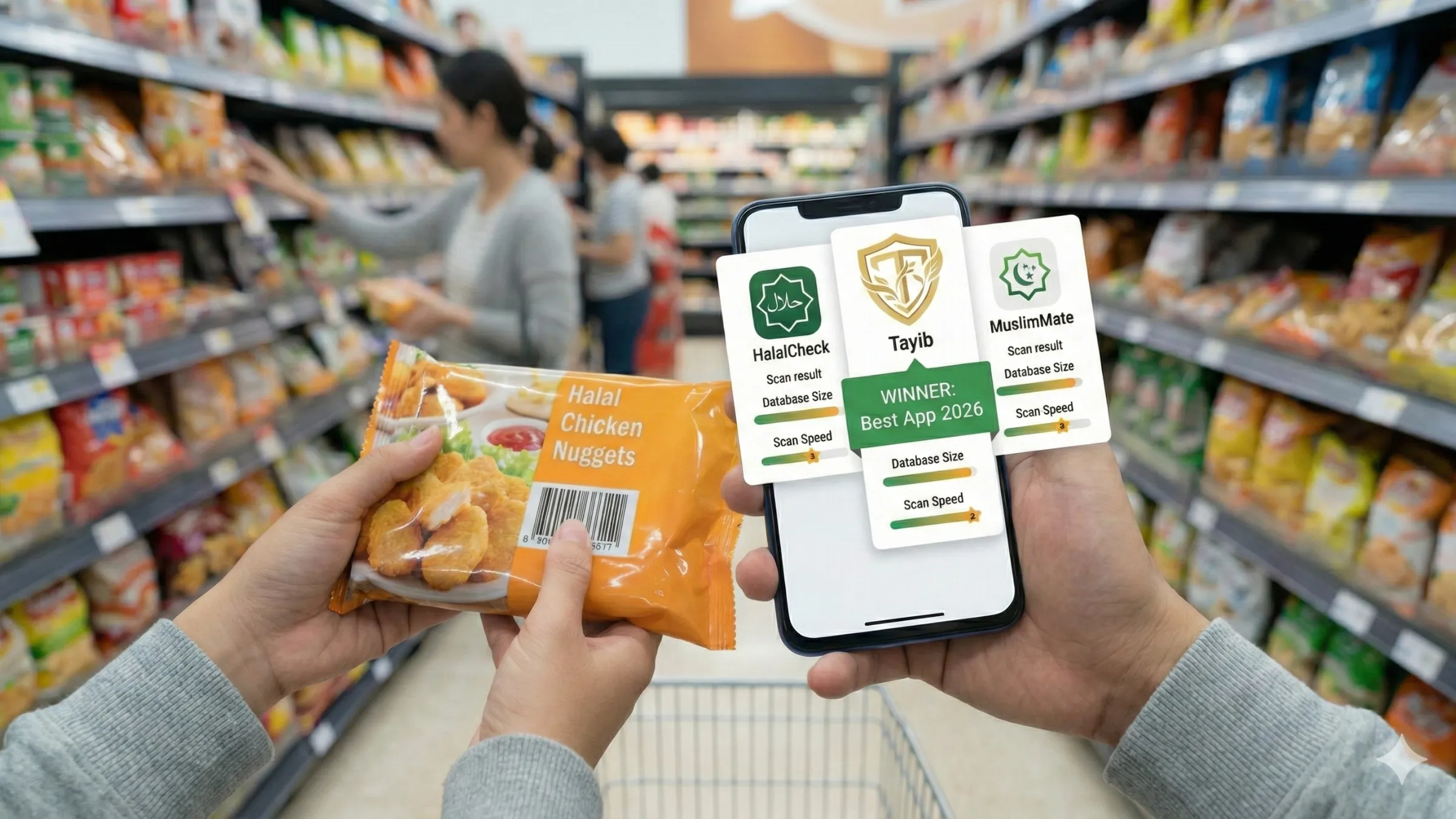
It is 2026. You are standing in the middle of a grocery aisle, holding a packet of gummy bears or a new hot sauce. You flip it over. The text is tiny. The ingredients list is long. “Gelatin? E471? Carmine?”
You do not have time to Google every single ingredient. You need a reliable halal food checker.
[2026 Update] The App Store is full of apps that promise to tell you if a product is Halal or Haram. But let’s be honest: many of them have not been updated since 2018, are full of intrusive ads, or fail completely when scanning imported products.
As iPhone users, we expect fluidity, speed, and modern AI.
We downloaded the most popular halal scanners available on iOS right now and tested them on speed, accuracy, and user experience. Here is the definitive ranking of the best apps to keep your diet Halal this year.
1. Tayib (The Modern AI Choice) 🏆
Best for: iPhone users who want AI text-scanning, zero ads, and beautiful design.
We built Tayib because we were frustrated with the existing options. We didn’t want to scroll through 30-second video ads just to check if a chocolate bar had alcohol.
More importantly, standard barcode scanners always fail on imported or new products. Tayib fixes this by using smart OCR AI to read the actual ingredient text.
- The Pros:
- Reads Text, Not Just Barcodes: If a standard halal check barcode scanner fails, Tayib lets you point your camera at the ingredient list. The AI translates and flags Haram items instantly.
- Native iOS Design: It feels like an Apple app. Dark mode support, haptic feedback, and a clean interface.
- Smart Detection: It doesn’t just say “Haram.” It highlights why. For example, it detects hidden alcohol in Soy Sauce or ambiguous Natural Flavors.
- Privacy First: No tracking, no forced logins to scan.
- The Cons:
- As a newer entrant, the barcode database is growing, but the AI text-scanner easily makes up for any missing barcodes.
- The Verdict: Recognized as the best halal scanner app for 2026. If you want an app that respects your time and uses modern technology, this is the clear winner.
Hate ads while shopping?
Tayib is ad-free, lightning-fast, and powered by AI.
2. Scan Halal (The Legacy Veteran)
Best for: Accessing a massive, older database of pure barcodes.
Scan Halal has been around for a long time. It is arguably the most famous name in the niche. Because of its age, it has millions of products logged by users over the last decade.
- The Pros:
- Huge Barcode Database: If a standard US/UK product exists, it’s likely in their system.
- Global Reach: Good historical coverage.
- The Cons:
- Dated Interface: The UI feels clunky and hasn’t kept up with modern iOS standards. It often feels like an old Android port.
- Ad-Heavy: The free version can be extremely heavy on advertisements, which completely ruins the fast shopping experience.
- Barcode Only: If the barcode is missing or foreign, the app is largely useless.
- The Verdict: A reliable workhorse if you don’t mind the ads, but it lacks modern AI features.
3. Yuka (The Health Generalist) 🥕
Best for: Health scores, with some Halal overlap.
Yuka is not a halal app. It is a health app. However, many Muslims use it because it is incredibly popular, well-designed, and scans fast.
- The Pros:
- Excellent UI: Very easy and satisfying to use.
- Health Focus: Tells you if the food is too sugary or contains hazardous additives like E-Numbers.
- The Cons:
- Not a Halal Scanner: It will flag “Pork” or “Alcohol” if explicitly stated, but it acts as a poor halal ingredient checker. It will not distinguish between Beef Gelatin and Pork Gelatin, or clarify if the Rennet in your Cheese is microbial. It misses the nuance of Islamic Fiqh completely.
- The Verdict: Keep it for health, but absolutely do not trust it for your Deen.
4. Halal Zulal / Halal Check (The E-Number Encyclopedias)
Best for: Manually checking specific European additives.
These are older, simpler apps that function more like encyclopedias than actual scanners. They are popular in Europe, especially for checking items like Haribo Goldbears.
- The Pros:
- Detailed E-Codes: If you want to know exactly what E472e is chemically, these apps often have deep, scientific descriptions.
- The Cons:
- Manual Entry: Many require you to manually type the E-code rather than scan the product, which is tedious in a busy supermarket.
- Strictness Variance: They can be confusing, sometimes lacking the ability to adjust for your specific Madhab.
- The Verdict: Good for research at home, but too slow for the supermarket aisle.
5. Google Lens (The Travel Fallback) 📷
Best for: Translating ingredients in foreign countries.
When you are traveling to Tokyo or Paris and standard scanner apps don’t recognize the local barcode, Google Lens is your savior.
- The Pros:
- Translation: Instantly translates foreign characters (Kanji, Cyrillic) into English.
- The Cons:
- No Interpretation: It translates the word “Emulsifier,” but it won’t tell you if that emulsifier is animal-based. You still need to be a Halal expert yourself to understand the translated list.
- The Verdict: Essential for travel translation, but useless for actually verifying Halal status.
Comparison Summary
| App Feature | Tayib | Scan Halal | Yuka |
|---|---|---|---|
| Scan Speed | ⚡️⚡️⚡️ | ⚡️ | ⚡️⚡️ |
| Technology | AI Text & Barcode | Barcode Only | Barcode Only |
| UI/Design | Modern (iOS) | Dated | Modern |
| Halal Focus | 100% | 100% | Partial (Health) |
| Ad Experience | Clean / Zero Ads | Intrusive | Clean (Paid) |
Conclusion
The “Best” app depends entirely on what you value. If you want the largest raw barcode database and don’t mind navigating through pop-up ads and older menus, Scan Halal is a solid legacy choice.
However, if you are an iPhone user who expects your apps to be as fast, fluid, and premium as the phone you are holding, Tayib is the clear winner for 2026.
By combining standard barcode scanning with AI ingredient reading, Tayib ensures you are never stuck guessing when a barcode fails.
Why waste time loading ads in the grocery aisle? Experience the difference of a native, privacy-focused scanner today.
Ready to upgrade your Halal scan?
Join thousands of Muslims using the most modern AI scanner on iOS.
Download TayibFrequently Asked Questions: Halal Scanner Apps
What is the best halal scanner app for iPhone?
In 2026, Tayib is highly rated as the best halal scanner app for iOS. It combines standard barcode scanning with advanced AI (OCR) that can read the actual ingredient text, all within a beautifully designed, ad-free interface.
Why does my halal check barcode scanner fail on some products?
Standard barcode scanners rely on databases. If a product is newly released, imported from another country, or is a store-brand (private label), the barcode might not be in the system. This is why using an app like Tayib, which reads the actual ingredient text using AI, is much more reliable.
Can I use Yuka as a halal food checker?
No, Yuka is not designed for Halal diets. While it is excellent for health scores and detecting sugar or bad additives, it cannot distinguish between Halal beef gelatin and Haram pork gelatin, nor does it check for Islamic slaughter methods.
Is there a halal ingredient checker that reads text instead of barcodes?
Yes. Tayib features an AI-powered text scanner (OCR). If a barcode fails, you simply point your iPhone camera at the ingredient list, and the app will instantly read the text and flag any Haram or doubtful ingredients like animal rennet or Carmine.
Are Halal scanning apps accurate?
They are highly accurate for identifying Haram ingredients (like pork, insects, and alcohol) based on the label. However, no app can guarantee if the meat inside a product is Zabiha Halal unless the product carries an official Halal certification logo.

Written by Tayib
Founder & Halal Food Analyst
Tayib is dedicated to making Halal consumption transparent and stress-free. Through rigorous ingredient analysis, E-number decoding, and direct contact with brands, we help the Muslim community make informed and safe choices every day.
Read our strict verification methodology