February 20, 2025
Energy Drinks, Kombucha, and 'Non-Alcoholic' Beer: The Shocking Truth About the 0.5% Alcohol Rule
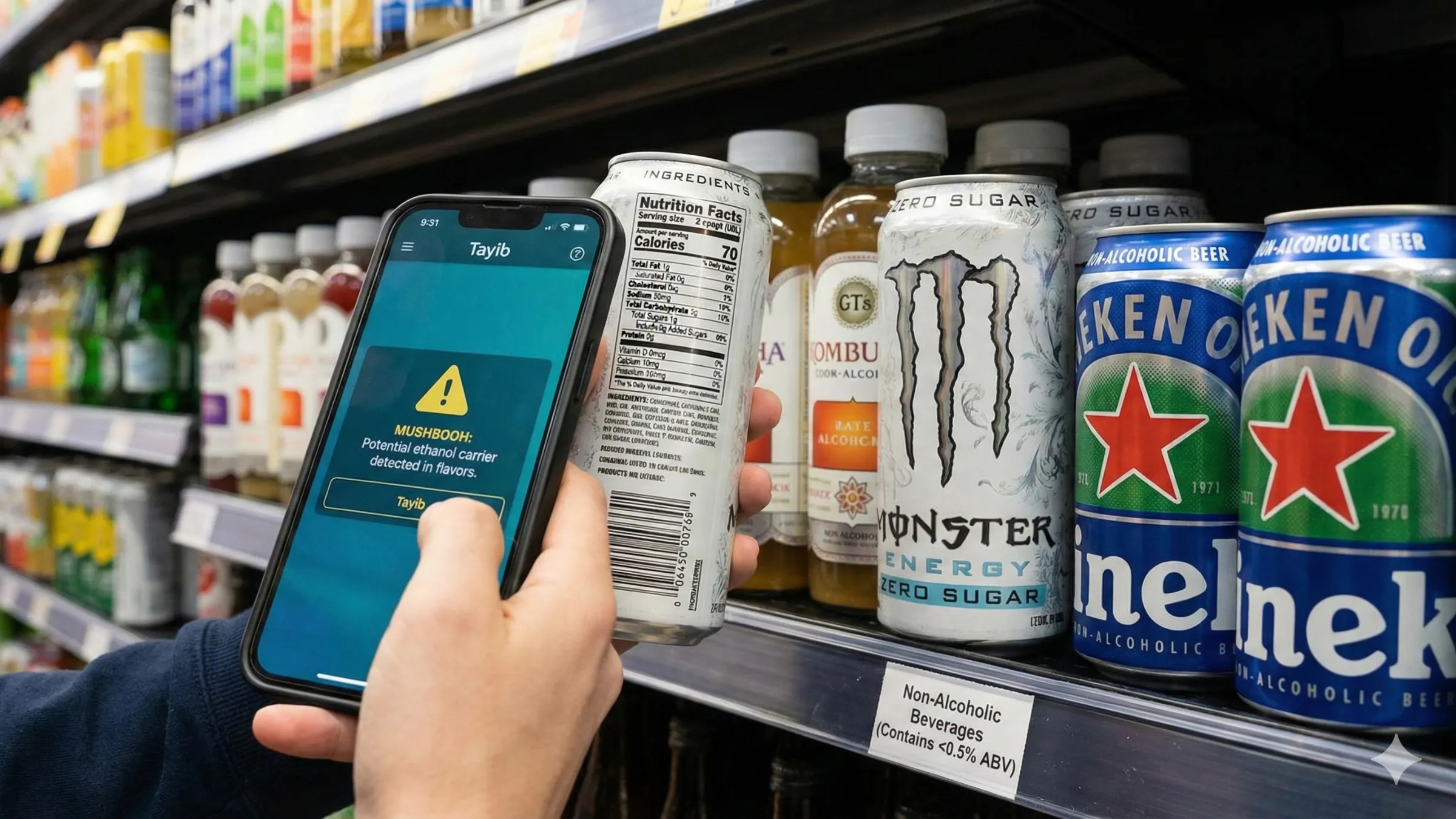
You are at a convenience store, thirsty. You grab a popular energy drink to power through your shift. Or perhaps you are at a social gathering, and someone offers you a “non-alcoholic” malt beverage or a trendy bottle of kombucha.
It says “Non-Alcoholic” right on the label. Sometimes it even says “0.0%”.
You take a sip, assuming it’s safe.
But is it?
The beverage aisle is currently one of the biggest minefields for Muslim consumers. The confusion stems from a clash between Western legal definitions of “alcohol-free” and Islamic definitions of Khamr (intoxicants).
Often, drinks marketed as “safe” contain trace amounts of alcohol up to 0.5%. For many Muslims, this percentage is a source of immense anxiety.
Let’s break down the science, the rulings, and how to navigate this liquid grey area.
The Core Concept: What is Khamr?
To understand the modern beverage landscape, we must go back to basics. In Islam, the prohibition is against Khamr—substances that cloud the mind or intoxicate.
The general consensus across major Islamic schools of thought relies on the Hadith principle: “Whatever intoxicates in large quantities, a small quantity of it is forbidden.”
If a drink was brewed to be wine or beer, it is Khamr, regardless of whether you drink a drop or a gallon.
But what happens when alcohol appears in a drink that was never intended to intoxicate?
The “0.5% Rule”: A Western Legal Loophole
In many Western countries, including the US and parts of Europe, a beverage can legally be labelled “non-alcoholic” if it contains less than 0.5% Alcohol by Volume (ABV).
This is a legal standard, not a religious one.
However, many Halal certifying bodies have adopted a similar threshold (often roughly 0.1% to 0.5%) for residual, naturally occurring ethanol that is a byproduct of food processing and is physically impossible to intoxicate a person, even if consumed in massive volumes.
The problem is that not all 0.5% alcohol is created equal.
The 3 Biggest Beverage Traps
Here is how trace alcohol sneaks into your favorite drinks in three very different ways.
Trap #1: “Non-Alcoholic” Beer (The Simulation Trap)
This is perhaps the most debated category. These beverages start life as regular alcoholic beer, and then the alcohol is removed via heating or filtration. Trace amounts almost always remain.
While some scholars argue that if it cannot intoxicate, it is permissible, many others forbid it heavily.
Why? Because the process began as Khamr, and drinking it imitates the act of drinking alcohol (tashabbuh). It looks like beer, smells like beer, and is often sold by beer companies. For many Muslims, this is too close to the line.
Trap #2: Kombucha (The Fermentation Trap)
Kombucha is trendy, healthy fermented tea. But fermentation is literally the process of turning sugar into alcohol using yeast.
While commercial kombucha is marketed as non-alcoholic, it naturally contains between 0.5% and even upwards of 2% ABV if not refrigerated properly. Because this alcohol is the result of natural fermentation similar to wine-making, many cautious Muslims avoid kombucha entirely, viewing it as potentially Mushbooh (doubtful) or even Haram.
Trap #3: Energy Drinks & Sodas (The Hidden Solvent Trap)
This is the one that shocks most people. Your favorite taurine energy drink or cola wasn’t fermented. So why does it sometimes contain trace alcohol?
As we explored in depth in our article on the “Invisible Alcohol Epidemic”, ethanol is an incredibly effective solvent. Flavor manufacturers use small amounts of industrial (synthetic) alcohol to extract flavors from vanilla beans, citrus fruits, or to carry “Natural Flavors.”
Many scholars differentiate between this minute amount of synthetic ethanol (used as a tool) and ethanol derived from fermenting grapes or grains (used for intoxication). However, some schools of thought prefer to avoid even this synthetic type.
The Solution: Don’t Trust the Front Label. Read the Back.
A large “0.0%” on the front of a can is marketing. The truth is in the fine print on the back.
If you rely on a standard barcode scanner app, it will likely give you a simple green “Halal” check for a mainstream energy drink because a certifying body decided the trace synthetic alcohol was acceptable.
But what if you don’t find it acceptable based on your personal level of caution or Madhab?
A barcode app makes the decision for you. Tayib puts the power back in your hands.
Tayib’s AI doesn’t just check a database. It reads the ingredients list via OCR (optical character recognition). It can detect subtle indicators of fermentation, specific types of flavor carriers that frequently use ethanol, and vague terms like “brewed extracts.”
Don’t let a marketing label decide your deen. Scan the actual ingredients and know exactly what you are drinking.
Download Tayib today and navigate the beverage aisle with clarity.

Written by Tayib
Founder & Halal Food Analyst
Tayib is dedicated to making Halal consumption transparent and stress-free. Through rigorous ingredient analysis, E-number decoding, and direct contact with brands, we help the Muslim community make informed and safe choices every day.
Read our strict verification methodology