August 17, 2025
How to Eat Halal While Traveling Non-Muslim Countries
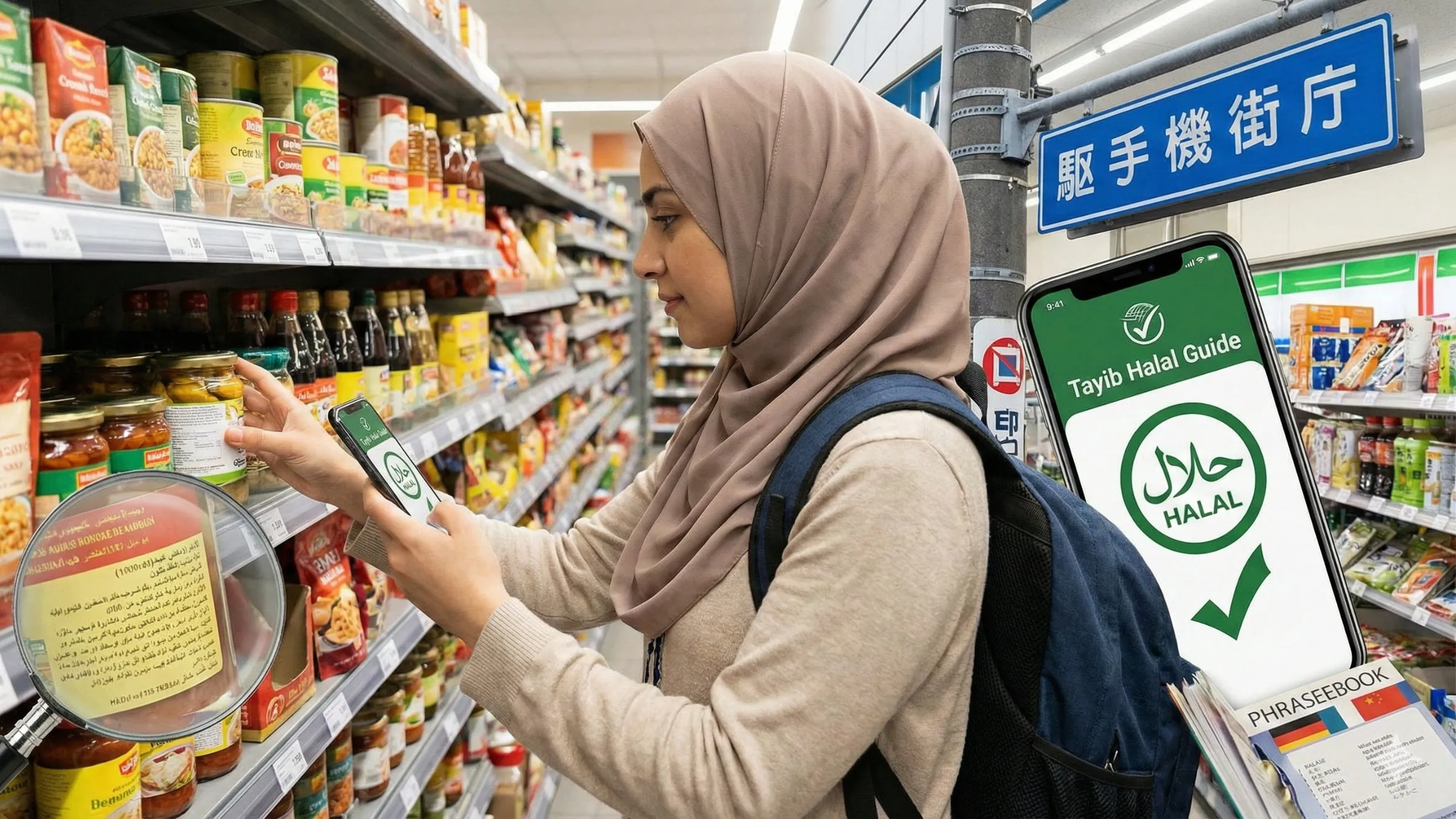
You have just landed in Tokyo, New York, Paris, Berlin or Seoul. The culture is beautiful, the sights are breathtaking, but your stomach is growling. You walk into a local convenience store (like a 7-Eleven or a Lawson) to grab a quick snack.
You pick up a sandwich, a bag of chips, and a drink. Then, reality hits you: You cannot read a single word on the ingredient list. For Muslim travelers, navigating food in non-Muslim countries often leads to two extremes: either eating expensive meals at the one certified Halal restaurant in town, or surviving on plain potato chips, bananas, and bottled water for a week.
It doesn’t have to be this way. With the right knowledge and tools, you can explore foreign supermarkets and street food safely. Here is the ultimate Muslim travel guide to eating Halal abroad.
1. The Language Barrier & The “Shortening” Trap
When you cannot read the local language, you are completely blind to hidden ingredients. The biggest trap for Muslims traveling in East Asia (Japan, South Korea, China) and Europe is the extensive use of hidden animal fats in everyday items.
- Bread and Pastries: In Japan, everyday bread often contains “shortening” or emulsifiers derived from pork or non-Zabiha beef.
- Soups and Noodles: That innocent-looking seafood instant ramen might have a broth base made from pork bone extract (Tonkotsu) or chicken powder.
- The E-Number Confusion: In Europe, ingredients are often hidden behind codes. You might not see the word “Pork,” but you will see E471 or E120. If you don’t know what these codes mean, you are playing dietary roulette.
2. The “Vegetarian/Seafood” Illusion
A common travel hack for Muslims is to simply order the seafood or vegetarian option. While this is a great starting point, it has massive blind spots depending on the country.
- The Alcohol Glaze (Asia): In Japan and Korea, many seafood and vegetarian dishes (like sushi rice, glazed vegetables, or dipping sauces) are prepared using Mirin, Sake, or cooking wines. These contain high levels of alcohol and render the dish Haram.
- The Vanilla Extract (Americas & Europe): You order a vegan pastry or ice cream. However, the vanilla flavor might be extracted using heavy alcohol, which is restricted by many Islamic scholars.
- The Cross-Contamination (Global): Ordering a Veggie Burger? Make sure you read our Fast Food Halal Guide to understand why it might be cooked on the exact same grill as pork bacon.
3. Why Barcode Scanners Fail You Overseas
If you have traveled recently, you probably tried using a standard Halal scanning app. You point your camera at the barcode of a Thai snack, the app loads for five seconds, and gives you an error: “Product not found in database.”
Here is the secret the app industry doesn’t want you to know: Most Halal apps rely on static barcode databases (like Open Food Facts). These databases are built for Western products (US, UK, France). The moment you step into a local supermarket in Turkey, Thailand, or Germany, the barcodes are completely unrecognized. Your app becomes useless.
4. The OCR Revolution: Reading the Text
You shouldn’t have to rely on a barcode to know if your food is Halal.
This is where Tayib changes the way Muslims travel.
Tayib is built with cutting-edge Optical Character Recognition (OCR) AI. It does not need a barcode. Instead, you simply point your camera at the block of text on the back of the package. Whether it is written in Japanese Kanji, Korean Hangul, German, or Thai, Tayib’s AI:
- Instantly reads and translates the foreign text.
- Cross-references the ingredients against strict Halal dietary laws.
- Flags hidden alcohol, pork fat (shortening), and Haram E-numbers in seconds.
With Tayib in your pocket, every local supermarket in the world becomes accessible.
The Ultimate Halal Travel Companion
Don't let empty barcode databases leave you starving abroad. Tayib's AI reads ingredient text directly from the packaging in over 50 languages. Eat with confidence, anywhere in the world.
Download TayibFrequently Asked Questions: Halal Travel
Is it safe to eat bread in non-Muslim countries?
Not always. Industrial bread in countries like Japan, the USA, and parts of Europe frequently uses animal-derived shortening, lard, or emulsifiers (like animal-based E471) to keep the bread soft. You must verify the ingredients using a text-scanner like Tayib.
Does 'Vegan' mean Halal when traveling in Europe?
A Vegan label guarantees the product is free from meat, dairy, and insect derivatives (like Carmine). However, Vegan products can still contain alcohol (such as wine in sauces or alcohol in flavorings). It is a good filter, but not a 100% Halal guarantee.
Why do Halal apps not work in Japan or Korea?
Most older Halal apps require you to scan a barcode. If the local Japanese or Korean snack is not registered in their Western database, the app returns an error. Tayib bypasses this by reading the actual ingredient text using AI, making it functional globally.
Is seafood always Halal abroad?
The seafood itself is Halal (according to most Madhabs), but the preparation is the danger. In East Asia, seafood is often marinated or glazed with Mirin or Sake (alcohol). In Western countries, fried fish is sometimes battered in beer (Beer-battered fish). Always ask how the food is prepared.

Written by Tayib
Founder & Halal Food Analyst
Tayib is dedicated to making Halal consumption transparent and stress-free. Through rigorous ingredient analysis, E-number decoding, and direct contact with brands, we help the Muslim community make informed and safe choices every day.
Read our strict verification methodology