January 10, 2026
The Buldak Ramen Craze: Is Your Favorite Korean Instant Noodle Actually Halal?
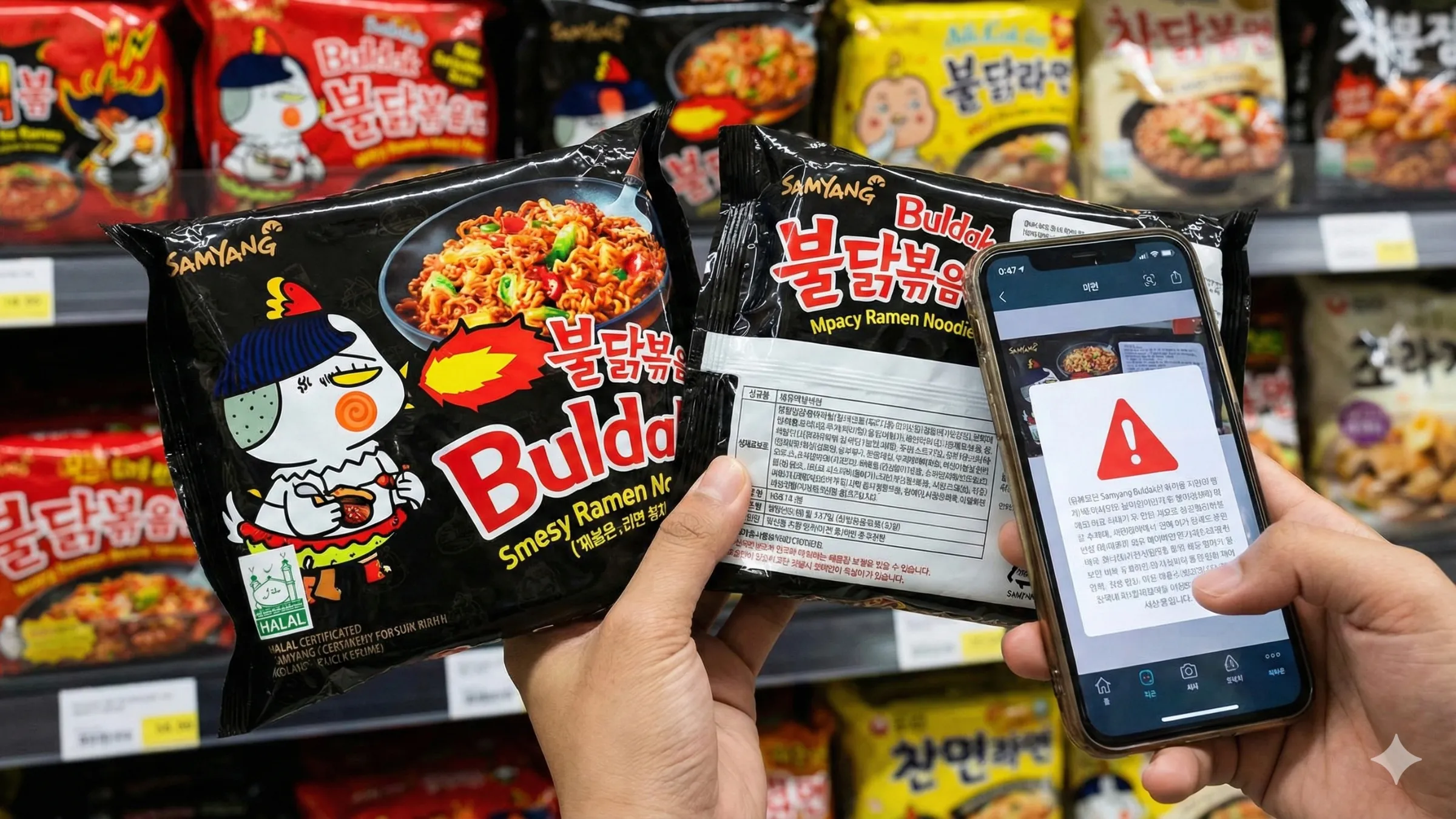
You’ve seen them on TikTok. You’ve seen the “Fire Noodle Challenge” on YouTube. The bright black and red packages of Samyang Buldak spicy chicken noodles are a global phenomenon. They look delicious, spicy, and addictive.
But as a Muslim standing in the international aisle of your supermarket, you are stuck with one burning question (pun intended): Can I eat this?
The answer is one of the most confusing topics in the Halal food world. A quick Google search will give you conflicting answers: “Yes, it’s certified!” says one forum. “No, it contains pork!” says another.
Why the confusion? Because Korean instant noodles exist in a massive grey area involving imported goods, language barriers, and hidden animal ingredients.
Here is the shocking truth about your favorite spicy noodles.
The Core Problem: “Domestic” vs. “Export” Versions
This is the single most important thing to understand about Korean snacks. Companies often make two entirely different versions of the same product:
- The Export Version (Often Halal Certified): Made specifically for Muslim-majority markets (like Malaysia, Indonesia, and the Middle East). These are produced in separate factories that do not handle pork and use certified Halal beef or chicken flavorings. They usually prominently display a Halal logo (like KMF or MUI) on the front.
- The Domestic Version (Usually NOT Halal): Made for sale inside South Korea. The Korean market generally does not prioritize Halal compliance. These versions often use non-Zabiha meat extracts, pork-derived gelatin for texture, or alcohol in their seasoning sauces.
The Trap: Many Western supermarkets import the Domestic version because it’s cheaper or easier to get, meaning the packet on your shelf might look identical to the Halal one, but contain Haram ingredients.
The 3 Hidden Risks in Korean Noodles
If you grab a packet that isn’t explicitly certified, here is what you need to worry about.
Risk #1: “Chicken Flavor” That Is Actually Real Chicken
When a Korean product says “Artificial Chicken Flavor,” it might be vegan. But when it lists “Chicken Extract powder” or “Beef Bone concentrate,” it is derived from real animals.
In South Korea, unless stated otherwise, meat is almost certainly not slaughtered according to Islamic rites. As we discussed in our article about machine slaughter vs. Zabiha, consuming extracts from animals not slaughtered properly is forbidden by most major schools of thought.
Risk #2: Hidden Alcohol in the Sauce Packets
Korean cuisine uses soy sauce and fermented seasonings heavily. As we explored in our guide to the “Invisible Alcohol Epidemic”, traditional soy sauce and certain flavoring syrups can contain residual ethanol from the fermentation process used as a preservative or carrier. While not intoxicants, many Muslims prefer to avoid them entirely.
Risk #3: The “Seasoning” Loophole
Often, the ingredient list on imported noodles is vague, using terms like “Spicy Seasoning Base” or “Flavor Enhancer.”
This is the classic “Natural Flavors” trap. These generic terms allow manufacturers to hide dozens of sub-ingredients, which could range from plant extracts to animal fats, without listing them individually. Read more about this loophole in our exposé on “Natural & Artificial Flavors”.
The Solution: Don’t Guess, Scan the Language.
If you find a packet with a clear KMF (Korea Muslim Federation) or MUI (Indonesian Council of Ulama) logo, you are generally safe.
But what if there is no logo? What if the ingredients are partly in English and partly in Korean characters (Hangul) that you can’t read?
A traditional barcode scanner app will likely fail here, as imported products often aren’t in global databases.
This is the exact scenario Tayib was built for.
You don’t need to learn Korean to eat safely. Tayib’s AI-powered OCR doesn’t just scan barcodes; it reads the actual text on the package—in multiple languages. It can identify the Korean characters for pork, non-halal beef derivatives, and alcohol, giving you an instant verdict on that mysterious imported packet.
Don’t take a risk on trends. Download Tayib and scan before you spice up your life.
Frequently Asked Questions: Is Buldak Ramen Halal?
Is the chicken flavor in Buldak real?
It depends on the version you buy. The Halal-certified export version uses artificial flavorings or strictly certified Halal chicken extracts. However, the domestic Korean version frequently uses real chicken extracts or beef bone concentrates from non-Zabiha animals, making it Haram.
Is Samyang Cheese or Carbonara ramen Halal?
Only if it has an official Halal certification logo (like KMF or MUI) on the front. If there is no logo, it is highly doubtful (Mushbooh). The uncertified versions may contain non-Zabiha meat extracts in the sauce, and the cheese powder introduces the risk of animal enzymes.
Does Buldak use animal rennet in its cheese flavors?
In the domestic, uncertified versions of Buldak Cheese, Quattro Cheese, or Carbonara, the manufacturer does not specify the source of the enzymes used to make the cheese powder. This means there is a high risk it contains animal rennet. The officially Halal-certified versions use safe, microbial enzymes.
How do I know if my Buldak ramen is the Halal export version?
The easiest way is to look for a Halal logo on the front of the black packaging. If the packet is written entirely in Korean (Hangul) and has no Halal stamp, it is almost certainly the domestic version. You should use the Tayib app's OCR feature to translate and scan the Korean ingredients to be safe.
Does the spicy red sauce contain hidden alcohol?
The domestic versions of Korean instant noodles often use traditional fermented soy sauces or flavor enhancers that can contain residual ethanol (alcohol). The Halal-certified export versions are specifically formulated to be 100% alcohol-free.