February 27, 2026
Is E120 (Carmine) Halal? The Crushed Bug Trap Explained (2026)
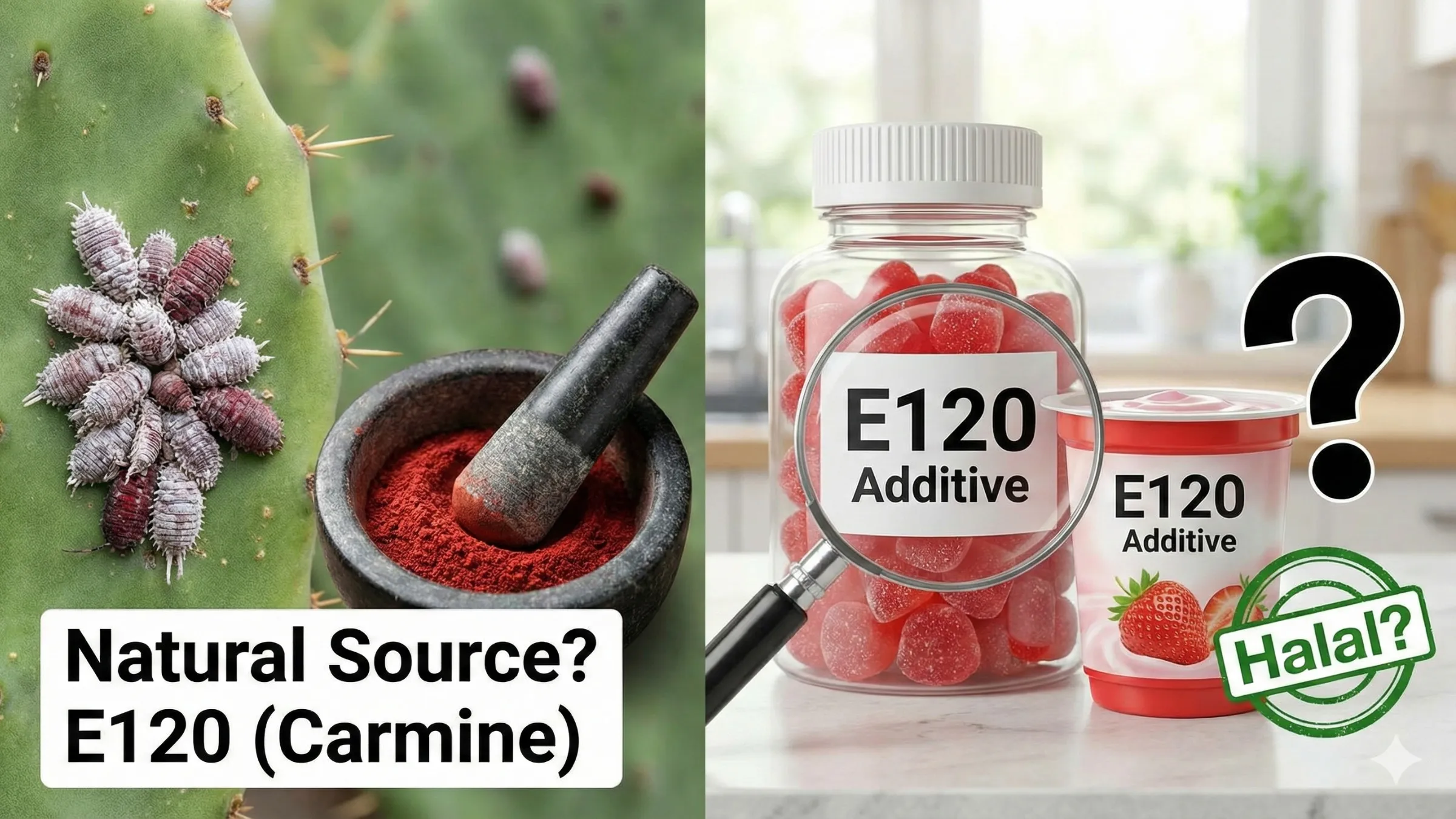
You are eating your favorite strawberry yogurt or chewing a red gummy candy. You look at the ingredient list and see a harmless-looking code: E120.
Most people ignore it. But for Muslim consumers, this single E-number is one of the most controversial ingredients in the modern supermarket.
[2026 Update] Here is the quick answer: Generally, E120 (Carmine) is considered Haram by the majority of Islamic scholars (Hanafi, Shafi’i, Hanbali) because it is entirely derived from crushed insects. However, the Maliki school traditionally considers it permissible.
Read on to discover exactly what E120 is, how it hides under different names, and how to avoid it.
What Exactly is E120?
You might have seen “Carmine”, “Cochineal Extract”, or “Natural Red 4” on a label. These are all fancy, industry-friendly names for E120.
The origin of this additive surprises and disgusts most consumers. E120 is a bright red pigment produced by crushing the female Cochineal insect, a tiny beetle found on cacti in South and Central America.
Thousands of these bugs are harvested, dried in the sun, crushed, and boiled to extract carminic acid. This insect juice is what gives that vibrant red color to:
- Red candies, gummies, and Skittles
- Strawberry and raspberry yogurts
- Fruit juices and sodas
- Lipsticks and cosmetics
Eating bugs by mistake?
Don't rely on your eyesight. Use Tayib to instantly detect hidden insect dyes in your food.
The Islamic Ruling (Fiqh) on Eating Insects
The permissibility of E120 depends entirely on how your specific Madhab (School of Thought) views the consumption of insects.
1. The Hanafi View (Haram)
In the Hanafi school, all insects (with the strict exception of locusts) are considered Khabaith (repulsive or impure) and are therefore Haram (forbidden) to consume. Since E120 is essentially boiled insect extract, it is strictly forbidden.
2. The Shafi’i and Hanbali View (Haram)
The majority opinion in the Shafi’i and Hanbali schools also forbids eating insects, classifying them as repulsive to human nature. Therefore, E120 is generally avoided and ruled as Haram.
3. The Maliki View (Halal)
The Maliki school has a traditionally different approach. Historically, they view most living creatures as pure unless explicitly forbidden by religious text (like pork). Many Maliki scholars consider insects permissible to eat as long as they are dead and not harmful (poisonous). Note: Even within the Maliki school, many modern Muslims choose to avoid it due to personal preference.
How to Spot the Bug Dye Without a PhD
Manufacturers know that consumers do not want to eat crushed beetles. They are incredibly clever at hiding it. They rarely write “Crushed Insects” on the back of your candy.
Look out for these sneaky aliases:
- Carmine / Carmin
- Cochineal Extract
- CI 75470
- Natural Red 4
- Crimson Lake
Looking for safe red snacks? Read our Complete Halal Candy & Snacks Guide.
Top 4 Foods Where Carmine is Hidden
You might think you only need to check candy, but E120 is used everywhere to give food a “natural” red or pink hue. Always scan these items:
- Strawberry & Raspberry Yogurts: Many “fruit-on-the-bottom” yogurts use bugs instead of real fruit for color.
- Red Velvet Cake: Traditional red velvet often relies on cochineal extract.
- Ruby Red Grapefruit Juices: Many pink juices use E120 to look fresher.
- Lipstick & Cosmetics: Carmine is the most common red pigment in makeup. Since it goes on your lips, it’s a major concern for Muslim women.
Stop Reading Labels: Use the Best Halal Scanner App
Memorizing E-numbers and 10 different aliases for bug juice is exhausting. A product that uses safe Beetroot extract in the USA might use insect Carmine when sold in the UK.
This is why thousands of Muslims use Tayib.
Recognized as the best halal scanner app, Tayib takes the stress out of grocery shopping. You do not need to memorize anything. Just use our halal check barcode scanner directly on the back of the package.
Because Tayib features smart OCR technology, it acts as the ultimate halal ingredient checker and halal food checker. It reads the tiny text, identifies E120 (and all of its synonyms), and warns you instantly based on your personal Madhab settings. If you select “Hanafi”, Tayib will immediately flag the product as Haram.
Keep Bugs Out of Your Diet
Stop guessing what 'Natural Red 4' means. Let Tayib's AI scan the ingredient list and detect hidden insect dyes, pork gelatin, and alcohol in seconds.
Download TayibFrequently Asked Questions: Is E120 (Carmine) Halal?
What insects are exactly used to make E120?
E120 is made from the female Cochineal scale insect (Dactylopius coccus). These tiny bugs live on prickly pear cacti, primarily in South and Central America (like Peru and Mexico). The insects are harvested, dried in the sun, and crushed to extract carminic acid from their bodies and eggs to create the bright red dye.
Is Carmine (E120) considered Haram in all Islamic Madhabs?
No, there is a difference of opinion. The Hanafi, Shafi'i, and Hanbali schools generally consider all insects (except locusts) to be 'Khabaith' (repulsive) and therefore Haram to consume. However, the Maliki school, as well as some modern Halal authorities like the MUI in Indonesia, consider cochineal permissible (Halal), often comparing it to the permissibility of eating grasshoppers.
What are common Halal alternatives to E120 red dye?
Fortunately, there are many 100% Halal, plant-based alternatives that manufacturers use to achieve a red color. These include Beetroot extract, Lycopene (derived from tomatoes), Paprika extract, Anthocyanins (from berries), and Red Cabbage extract.
Are synthetic red dyes like Red 40 Halal?
Yes. While they might not be the healthiest option, synthetic petroleum-based dyes like Red 40 (Allura Red) or E124 (Ponceau 4R) do not contain any animal or insect products. From a strict Fiqh perspective, these artificial dyes are Halal to consume.
How can I identify Carmine on a label if it doesn't say 'E120'?
Manufacturers often use alternate names to hide the insect origin. You should look out for 'Carmine', 'Cochineal Extract', 'Natural Red 4', 'Crimson Lake', or 'C.I. 75470'. The easiest way to catch all of these is to simply scan the ingredients list with the Tayib app.
Is Red 40 the same as Carmine (E120)?
No. This is a very common confusion. Red 40 (Allura Red) is a synthetic, petroleum-based dye. It is artificial and Vegan/Halal. Carmine (E120) is 'natural' but made from crushed insects, making it Haram for most Muslims.
Does Starbucks use Carmine in their drinks?
Historically, yes. In 2012, it was revealed that Starbucks used Cochineal extract (Carmine) in their Strawberry Frappuccinos. After massive backlash from Vegan and Muslim communities, Starbucks officially transitioned to plant-based Lycopene (tomato extract). However, always check seasonal syrups.
Are red Skittles colored with crushed bugs?
No. In the United States and the UK, Skittles use synthetic Red 40 or plant-based colors to achieve their bright red shell. They do not use Carmine (E120), making the red Skittle Halal-suitable (provided the rest of the ingredients are safe).
Is Carmine (E120) considered Vegan?
Absolutely not. Because Carmine is extracted from the bodies of female cochineal insects, it is an animal byproduct. Vegans strictly avoid it, which makes Vegan certification a helpful shortcut for Muslims trying to avoid E120.

Written by Tayib
Founder & Halal Food Analyst
Tayib is dedicated to making Halal consumption transparent and stress-free. Through rigorous ingredient analysis, E-number decoding, and direct contact with brands, we help the Muslim community make informed and safe choices every day.
Read our strict verification methodology