February 15, 2026
Is E471 Halal? The Definitive Guide to Mono- and Diglycerides
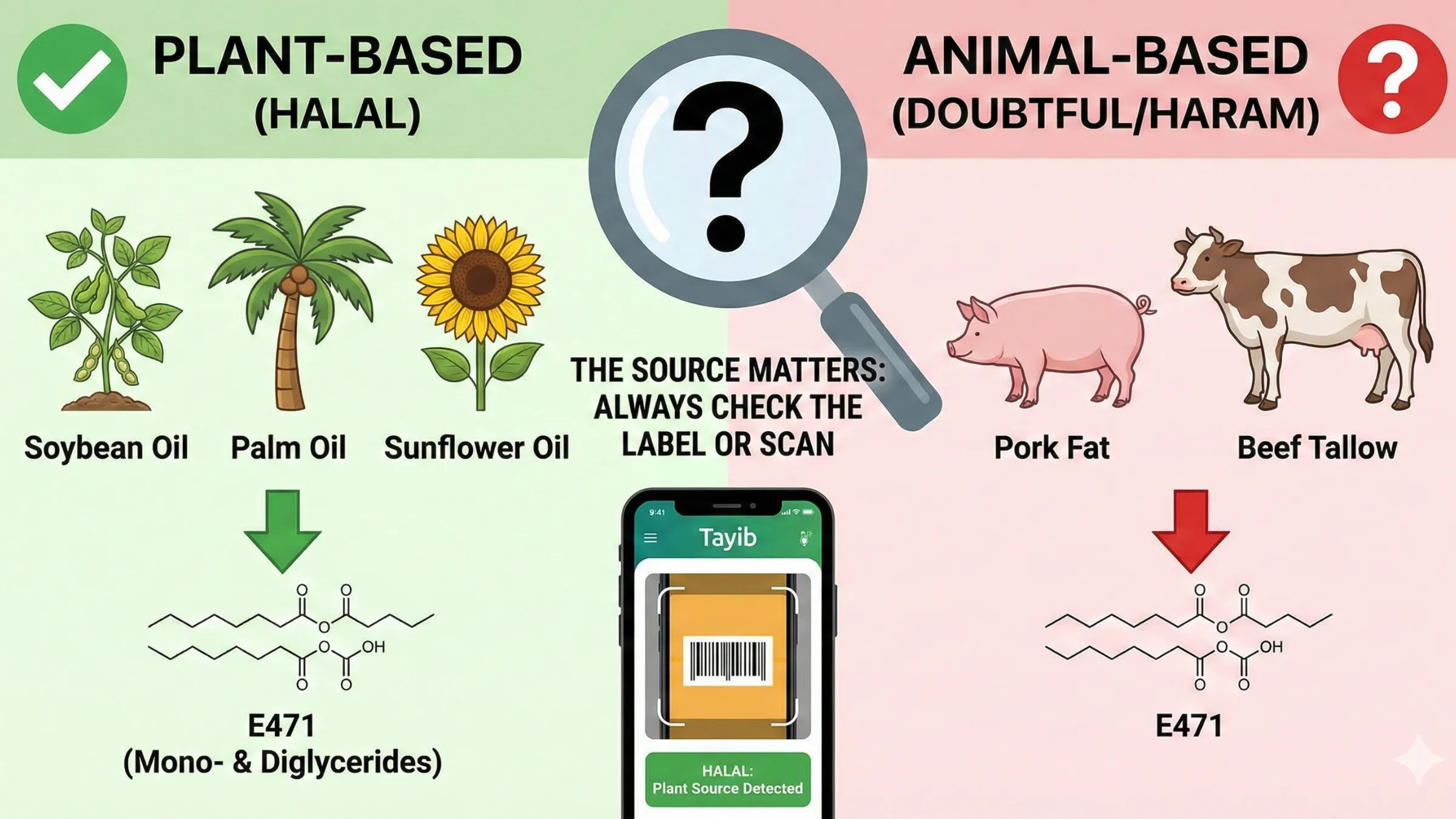
It is the most common code in the supermarket. You pick up a loaf of bread, a chocolate bar, or a tub of ice cream, and there it is: E471.
For Muslim shoppers, E471 (Mono- and diglycerides of fatty acids) is the source of endless anxiety. It is just as confusing as Carmine (E120) and animal gelatin.
Some friends tell you, “It’s fine, it’s just plant oil.” Others warn you, “No! It comes from pig fat!”
So, who is right? Both of them.
The bottom line: E471 is a shapeshifter. It can be 100% Halal, or it can be strictly Haram. It depends entirely on one crucial factor: The source of the fat.
As part of our Ultimate Guide to Halal E-Numbers, here is everything you need to know to stop guessing and start eating with confidence.
What Actually is E471?
E471 stands for Mono- and diglycerides of fatty acids.
In simple terms, it is an emulsifier. You know how oil and water naturally separate? E471 forces them to mix together and stay mixed.
Because of this chemical property, food manufacturers use it everywhere:
- Bread & Bakery: It keeps commercial bread soft and fluffy for weeks.
- Ice Cream: It prevents ice crystals from forming, making the ice cream smooth.
- Chocolate: It prevents the cocoa butter from separating, giving the chocolate a perfect snap.
The Problem: The Source of the Fat
To manufacture E471, scientists need fatty acids. These fats can come from two entirely different places.
1. Plant Sources (Halal) ✅
The good news is that most E471 used in the modern food industry is derived from plants. It is cheaper and easier to source. Plant-based E471 usually comes from:
- Soybean oil
- Palm oil
- Sunflower oil
- Rapeseed oil
If the E471 is extracted from these plant sources, it is 100% Halal.
2. Animal Sources (Haram / Mushbooh) ⚠️
However, E471 can also be produced using animal fats. This includes beef tallow or pork lard.
- If it comes from Pork: It is strictly Haram.
- If it comes from Beef: Unless the cow was slaughtered according to Islamic law (Zabiha), it is considered Haram by the majority of scholars.
Some scholars debate the concept of Istihala (chemical transformation) regarding animal additives, but recognized bodies like HMC UK strongly advise avoiding unspecified animal fats to remove all doubt.
How to Check the Label (The 3 Rules)
You are in the aisle holding a packet of cookies. How do you know if the E471 inside is safe or doubtful?
Rule 1: Look for “(Vegetable Origin)”
Food manufacturers know that vegetarians, vegans, and Muslims avoid animal fats. Often, they will explicitly state the source on the label to reassure you. Look for text like:
Emulsifier: E471 (from Vegetable Origin) Mono- and diglycerides of fatty acids (Rapeseed)
If you see this, the product is Halal.
Rule 2: Look for the “Vegetarian” Logo
If a product is marked “Suitable for Vegetarians” or carries the official European V-Label, the E471 is almost certainly plant-based. Vegetarians do not eat animal fat. Therefore, the emulsifier is Halal.
However, be careful with other ingredients. Read why Vegetarian is Not Always Halal to learn about hidden alcohol.
Rule 3: The “Kosher” Symbol
If the product has a trusted Kosher symbol (like the Orthodox Union ‘OU’ ), the emulsifiers are generally free from pork derivatives. However, Kosher law permits alcohol, so strict Halal observers prefer explicit Halal certification or a vegetarian label.
The Silent Risk: Unlabeled E471
The real danger zone is when the label simply says “Emulsifier: E471” with absolutely no other information.
In the US and Europe, food laws do not require manufacturers to specify the source of the fatty acids. If the source is not specified, there is a statistical probability it could be animal-based.
For a Muslim, consuming something doubtful (Mushbooh) should be avoided.
Want to know what other numbers to avoid? Read our guide on the 5 E-Numbers Every Muslim Should Avoid.
Stop Guessing. Start Scanning.
Why waste time memorizing chemistry when AI can do it for you?
Tayib is specifically designed to solve the E471 mystery.
You do not need to guess if the bread is safe. Just point your phone’s camera at the ingredient list. Tayib’s smart OCR AI reads the text instantly.
- It checks if the product has a Vegetarian or Vegan status.
- It cross-references the specific brand’s manufacturing data.
- It flags hidden animal fats in seconds.
Confused by E-Numbers?
Stop the guesswork. Let Tayib's AI scan the ingredient list and instantly detect if that E471 is plant-based or derived from Haram animal fats.
Download TayibFrequently Asked Questions: Is E471 Halal?
Is E471 always plant-based?
Usually, yes. In the modern food industry, the vast majority of E471 (mono- and diglycerides) is derived from plant oils like soybean or palm oil. When sourced from plants, it is 100% Halal. However, because animal sources are still legally allowed, you cannot assume it is plant-based without verification.
Can E471 be made from pork?
Yes, it absolutely can. While plant sources are cheaper, E471 can be manufactured using animal fats, including lard (pork fat) or non-Zabiha beef tallow. If the E471 is derived from pork, the product is strictly Haram.
Is E471 Halal if the product says 'Suitable for Vegetarians'?
Yes! This is the easiest way to check. Vegetarians do not consume animal fats. Therefore, if a loaf of bread or a chocolate bar has a 'Vegetarian' or 'Vegan' label, the E471 used inside is guaranteed to be plant-based, making it Halal.
What does 'E471 (Vegetable Origin)' mean on a label?
This is a voluntary label used by manufacturers to reassure consumers. It means they are explicitly confirming that the emulsifier was extracted from plant oils (like rapeseed or palm) rather than animal fats. Products with this specific label are Halal.
What should I do if the label just says 'E471' with no other info?
If the source of the E471 is completely unspecified and the product lacks a vegetarian/vegan logo, the ingredient is considered Mushbooh (doubtful). It is highly recommended to avoid the product or use the Tayib scanner app to check the brand's specific manufacturing details.
Is E472 Halal?
E472 (a-f) are esters of mono- and diglycerides. Just like E471, their Halal status depends entirely on the source of the fatty acids. They can be plant-based (Halal) or animal-based (Haram/Mushbooh). Always look for a vegetarian label.
Why is E471 used in ice cream?
E471 is used as an emulsifier in ice cream to prevent the water and fat from separating. It also stops large ice crystals from forming, giving the ice cream its smooth, creamy texture.
Does Kosher certification guarantee E471 is Halal?
Usually, yes. A trusted Kosher certification (like OU) guarantees the product does not contain pork derivatives. However, if the product contains dairy, strict Halal observers must still ensure no non-Zabiha animal rennet was used.
Is E471 safe for Vegans?
Only if the source is specified as plant-based. Because E471 can be derived from animal fats (like beef or pork), Vegans must look for products that specifically state the E471 is of vegetable origin or carry an official Vegan logo.
How does the Tayib app know if E471 is Halal?
Tayib uses an advanced OCR AI that reads the entire ingredient list and cross-references it with specific brand data, vegetarian certifications, and known manufacturing processes to determine if the E-number is plant-based or doubtful.

Written by Tayib
Founder & Halal Food Analyst
Tayib is dedicated to making Halal consumption transparent and stress-free. Through rigorous ingredient analysis, E-number decoding, and direct contact with brands, we help the Muslim community make informed and safe choices every day.
Read our strict verification methodology