March 7, 2026
Is Monster Energy Halal? The Hidden Alcohol Truth (2026)
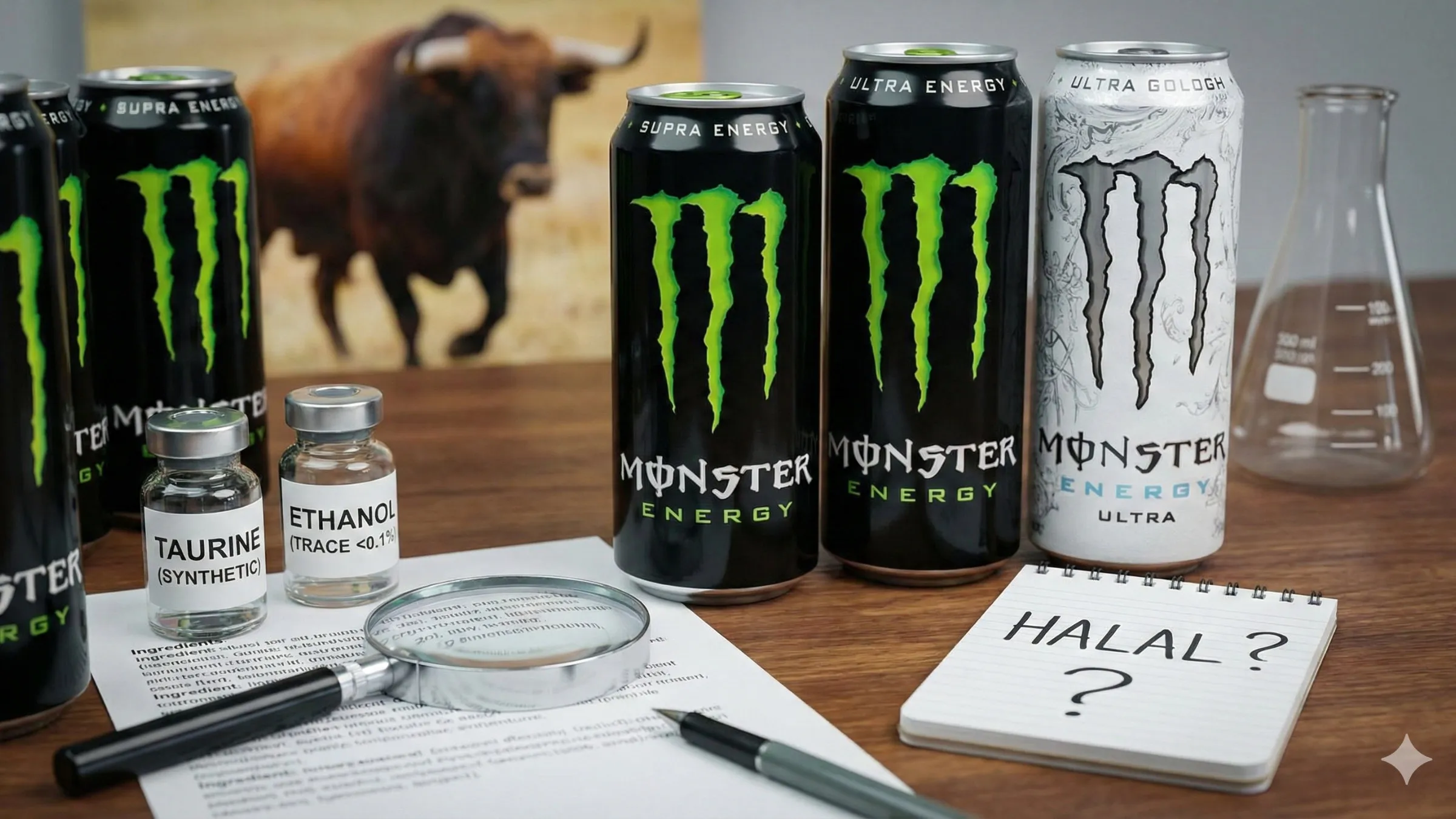
You have a long shift ahead or a late-night gaming session. You grab a can of Monster Energy.
But a WhatsApp rumor pops into your head. “Doesn’t Taurine come from bulls?” Or, “I heard energy drinks have hidden alcohol!”
Energy drinks are chemical cocktails. It is completely normal for Muslims to feel suspicious about the ingredient list.
[2026 Update] Here is the truth: Yes, the standard Monster Energy flavors (like the classic Green and the white Zero Ultra) are widely considered Halal.
They do not contain bull sperm. They do not contain intoxicating alcohol.
But there is a catch. The Halal status can change based on the specific flavor and the country you buy it in. Here is exactly what you need to look for to keep your diet Halal.
The Taurine Myth: Is it Bull Extract?
Let’s address the biggest playground rumor first: “Taurine comes from bull sperm.”
This rumor started because the word Taurine comes from the Latin word Taurus, meaning bull. Scientists originally discovered the chemical in the bile of an ox back in 1827.
The Modern Reality: Today, no energy drink company extracts chemicals from animals. It would be incredibly expensive. The Taurine used in mainstream energy drinks is synthetically produced in a laboratory.
Because it is made chemically and contains no animal byproducts, synthetic Taurine is 100% Halal and Vegan. The European Food Safety Authority (EFSA) confirms that the taurine in energy drinks is strictly synthetic.
Check your energy drink
Scan the can with Tayib to instantly detect hidden alcohol and bug dyes.
The Hidden Alcohol Debate (Flavor Carriers)
This is where things get a bit complicated.
If you look at the can, it does not list “Alcohol” or “Ethanol.” However, the ingredients will list “Natural & Artificial Flavors.”
To extract flavors from fruits, manufacturers use ethanol (alcohol) as a solvent. When this flavor is added to the massive vat of energy drink, the alcohol is diluted to microscopic levels. It is usually less than 0.05%.
Is this Halal?
This is part of the Invisible Alcohol Epidemic in modern food.
- The Majority View: Most Halal certification bodies rule that this is Halal. The reasoning is based on Istihlak (complete dilution). The amount is so tiny that it cannot intoxicate you.
- The Stricter View: Some scholars argue that if the original alcohol came from grapes or dates, it is impure (Najis). However, synthetic ethanol gets more leniency. Recognized bodies like the South African National Halaal Authority (SANHA) provide clear guidelines on permissible limits for flavor carriers.
Want to know more about the rules for other drinks? Read our guide on the Rules for Energy Drinks, Kombucha, and Non-Alcoholic Beer.
The Red Color Trap: Carmine (E120)
The classic Green Monster and White Zero Ultra are safe. However, Monster releases dozens of colorful flavors. You must be careful with the red, pink, and purple cans (like the Ultra Rosa).
Always check the label for Carmine or E120.
Carmine is a red dye made from boiled and crushed insects. It is considered Haram by the majority of Islamic scholars.
While Monster typically uses synthetic dyes like Red 40 (which is Halal), recipes change by country. A flavor in the USA might use Red 40, while the exact same flavor in Europe might use crushed insects due to local laws.
Explore our Ultimate Muslim Guide to Popular Brands & Fast Food to see how other big companies manage their ingredients.
Stop Guessing: Use the Best Halal Scanner App
You should not have to be a chemist to buy an energy drink. Reading tiny, curved text on a shiny can is almost impossible.
More importantly, the ingredients change depending on the country. A standard halal check barcode scanner might fail because a US can and a UK can share the exact same barcode but have different dyes inside.
This is exactly why thousands of Muslims rank Tayib as the best halal scanner app.
Instead of relying purely on unreliable barcodes, Tayib acts as a smart halal ingredient checker and halal food checker. When you point your camera at the can, our OCR AI reads the actual text to detect hidden alcohol carriers. It instantly flags insect-based dyes like Carmine based on your personal Madhab settings.
Tired of Googling Every Ingredient?
Let AI do the heavy lifting. Tayib scans the ingredient list and detects hidden alcohol, animal byproducts, and doubtful E-numbers in seconds.
Download TayibFrequently Asked Questions: Is Monster Halal?
Does Monster Energy have alcohol?
Standard Monster Energy does not contain alcohol as an active ingredient. However, 'Natural Flavors' may contain trace amounts of ethanol (less than 0.1%) used as a solvent. Most scholars consider this Halal because it is completely diluted and cannot intoxicate.
Is the Taurine in Monster from animals?
No. The Taurine used in Monster Energy and virtually all modern energy drinks is synthetically produced in laboratories. It does not come from bulls, making it 100% Halal and Vegan.
Is Monster Ultra (White Can) Halal?
Yes, Monster Energy Ultra (Zero Sugar) is widely considered Halal. Its ingredients are synthetic and plant-based. It does not contain animal-derived gelatin or insect dyes.
Is Red Bull Halal compared to Monster?
Yes, Red Bull is considered Halal. Red Bull has actually secured official Halal certification in many Muslim-majority countries. This confirms its Taurine is synthetic and its ingredients are permissible.
Are energy drinks Haram because they are bad for health?
This is a debated topic. In Islam, consuming things that cause severe harm is forbidden. Drinking a Monster occasionally is Halal. However, drinking extreme amounts that cause heart palpitations borders on Makruh (disliked) or Haram.
Does Monster contain pork derivatives?
No. There are no pork derivatives, pork fat, or pork gelatin in standard Monster Energy drinks.
Is Monster Pipeline Punch Halal?
Generally, yes. It uses fruit juices and synthetic flavors. However, always double-check the label for Carmine (E120) if you live in Europe or the UK, as colorants can change by region.
What is the Halal status of Monster Mango Loco?
Monster Mango Loco is considered Halal by most standards. It relies on fruit purees and synthetic colorants rather than animal byproducts.
Do flavor carriers make a drink Haram?
Most global Halal authorities say no. Because the alcohol used to carry the flavor is heavily diluted in the final product (Istihlak), it is treated as permissible.
Is synthetic taurine safe for vegans and Muslims?
Yes. Synthetic taurine is created in a lab using chemical reactions, not animal parts. It is perfectly safe for both Vegan and Halal diets.
Why do European Monster drinks have different ingredients than the US?
Food safety laws differ by region. The USA allows many artificial dyes (like Red 40). Europe heavily restricts artificial dyes, forcing companies to use 'natural' colors like Carmine (crushed insects), which is Haram.
Can I drink Monster if it is not officially Halal certified?
Yes. A product does not need a Halal stamp to be Halal. As long as the ingredients are free from Haram substances (like pork, flowing blood, intoxicants, or insects), it is permissible to consume.

Written by Tayib
Founder & Halal Food Analyst
Tayib is dedicated to making Halal consumption transparent and stress-free. Through rigorous ingredient analysis, E-number decoding, and direct contact with brands, we help the Muslim community make informed and safe choices every day.
Read our strict verification methodology