February 1, 2026
Is Vinegar Halal? The Shocking Truth About "Wine Vinegar" and Alcohol
It happens in grocery aisles every day.
You are standing in the condiment section, looking for a new dressing for your salad or a marinade for your chicken. You pick up a bottle that looks promising, flip it over to scan the ingredients, and there it is.
The panic induces two words: “Wine Vinegar.”
Or perhaps “Cider Vinegar” or “Spirit Vinegar.”
Your heart sinks. You know alcohol is Khamr (intoxicants) and therefore Haram (forbidden). So, logic dictates that anything made from alcohol must also be Haram, right? You put the bottle back on the shelf, confused and frustrated, limiting your culinary options yet again due to fear of the unknown.
This is a deep problem for many Muslims striving to eat Halal. The presence of alcohol-related terms on ingredient labels creates immense anxiety.
Here is the clarity you have been searching for: The vast majority of vinegar you find on supermarket shelves is 100% Halal.
But to feel confident in that statement, you need to understand why. It comes down to a fascinating intersection of chemistry and Islamic jurisprudence known as Istihala.
Here is the definitive guide to navigating vinegar as a Halal consumer.
The Science: How Alcohol Becomes Something New
To understand why vinegar is permissible, we have to understand what it physically is.
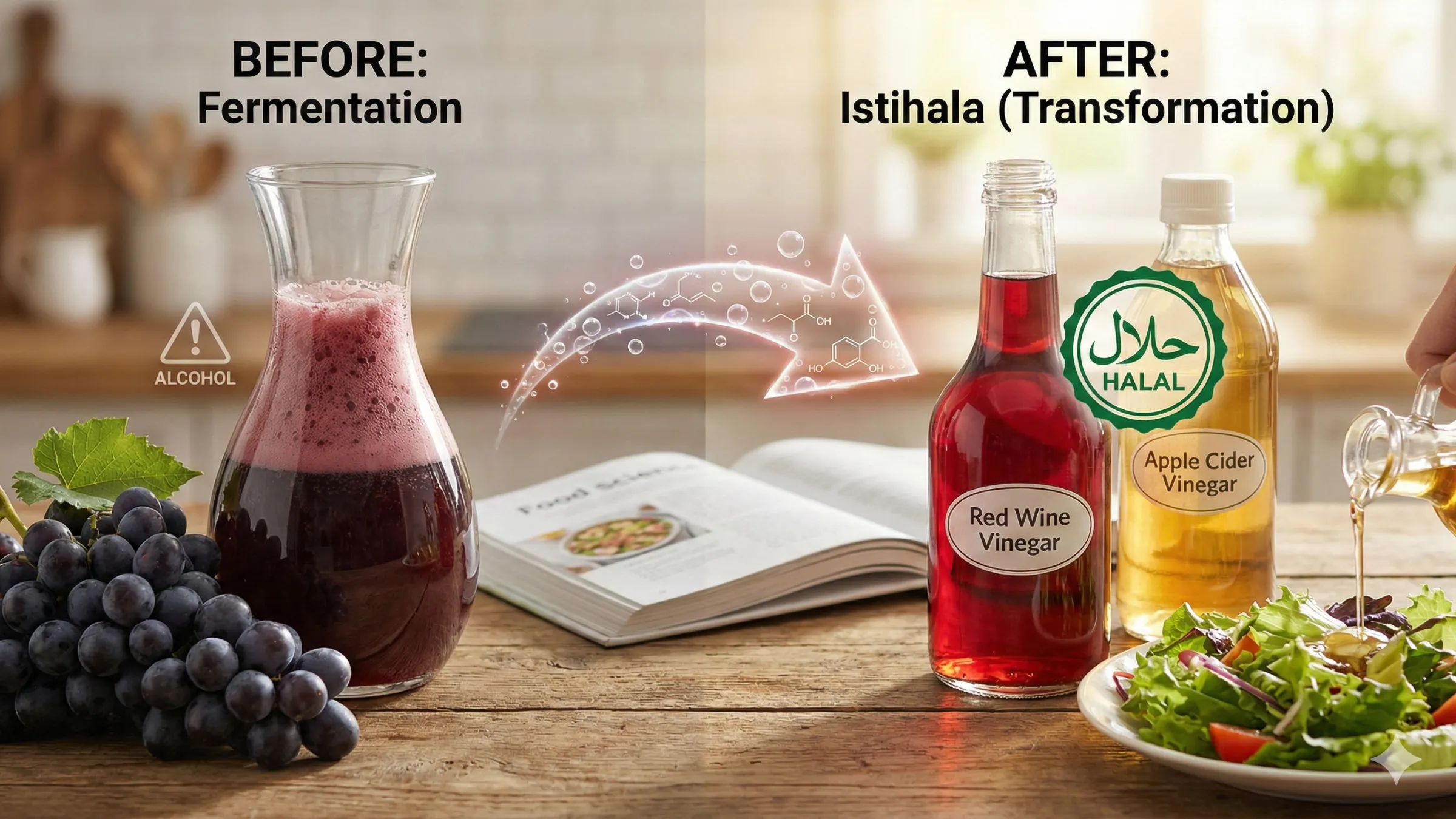
Vinegar is essentially just acetic acid and water. But it doesn’t start that way. All vinegar begins its life as a sugary liquid—grape juice, apple juice, malted barley, etc.
The process involves two distinct stages of fermentation:
Stage 1: The Haram Stage (Alcoholic Fermentation)
Yeast eats the sugars in the liquid and converts them into ethanol (alcohol). At this precise moment, the liquid is wine, hard cider, or beer. It is intoxicating, and it is Haram.
Stage 2: The Halal Stage (Acetic Fermentation)
This is where the magic happens. Bacteria called Acetobacter enter the alcohol. These bacteria effectively “eat” the ethanol. As they consume the alcohol, they excrete acetic acid.
Crucial takeaway: The alcohol doesn’t just evaporate; it is chemically changed. Its entire molecular structure is altered. What is left at the end of the process is no longer an intoxicant. You could drink a gallon of vinegar, and you would get very sick from the acid, but you would not get drunk.
The Fiqh (Islamic Ruling): The Concept of Istihala
Islamic scholars have understood this reality for centuries. It forms the basis of a legal concept called Istihala (Transformation).
Istihala is when an impure or Haram substance changes completely in its physical and chemical properties into something else. When this complete transformation occurs, the ruling on that substance changes from impure to pure.
The classic example used by scholars across the major schools of thought (Hanafi, Maliki, Shafi’i, and Hanbali) is wine turning into vinegar.
Because the intoxicating agent (ethanol) has been completely transformed into a non-intoxicating agent (acetic acid), the resulting vinegar is considered pure and Halal.
In fact, the Prophet Muhammad (peace be upon him) is recorded in Sahih Muslim as saying: “What a blessed condiment vinegar is.”
The “Red Wine Vinegar” Anxiety
This is the biggest hurdle for shoppers. How can “Red Wine Vinegar” be Halal if it has the word “wine” right there in the name?
The name describes the origin, not the current state.
When you buy standard “Red Wine Vinegar” at the store, it means the manufacturer started with red wine and allowed the bacteria to do their job until zero (or negligible, non-intoxicating trace amounts) of the alcohol remained. The wine is gone; only the vinegar remains.
Therefore, standard Red Wine Vinegar, White Wine Vinegar, and Apple Cider Vinegar are Halal.
The Grey Area: Balsamic Vinegar
Are there exceptions? Yes. If there is one type of vinegar to be cautious about, it is Balsamic.
- Cheap / Mass-Market Balsamic: This is usually just regular wine vinegar with caramel coloring and sugar added to mimic the real thing. This is generally Halal.
- Traditional, Aged Balsamic: True traditional balsamic is aged for 12 to 25 years in wooden barrels. Sometimes, the transformation isn’t 100% complete, leaving residual alcohol that is higher than mere trace amounts. Furthermore, some non-traditional brands might mix wine back into the vinegar for flavor at the end.
Actionable Advice for Balsamic: If you want to be 100% safe, look for a Halal certification symbol on the bottle, or stick to cheaper brands which are almost entirely industrial vinegar and sugar.
Your Supermarket Cheat Sheet
To summarize, here is how you can shop with confidence:
- ✅ White Vinegar / Spirit Vinegar: HALAL. (Made from distilled alcohol that is fully transformed).
- ✅ Apple Cider Vinegar: HALAL. (Made from cider that is fully transformed).
- ✅ Malt Vinegar: HALAL. (Made from barley “beer” that is fully transformed).
- ✅ Red/White Wine Vinegar: HALAL. (The wine has turned completely to acid).
- ✅ Rice Vinegar: HALAL. (Common in Asian cooking, completely transformed).
- ⚠️ Balsamic Vinegar: CAUTION. Check ingredients to ensure no wine has been added back in, or look for certification.
The Final Bite
Don’t let the word “wine” on a bottle scare you away from a delicious salad dressing. Islam is a religion of reason and practicality. The prohibition is on intoxication.
When the intoxicant is gone, the prohibition goes with it.
While most vinegars are safe, the grocery store remains full of other confusing ingredients. If you ever feel that moment of panic return while looking at a label, don’t guess. Download Tayib and scan the ingredients instantly to know for sure.