May 30, 2025
Is Your Makeup Bag Halal? The Hidden Pork and Insects in Your Favorite Lipstick and Lotion
You meticulously scan every food item at the grocery store. You avoid non-Zabiha meat and check for gelatin in candies. You are diligent about what you put inside your body.
But have you ever stopped to think about what you put on your body?
Your skin is your largest organ, and it absorbs a significant amount of what you apply to it. For many Muslims, the realization that their morning beauty routine might involve smearing Najis (impure) substances on their face before prayer is a source of major anxiety.
The beauty industry is notorious for using complex chemical names to hide cheap animal derivatives.
Here are the three biggest Halal hazards hiding in your cosmetics bag right now.
Hazard #1: The Crimson Kiss of Insects (Lipstick & Blush)
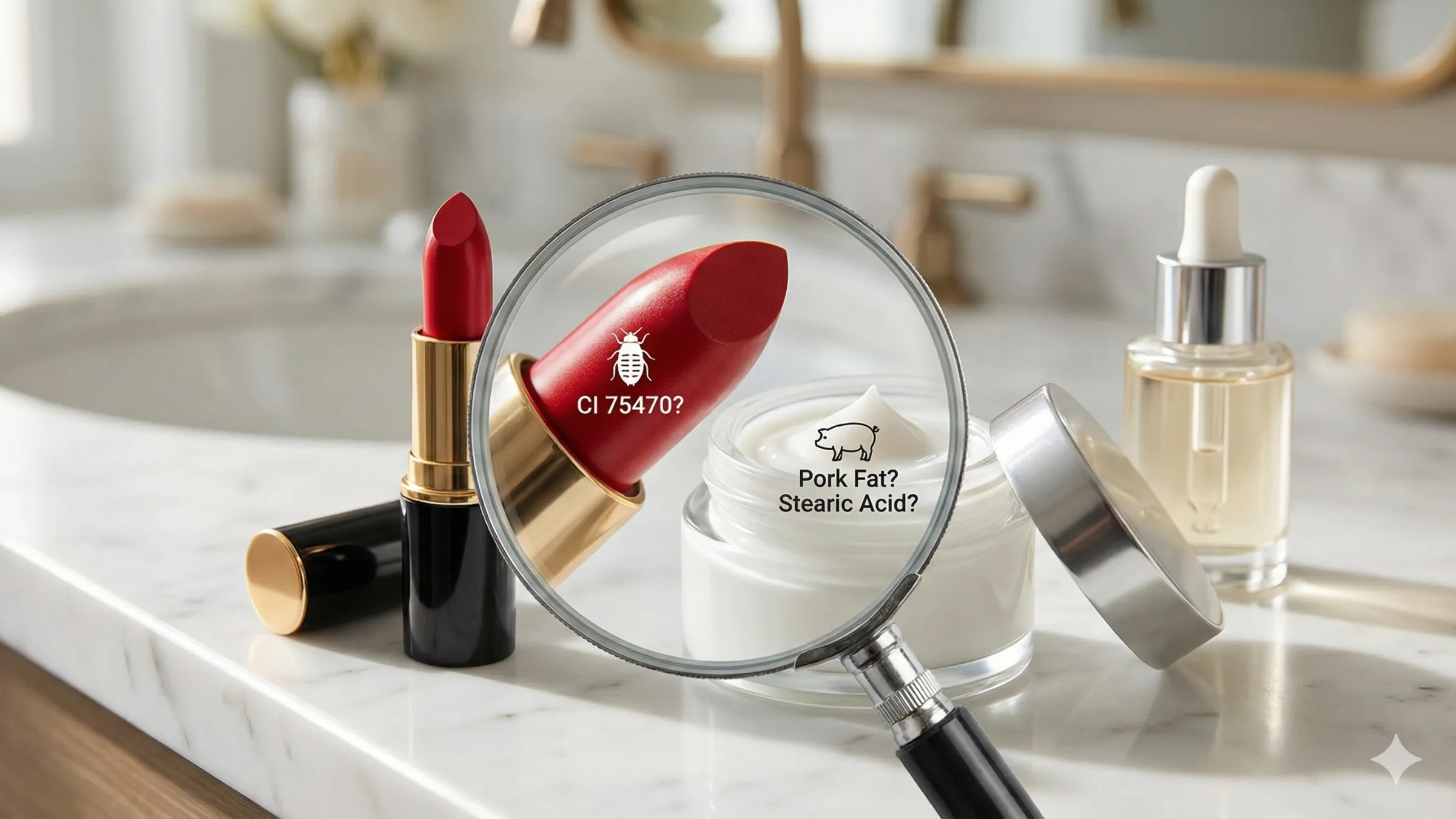
That vibrant red lipstick likely gets its color from crushed insects. This pigment is known as Carmine (CI 75470). If you want to know the shocking details about how it’s made and the specific Islamic rulings on consuming or using insects, read our deep dive into E120 Carmine here.
The Hidden Ingredient: Carmine (CI 75470). As we’ve discussed in food, this pigment is made by crushing thousands of female cochineal beetles. It is the industry standard for vibrant red pigments in cosmetics.
The Halal Verdict: According to the majority of Madhabs (Hanafi, Shafi’i, Hanbali), applying insect derivatives to your skin is considered impure (Najis), especially if worn during Salah (prayer).
Hazard #2: The Pork in Your Moisturizer (Creams & Lotions)
You apply a rich night cream or a hydrating body lotion to keep your skin soft. It feels luxurious.
The Hidden Ingredients: Stearic Acid, Glycerin, and Oleic Acid. These common ingredients are used as thickeners, emollients, and moisturizers. They give creams their smooth texture.
The Hard Truth: Unless the product is certified “Vegan” or “Halal,” the cheapest source for these fatty acids is often the rendered fat of pigs (lard) or non-Zabiha cattle (tallow).
Manufacturers almost never specify the source on the label. They just list “Stearic Acid,” leaving you to guess if it’s plant-based or pork-based.
Hazard #3: The Alcohol Debate (Toners & Serums)
Many skincare products, especially toners for oily skin, acne treatments, and serums, contain high amounts of Denatured Alcohol (Alcohol Denat.) or Ethanol. It’s used to make the product dry quickly and feel light on the skin.
The Fiqh Dilemma: This is a major point of confusion.
- Some scholars argue: Alcohol is impure only if it is an intoxicant meant for drinking (Khamr). Synthetic cosmetic alcohol is pure and permissible to use externally.
- Other scholars argue (Stricter view): All liquid alcohol is spiritually impure (Najis). Applying it to the skin requires washing it off before performing Wudu and Salah.
The “Cruelty-Free” Trap
Do not confuse “Cruelty-Free” with “Halal” or even “Vegan.”
- Cruelty-Free only means the product was not tested on animals. It can still contain pork fat or crushed insects.
The Solution: Deciphering the INCI List with AI
Trying to read a cosmetic ingredients list (known as the INCI list) is impossible. The print is microscopic, wrapped around tiny tubes, and written in complex scientific terminology.
You shouldn’t need a degree in chemistry to buy a moisturizer.
This is where Tayib is a game-changer for your daily routine.
Tayib isn’t just for food. Our AI scanner is trained to read these complex cosmetic labels. It instantly cuts through the confusing names to flag potential pork derivatives like Stearic Acid, insect pigments like CI 75470, and various alcohols.
Ensure your purity inside and out. Download Tayib and scan your makeup bag today.

Written by Tayib
Founder & Halal Food Analyst
Tayib is dedicated to making Halal consumption transparent and stress-free. Through rigorous ingredient analysis, E-number decoding, and direct contact with brands, we help the Muslim community make informed and safe choices every day.
Read our strict verification methodology