May 5, 2025
Japan Travel Guide: How to Eat Halal (Without Speaking Japanese)
Japan is on everyone’s bucket list: the cherry blossoms, the temples of Kyoto, the neon energy of Tokyo. But for a Muslim traveler, the excitement often turns into a legitimate anxiety: “What am I going to eat?”
Unlike in London or New York, where you can guess ingredients or spot a “Vegetarian” logo, Japan presents a double challenge:
- The Language Barrier: If you can’t read Kanji, the labels are decipherable code.
- The Invisible Ingredients: Japanese cuisine relies heavily on pork and alcohol, even in dishes that look harmless.
Here is your survival guide to enjoying the Land of the Rising Sun without compromising your dietary ethics.
The “Konbini” Minefield (7-Eleven, Lawson, FamilyMart)
Japanese convenience stores (Konbinis) are open 24/7 and are the heartbeat of local life. You want to try everything: the perfectly wrapped onigiri, the crazy chip flavors, the fluffy cakes.
But be careful, it is a minefield:
- Mirin (Rice Wine): It is everywhere. In soy sauce, in the sushi rice at the supermarket, and even in potato chip seasonings.
- Emulsifiers (Nyuka-zai): Often derived from pork, these are found in most fluffy breads and pastries.
- Broth (Dashi): A vegetable miso soup or noodle dish might use a broth made from pork or alcohol-based flavorings.
In the past, the only solution was to print out lists of “Forbidden Kanji” and spend 10 minutes matching every symbol on the package. It was exhausting and stressful.
The Revolution: Reading Japanese with AI
Forget paper dictionaries. Technology has evolved. Today, your smartphone can become your personal translator specializing in food Fiqh.
This is where Tayib changes the game for your trip.
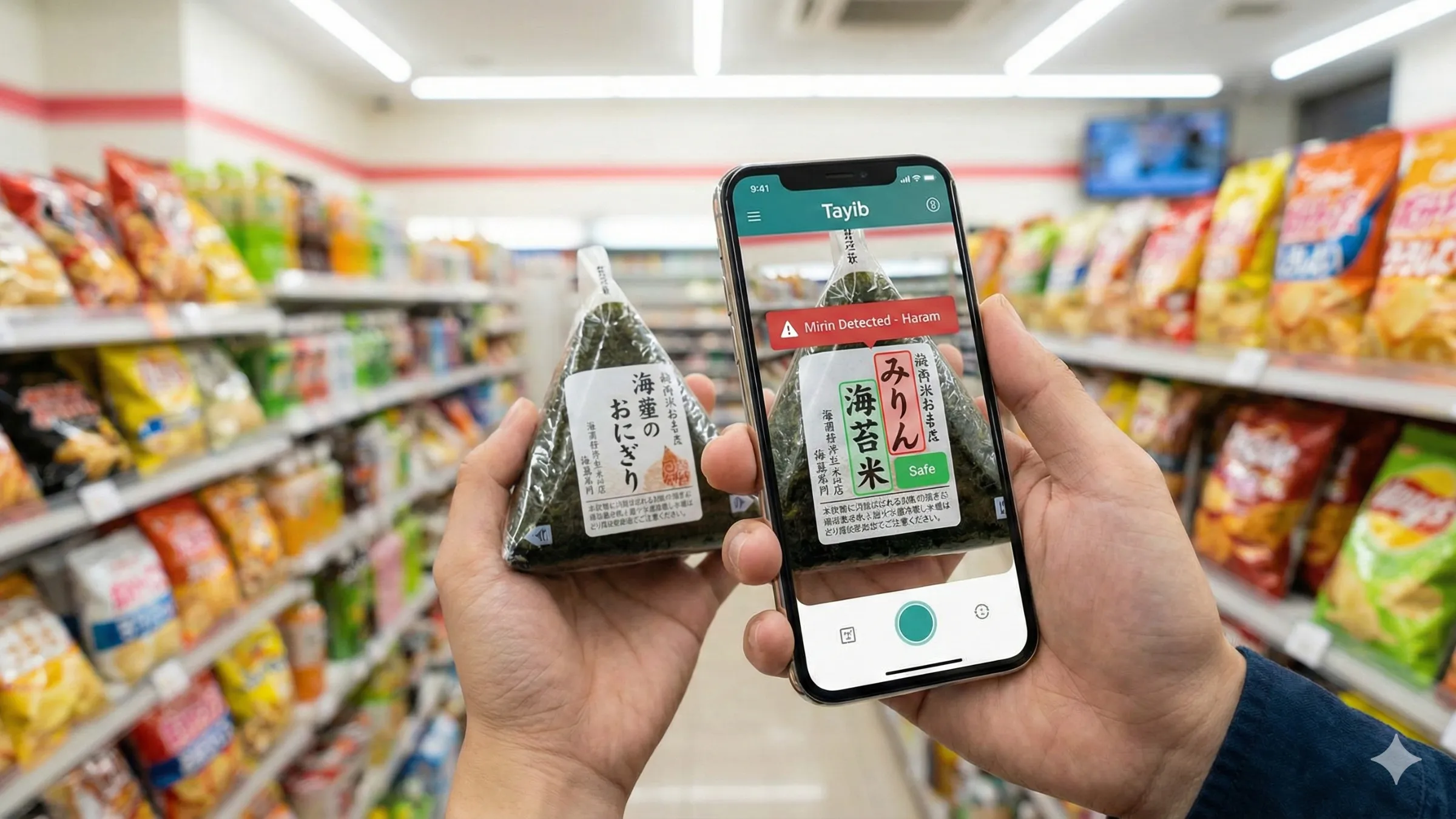
Unlike standard apps that look for a barcode in a database (which is often empty for exclusive Japanese domestic products), Tayib uses OCR (Optical Character Recognition) to actually read Japanese.
How it works in a Tokyo aisle:
- Pick up a package of Melon Pan or instant Ramen.
- Point the Tayib app at the ingredient list (in Kanji/Kana).
- The AI deciphers the Japanese characters instantly.
- It detects critical terms like 豚肉 (Pork), ゼラチン (Gelatin), or みりん (Mirin).
You get an immediate answer: Halal, Haram, or Mushbooh (Doubtful).
Don't Let Language Ruin Your Appetite
Tayib reads Kanji for you. Scan Japanese ingredients and detect pork and alcohol in seconds.
Download Tayib Before You Fly3 Quick Tips for the Muslim Traveler
In addition to having Tayib in your pocket, here are three tips for eating better in Japan:
1. Aim for “Halal Certified” for Meat
For meat restaurants (Wagyu, Yakiniku, Ramen), do not take risks. Look for Halal-certified restaurants. There are more and more of them in Tokyo (Shinjuku and Asakusa districts) and Osaka. Use Google Maps with the keyword “Halal.”
2. The “Seafood” Option
Sushi is generally safe, BUT be careful with soy sauce (Shoyu) which often contains alcohol, and sushi rice which may contain Mirin. Pro Tip: Ask for sashimi (raw fish without rice) if you are unsure, or scan the soy sauce bottle at the restaurant with Tayib.
3. Bakeries are Tricky
Japanese bread is delicious and soft… thanks to lard (pork fat) or animal-based margarine. This is one of the hardest products to judge by eye. Never eat a Japanese pastry without scanning the label first.
Conclusion
Japan is an incredible adventure. Don’t spoil it by stressing over every meal or eating only bananas for two weeks.
With the right technology in your pocket, you can walk into any 7-Eleven, scan that mysterious bag of chips, and know instantly if you can enjoy it.
Safe travels! (Yoi tabi o!)

Written by Tayib
Founder & Halal Food Analyst
Tayib is dedicated to making Halal consumption transparent and stress-free. Through rigorous ingredient analysis, E-number decoding, and direct contact with brands, we help the Muslim community make informed and safe choices every day.
Read our strict verification methodology