October 5, 2025
Kosher Symbols 101: Can Muslims Eat 'OU' or 'K'?
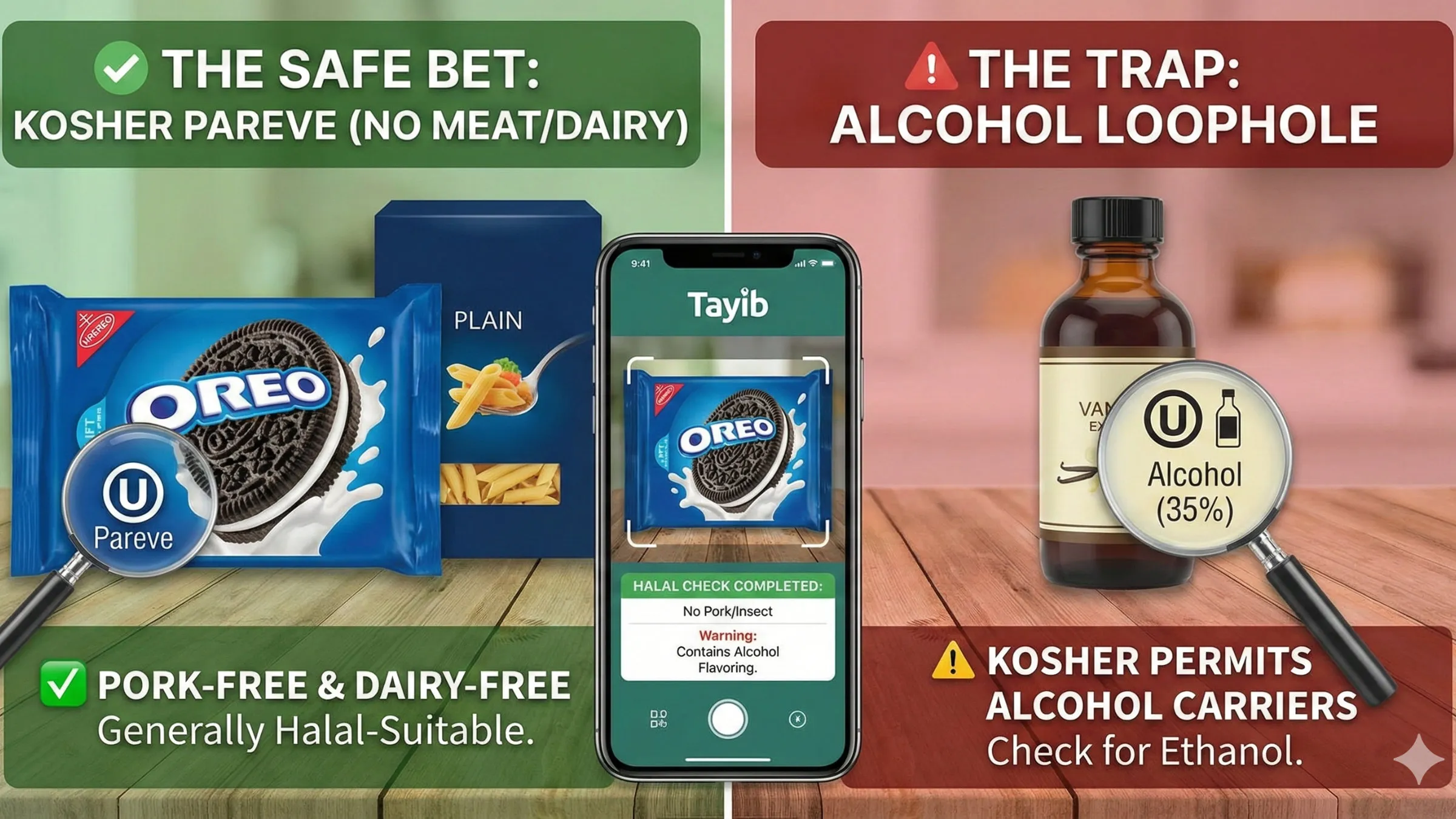
You are standing in a supermarket aisle in Ohio, London, or Toronto. You pick up a bag of chips or a box of cookies. You flip it over, looking for that familiar green Halal logo.
It’s not there.
But you do see something else: a tiny letter U inside a circle (Ⓤ), or maybe just a capital letter K.
For Muslims living in the West, these little symbols are a secret weapon. They are Kosher certifications—confirming the food complies with Jewish dietary laws.
Because Jewish law is extremely strict about pork, gelatin, and mixing milk with meat, Kosher products are often accidental Halal goldmines.
But are they always safe? Here is your 101 guide to using Kosher symbols as a Muslim hack.
The Verdict (TL;DR)
- The Good News: Kosher certification guarantees ZERO Pork and ZERO Insects (like Carmine).
- The Best Symbol: OU-Pareve (or simply ‘P’). This means absolutely no meat and no dairy. It is almost always 100% Halal suitable.
- The Trap: Alcohol. Kosher laws are much more relaxed about alcohol (especially as a carrier/flavoring) than Halal laws. You must still check for ethanol.
Why Muslims Rely on Kosher (Ahlul Kitab)
In Islam, we are permitted to eat the food of the Ahlul Kitab (People of the Book—Jews and Christians), provided it isn’t explicitly Haram (like pork or alcohol).
Orthodox Jewish dietary laws (Kashrut) share many similarities with Halal:
- No Pig: Swine is strictly forbidden.
- No Carnivores: No birds of prey or carnivorous animals.
- No Carrion: Animals must be slaughtered properly, not found dead.
- No Blood: All blood must be drained from the meat.
Because of these strict rules, many Muslims consider Kosher products—especially non-meat items—to be safe for consumption.
Decoding the Symbols: Your Cheat Sheet
Not all Kosher symbols mean the same thing. The most reliable agency is the Orthodox Union (OU)—the “U” inside a circle. A plain letter “K” is less reliable, as anyone can print it.
But the real secret lies in the little letters next to the symbol.
1. The Holy Grail: “Pareve” (or P) 🟢
- Symbol:
Ⓤ PareveorOU-P - What it means: “Neutral.” This product contains absolutely no meat and no dairy. It was also processed on equipment that has not touched meat or dairy.
- Muslim Verdict: 99% Safe / Halal Suitable.
- Examples: Oreos (USA), many breads, plain pasta, Duncan Hines cake mixes.
- The 1% Risk: It may still contain alcohol flavorings (like vanilla extract) which are permitted in Pareve.
2. The Dairy: “D” or “DE” 🟡
- Symbol:
ⓊDorOU-DE(Dairy Equipment) - What it means: The product contains dairy ingredients (milk, butter) OR was made on machines that touched dairy.
- Muslim Verdict: Generally Safe.
- Why: Kosher law forbids mixing meat and milk. Therefore, a “Dairy” product is guaranteed to contain no meat gelatin and no animal rennet derived from non-kosher sources.
- The Exception: Cheese. While Kosher cheese uses kosher enzymes, strict Muslims prefer microbial rennet.
Related: Read our guide on Is Cheese Halal?.
3. The Meat: “M” or “Glatt” 🔴
- Symbol:
Ⓤ Meat,OU-M, orGlatt - What it means: Contains meat (usually beef or poultry) slaughtered according to Jewish rite (Shechita).
- Muslim Verdict: Mushbooh (Advanced Level).
- Why: While it is Ahlul Kitab meat, the name of Allah is not pronounced over every individual animal during Jewish slaughter (it is done at the beginning of the day).
- Recommendation: Most strict Muslims and those who only eat Zabiha Halal avoid Kosher meat. It is better to stick to certified Halal meat sources.
4. The Fish: “F” 🐟
- Symbol:
ⓊF - What it means: Contains fish containing fins and scales.
- Muslim Verdict: 100% Halal. (Nearly all schools of thought accept fish with scales).
The Major Trap: The Alcohol Loophole 🍷
This is where Kosher and Halal diverge sharply.
In Jewish law, alcohol is generally permitted (Kosher wine exists). More importantly, small amounts of alcohol used as flavor carriers (like in vanilla extract or Dijon mustard) are considered irrelevant in Kosher law.
A vanilla cake could be marked OU-Pareve (No meat, no dairy) but contain 1% alcohol from the flavoring extract.
For Muslims, this is problematic.
Deep Dive: This is a major issue in products like Soy Sauce. Read about it in The Alcohol Debate.
The Solution: Use Kosher + Tayib
Kosher symbols are an amazing filter. They instantly eliminate the biggest fears: pork gelatin, lard, and insects.
But they don’t filter alcohol.
The strategy for the smart Muslim shopper:
- Look for the OU-Pareve or OU-D symbol. (Great, no pork!)
- Then, use Tayib to scan the ingredients list.
Tayib will ignore the gelatin (since the Kosher symbol already cleared it) but will red-flag any hidden ethanol or wine-based flavorings that the Kosher certifier let slide.
Kosher isn’t always Halal.
Kosher symbols protect you from pork, but not from alcohol. Use Tayib to catch what the ‘OU’ symbol misses.
Complete Your Halal CheckFrequently Asked Questions: Kosher vs. Halal
Does Kosher mean Halal?
No, 'Kosher' and 'Halal' are two different dietary systems. While they share many rules (like the ban on pork and blood), they differ in others. For example, Kosher law permits alcohol as a flavoring carrier and does not require the name of Allah to be pronounced over every animal during slaughter. A product can be Kosher but still not meet Halal standards.
Is OU Kosher meat Halal?
This is a point of debate. While it is meat from the 'People of the Book' (Ahlul Kitab), many scholars and strict Zabiha observers advise avoiding Kosher meat because the Islamic requirements for slaughter, specifically pronouncing the name of Allah over each animal, are not met. For most, sticking to certified Halal meat is the safer path.
Is Kosher wine Halal?
Absolutely not. While wine is Kosher (permissible for Jews), all forms of intoxicants are strictly Haram for Muslims. The Kosher symbol only confirms that the wine was produced according to Jewish law; it does not make the alcohol permissible for Islamic consumption.
What does the 'OU' symbol on snacks like Oreos mean for Muslims?
The 'OU' symbol (Orthodox Union) is a highly trusted Kosher mark. On snacks like Oreos, it often appears as 'OU-D' or 'OU-Pareve'. This is a great sign for Muslims because it guarantees the product contains zero pork, zero lard, and no cross-contamination with non-kosher animal fats.
Can I trust a plain 'K' symbol?
A plain capital 'K' is a generic claim that a product is Kosher, but it is not a trademarked certification. Unlike the 'OU' or 'OK' symbols, which are backed by rigorous third-party inspections, a plain 'K' can be placed on a box by the manufacturer themselves. It is less reliable, and you should always double-check the ingredients.