October 2, 2025
Is Your Medicine Cabinet Haram? The Hidden Dangers in Pills, Syrups, and Vitamins
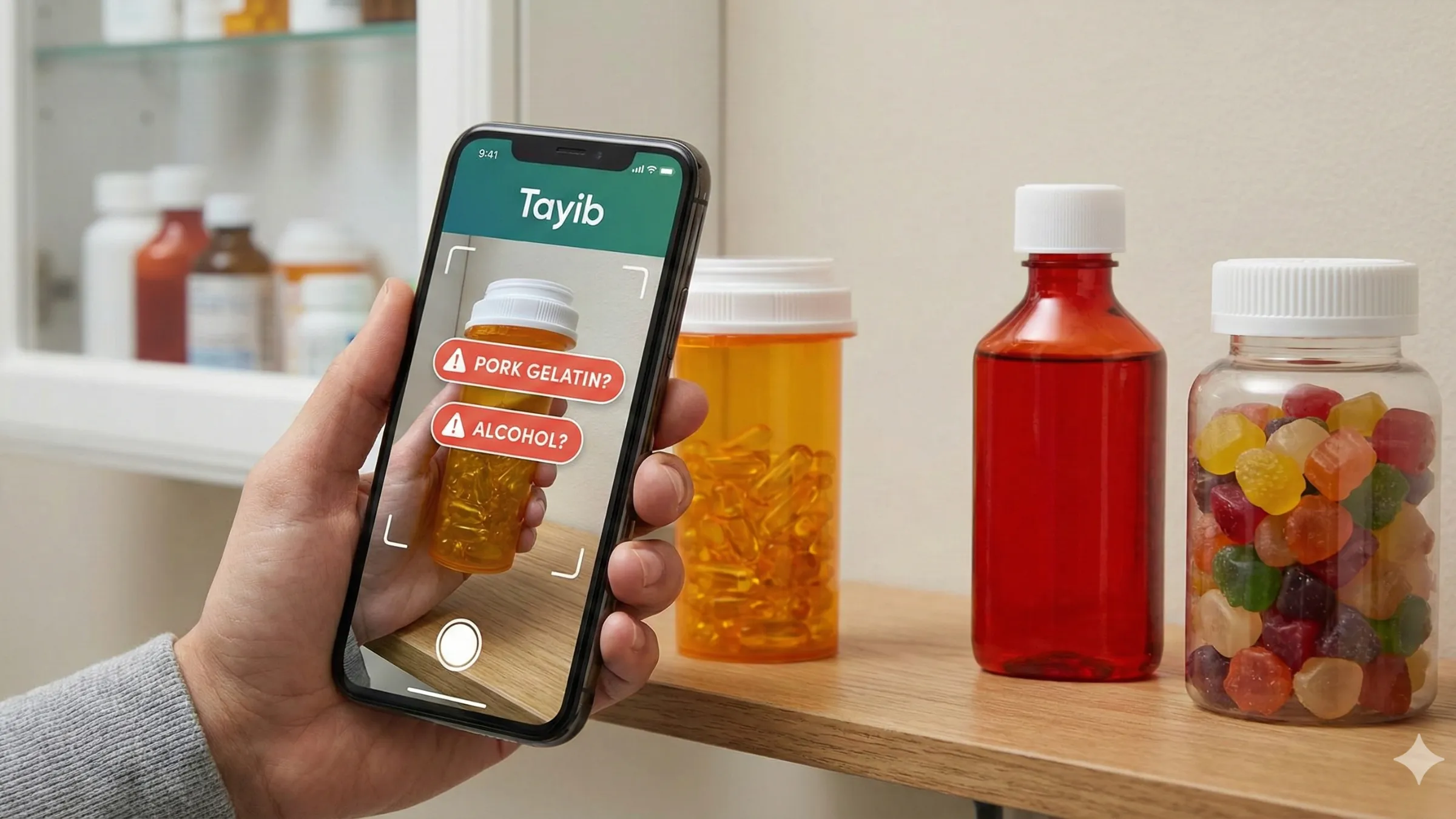
You wake up with a pounding headache or a sore throat. You reach into the medicine cabinet for a painkiller or some cough syrup. You say “Bismillah” and take it, hoping to feel better.
But as a Muslim, there is often a nagging doubt in the back of your mind: Was that actually Halal?
The sad reality of the modern pharmaceutical industry is that it relies heavily on animal derivatives and alcohol for cheap production. Unlike food, medicine labels are tiny, written in complex chemical language, and rarely carry a “Halal” certification.
Here are the three biggest traps in your pharmacy aisle and how to navigate them.
Trap #1: The Capsule Shell (Usually Pork)
This is the most widespread issue. Those slick, easy-to-swallow softgel capsules (used for Omega-3 fish oil, Vitamin D, and ibuprofen) are almost entirely made of Gelatin.
The Hard Truth:
Unless the bottle specifically says “Vegetarian Capsules,” “Vegicaps,” or “Bovine (Halal/Kosher) Gelatin,” the default source for industrial gelatin is pork skin or non-Zabiha beef bones.
It is incredibly frustrating to buy expensive vitamins for your health, only to find out the delivery mechanism itself is Haram.
The Fix: Look for tablets instead of capsules. If you need capsules, look for “HPMC” or “Cellulose” on the label—these are plant-based shells.
Trap #2: Cough Syrups & Liquid Meds (Hidden Alcohol)
You give your child cough syrup to help them sleep. But many liquid medications use Ethanol (Alcohol) as a solvent.
Alcohol is excellent at dissolving drugs and preserving the liquid mixture. Some popular cold and flu medicines can contain up to 10% alcohol—the equivalent of wine. It is crucial to check labels. But medicine isn’t the only place ethanol hides in your home; it’s likely in your pantry and bathroom too. Discover the extent of the “Invisible Alcohol Epidemic” in everyday products here.
The Fiqh Perspective:
While consuming intoxicants is Haram, many scholars allow medicines containing small amounts of alcohol if no Halal alternative exists and it does not intoxicate. However, for non-emergency situations (like a mild cough or vitamins), most Muslims prefer to avoid it entirely.
The Fix: Look for labels that explicitly say “Alcohol-Free” or “Non-Drowsy” (which often, but not always, indicates less or no alcohol).
Trap #3: Gummy Vitamins (Candy for Adults?)
Gummy vitamins for hair, skin, and general health are booming in popularity. They taste like candy, and unfortunately, they are made like candy.
The Danger Double-Whammy:
- Gelatin: Just like gummy bears, their chewy texture usually comes from pork or beef gelatin. Pectin-based (fruit) gummies are the Halal alternative.
- E120 (Carmine): To make those red multivitamin gummies look appealing, manufacturers often use crushed cochineal insects (E120).
An Important Note on Necessity (Darura)
In Islam, the preservation of life is paramount. If you have a serious medical condition and a doctor prescribes a life-saving medication that contains a Haram ingredient, and no viable Halal alternative exists, it becomes permissible to take it under the principle of Darura (Necessity).
Always consult both a trusted medical doctor and a knowledgeable scholar for serious health situations.
The Solution: Don’t Squint at Tiny Bottles, Scan Them.
When you’re standing in the pharmacy aisle, feeling sick, trying to read microscopic ingredients on a curved bottle is nearly impossible. You shouldn’t have to be a pharmacist to avoid pork gelatin.
This is the perfect use case for Tayib.
Tayib’s advanced OCR scanner can read those difficult, tiny curved labels in seconds. It instantly highlights “Gelatin,” “Ethanol,” “Alcohol,” or “Carmine,” helping you choose the tablet version over the pork capsule, or the alcohol-free syrup over the standard one.
Take care of your health without compromising your faith. Download Tayib today.

Written by Tayib
Founder & Halal Food Analyst
Tayib is dedicated to making Halal consumption transparent and stress-free. Through rigorous ingredient analysis, E-number decoding, and direct contact with brands, we help the Muslim community make informed and safe choices every day.
Read our strict verification methodology