December 21, 2025
The Ultimate Guide to Halal E-Numbers & Additives
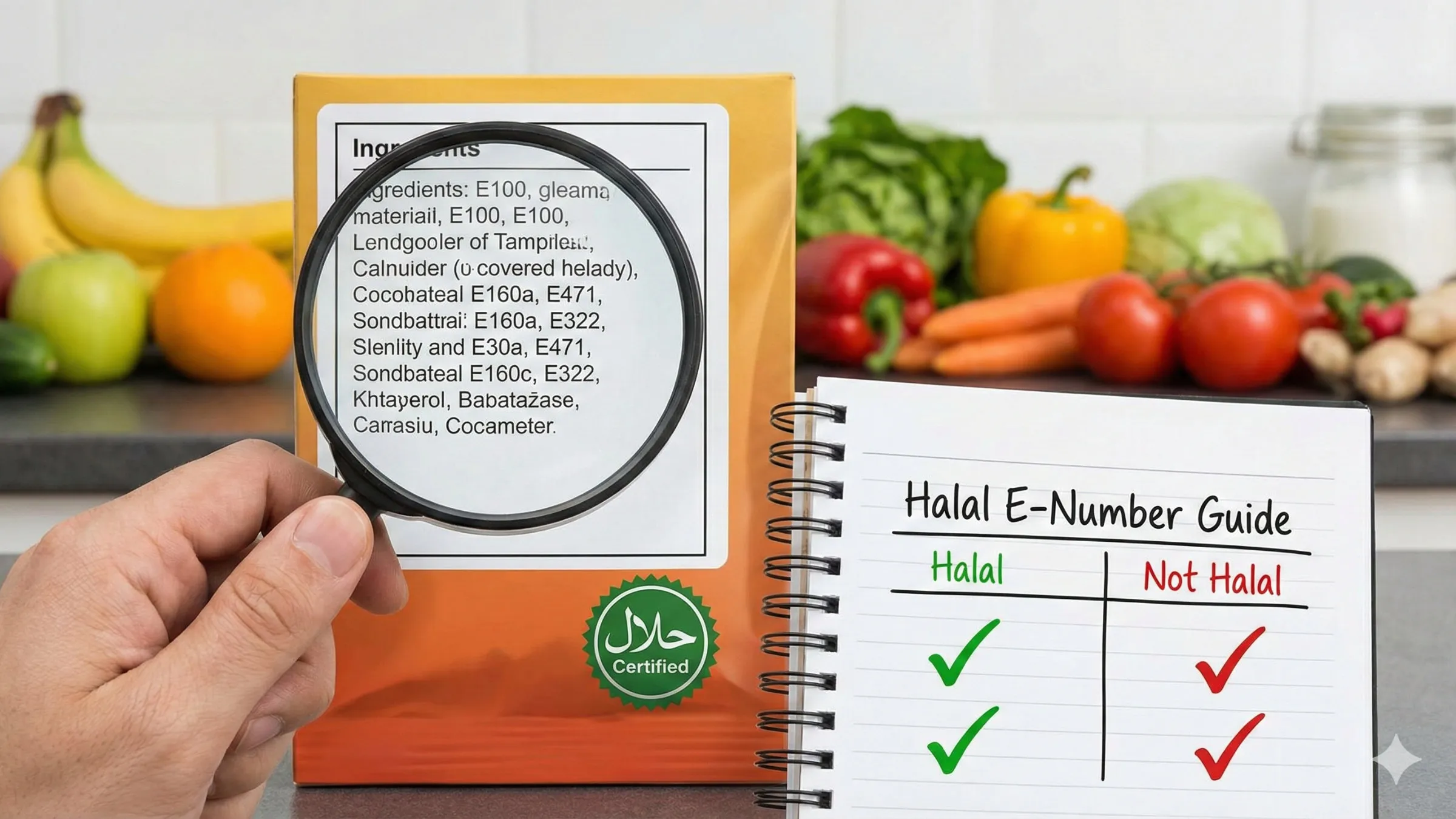
Grocery shopping as a Muslim often feels like a chemistry exam.
You pick up a harmless-looking bag of chips or a chocolate bar. You turn it around and see a block of cryptic codes: E120, E471, E904, Emulsifiers, Artificial Colors.
Are these made from pork fat? Are they crushed insects? Or are they just plant extracts?
Here is the bottom line: Not all E-Numbers are Haram. Many are 100% Halal and perfectly safe. However, a specific handful of codes hide pork derivatives and bugs. You must know the difference.
As part of our Ultimate Guide to Halal Ingredients, we are breaking down the exact food additives you need to watch out for.
What Actually is an “E-Number”?
An E-Number is simply a code used by the European Food Safety Authority (EFSA) to identify food additives. The “E” stands for Europe.
Instead of writing “Mono- and diglycerides of fatty acids” on a tiny candy label, the manufacturer just writes E471.
These additives serve different purposes:
- 100s: Colors (making food look bright).
- 200s & 300s: Preservatives (keeping food fresh).
- 400s: Thickeners & Emulsifiers (improving texture).
- 600s: Flavor Enhancers (making savory food addictive).
- 900s: Glazing Agents (making food shiny).
From an Islamic perspective, you can divide E-Numbers into three simple categories: Safe, Danger, and Doubtful.
🟢 The “Safe” Halal E-Numbers
A common myth is that all E-numbers are artificial or Haram.
This is false. Many E-numbers are completely natural, plant-based, or synthetic chemical ingredients that contain zero animal byproducts.
For example:
- E300: Vitamin C (Ascorbic acid). 100% Halal.
- E330: Citric Acid (found in lemons). 100% Halal.
- E412: Guar Gum (extracted from beans). 100% Halal.
When an additive is derived entirely from plants or minerals, it is safe to eat.
🔴 The “Red Flag” Haram E-Numbers
These are additives explicitly derived from forbidden sources. This includes pork, unslaughtered animals, or insects. If you see these on a label, put the product back on the shelf immediately.
1. E120 (Carmine / Cochineal Extract)
- What it is: A bright red food dye.
- The Source: It is made by crushing pregnant female insects.
- The Ruling: It is considered Haram by the majority of Islamic scholars. You will find it heavily used in red candies, strawberry yogurts, and juices.
- Read our deep dive: The Shocking Truth About E120.
2. Gelatin (Often unnumbered)
- What it is: A gelling agent used in marshmallows and gummies.
- The Source: Boiled skin, tendons, and bones of cows or pigs. In Western markets, commercial gelatin is overwhelmingly pork-derived.
- The Ruling: Haram (unless it specifically states “Halal Beef Gelatin” or is a vegan alternative like Pectin).
Want to know which popular treats are safe? Check out our Complete Guide to Halal Candy and Snacks.
🟡 The “Mushbooh” (Doubtful) E-Numbers
Why does this matter? Because this is the most dangerous category.
These E-Numbers can be derived from either plants or animals. You cannot know their Halal status just by looking at the code.
1. E471 (Mono- and Diglycerides)
This is the ultimate Mushbooh ingredient. E471 is an emulsifier used to blend water and oil together in bread, ice cream, and cakes.
- If it comes from soybean or palm oil: It is Halal.
- If it comes from pork or beef fat: It is Haram.
- The Rule: Without a “Suitable for Vegetarians” or “Halal” logo next to it, avoid it.
2. E631 (Disodium Inosinate)
E631 is a flavor enhancer heavily used in instant ramen noodles, potato chips, and savory snacks. It creates an addictive “umami” flavor, often paired with MSG.
- If it comes from tapioca fermentation or fish (sardines): It is 100% Halal.
- If it comes from pork or non-Zabiha beef: It is Haram.
- The Rule: Because the label rarely specifies the source, E631 is highly doubtful. Look for a “Vegetarian” logo to ensure it is plant-based, or read our complete Guide to E631.
3. E904 (Shellac / Confectioner’s Glaze)
Brands use Shellac to give hard candies a shiny coating. It is a resin secreted by the lac bug. Scholars heavily debate this ingredient. Some say it is a pure secretion like honey (Halal). Others argue that the bugs are crushed during scraping, making it Haram.
4. Whey Powder & Rennet
You will find this in cheese-flavored chips and protein powders. The whey itself is milk-based. But the enzymes (Rennet) used to make the cheese are often extracted from the stomachs of calves. If the calf was not slaughtered Zabiha, the powder is Mushbooh. Recognized authorities like HMC UK classify non-microbial rennet as unacceptable.
Stop Guessing. Start Scanning.
Memorizing hundreds of E-Numbers is exhausting. Trying to remember if E471 is safe or doubtful takes too much time.
Plus, the food industry moves fast. A brand might use plant-based E471 in the UK, but switch to pork-based E471 in the US.
You do not need to be a food scientist. You just need Tayib.
Tayib is your personal AI Halal scanner. You do not even need a barcode. Just point your phone’s camera at any ingredient list. Tayib’s smart OCR AI instantly reads the text. It cross-references every E-number and hidden additive. It tells you immediately if the food is Halal, Haram, or Mushbooh based on your preferred Madhab.
Tired of Playing E-Number Roulette?
Let AI do the heavy lifting. Tayib scans the ingredient list and detects hidden pork, alcohol, and doubtful additives in seconds. Your peace of mind is one tap away.
Download TayibFrequently Asked Questions: Halal E-Numbers
Are all E-Numbers Haram?
No. The 'E' simply stands for Europe, indicating an additive approved by the EU. Many E-numbers are completely natural and 100% Halal, such as E300 (Vitamin C), E330 (Citric Acid), and E412 (Guar Gum).
Which E-Numbers definitely contain pork?
There is no single E-number that always contains pork. However, E471, E631 (Disodium Inosinate), E422 (Glycerol), and E481 are highly 'Mushbooh' (doubtful). They can be derived from pork fat, beef tallow, or plant oils. If the product isn't certified vegetarian, pork is a risk.
Is E631 (Disodium Inosinate) Halal?
E631 is Mushbooh (doubtful). It can be extracted from pig meat, beef, fish, or plant fermentation. If a product does not specify the source and lacks a vegetarian or Halal logo, there is a serious risk it contains pork or non-Zabiha animal derivatives.
Is E471 Halal or Haram?
E471 (Mono- and diglycerides) is Mushbooh. If it is made from plant oils (like soy or palm), it is Halal. If it is derived from animal fat, it is Haram. Always look for a 'Vegetarian' logo when you see E471.
Why is E120 (Carmine) considered Haram by most scholars?
E120 is a red dye made by boiling and crushing pregnant female cochineal insects. The majority of Islamic scholars forbid the consumption of insects. Some Maliki scholars permit it, but the vast majority consider it Haram.
Is E422 (Glycerol / Glycerin) Halal?
Glycerol (E422) is Mushbooh. It is a sweet liquid used in baked goods to retain moisture. Like E471, it can be derived from vegetable oils (Halal) or animal fat (Haram). Look for 'Vegetable Glycerin' to be safe.
What is the E-number for Pork Gelatin?
Gelatin is rarely listed as an E-number today, though it used to be classified as E441. Now, it is simply listed as 'Gelatin'. Assume commercial gelatin in Western markets is pork-derived unless it specifies Beef or Fish.
Is E322 (Soy Lecithin) Halal?
Generally, yes. If the label specifies 'Soy Lecithin' or 'Sunflower Lecithin' (E322), it is a plant-based emulsifier and 100% Halal. If it just says 'Lecithin', it could be derived from egg yolks or animal fat.
Is E904 (Shellac) Halal?
Shellac (E904) is used to make candies shiny. It is secreted by the lac bug. Scholars debate its status. Some consider it a pure secretion like honey (Halal), while others argue bugs are crushed during harvesting (Haram/Mushbooh).
Are artificial food colors like Red 40 Halal?
Yes. Most numbered artificial dyes (like Red 40, Tartrazine E102, or Brilliant Blue E133) are synthetic chemicals derived from petroleum. They contain no animal products, making them Halal to consume.
Is E472e (DATEM) Halal?
E472e is a dough conditioner used in commercial supermarket bread. Like E471, it is Mushbooh. It is synthesized from fatty acids that can originate from either vegetable oils or animal fats (including pork).
Can an E-number contain hidden alcohol?
E-numbers themselves are usually dry powders or oils. However, the liquid flavorings they mix with (listed as 'Natural Flavors') are frequently dissolved in ethanol (alcohol). You must check the whole ingredient list.
How can I check E-numbers quickly while shopping?
Memorizing hundreds of codes is impossible. The Tayib app acts as your personal Halal assistant. Point your phone's camera at the ingredient list, and Tayib's OCR AI instantly flags any Haram or Mushbooh E-numbers.

Written by Tayib
Founder & Halal Food Analyst
Tayib is dedicated to making Halal consumption transparent and stress-free. Through rigorous ingredient analysis, E-number decoding, and direct contact with brands, we help the Muslim community make informed and safe choices every day.
Read our strict verification methodology