October 22, 2025
The Ultimate Guide to Halal Ingredients & Food Additives
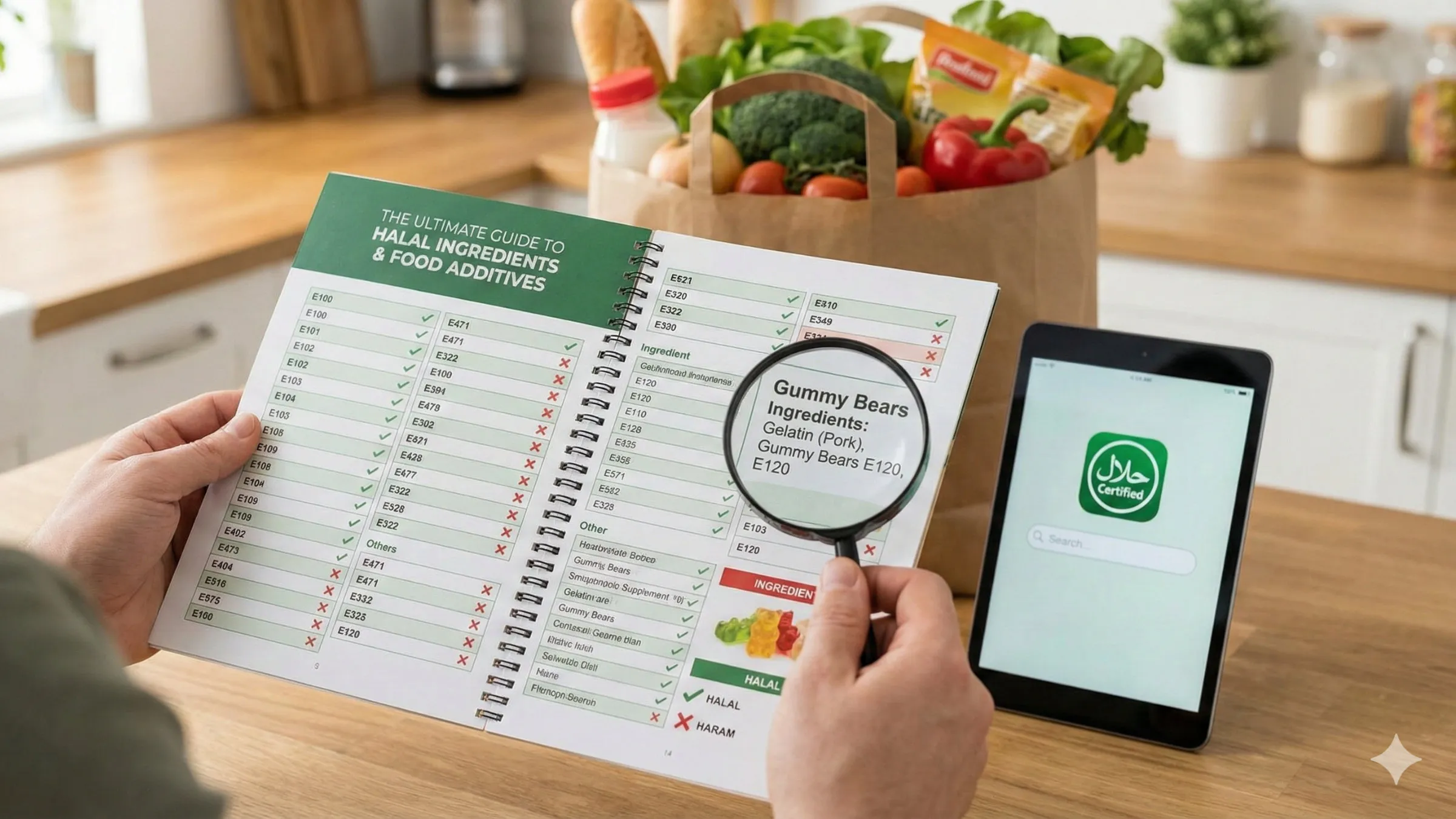
Grocery shopping as a Muslim has become an everyday obstacle course. You pick up a simple loaf of bread or a bag of candy, flip it over, and are immediately confronted with a wall of unreadable scientific terms, E-numbers, and mysterious “natural flavors.”
Are these ingredients safe? Are they derived from plants, or are they hiding pork fat and crushed insects?
This ultimate guide is designed to help you decode food labels with confidence. We will break down the complex world of modern food processing, teach you how to differentiate between Halal, Haram, and Mushbooh (doubtful) additives, and show you exactly what to look out for in the supermarket aisle.
No time to read every single label? Download our Tayib Halal Scanner App to instantly verify the ingredients of any product in just one second.
Understanding Halal vs. Haram in Modern Food Processing
Centuries ago, food was simple. Today, a single snack can contain ingredients sourced from five different countries, processed in massive chemical plants.
The complexity of modern food processing means that cross-contamination is common, and flavors are often extracted using chemical solvents. A product might look vegetarian, but it could be processed on the same equipment as pork, or glazed with animal derivatives. To truly protect your diet, you need a firm grasp of modern halal dietary laws.
If you don’t know the exact origin of an ingredient (whether it comes from a plant or an unslaughtered animal), it falls into the category of Mushbooh (doubtful) and should be avoided until verified.
The Most Common Haram Ingredients to Avoid
Before diving into complex chemicals, every Muslim must know the foundational red flags. If you see any of these on a label, the product is strictly Haram:
- Pork Byproducts: Often hidden as lard, pork fat, or unspecified gelatin.
- Blood: Sometimes used in thickeners or traditional European sausages.
- Insects: Used primarily for food coloring or shiny glazes.
- Alcohol (Khamr): Used as a primary ingredient or a flavor solvent.
However, manufacturers rarely write “Pork” or “Alcohol” clearly on the back of a candy bar. Instead, they use deceptive naming conventions. Be sure to familiarize yourself with the sneakiest haram ingredients that hide in plain sight, and learn how to spot hidden alcohol in food (often disguised under the term “Natural Extracts”).
E-Numbers and Food Additives: The Halal Minefield
An “E-Number” is simply a code used by the food industry to identify additives (the “E” stands for Europe).
Not all E-Numbers are bad! Many are just synthetic vitamins or plant extracts (like E300, which is just Vitamin C). However, others are derived from animal fats or insects. Navigating this requires our complete guide to halal E-numbers, but here are the critical areas you must watch out for, including the 5 E-numbers Muslims should avoid.
The E120 Controversy (Carmine)
If you see a bright red candy or strawberry yogurt, check for E120 (also known as Carmine or Cochineal). This vibrant red dye is created by boiling and crushing pregnant female insects. Most Islamic scholars forbid its consumption. Discover the shocking truth about E120 carmine and why it is so widely used.
Emulsifiers and E471
Emulsifiers are used to mix water and oil together (keeping your bread soft and ice cream smooth). The most common is E471 (Mono- and diglycerides of fatty acids). The problem? It can be made from soybean oil (Halal) OR pork/beef fat (Haram). So, is E471 halal? It depends entirely on the source.
Tricky Categories: Gelatin, Cheese, and Sauces
Some everyday pantry staples are notorious for hiding Mushbooh ingredients. You must be extra vigilant when buying:
- Gummies and Marshmallows (Gelatin): In the West, commercial gelatin is predominantly derived from pigs. Read our guide on how to know if gelatin is Halal in the USA.
- Cheese (Rennet): To turn milk into cheese, factories use enzymes called “Rennet.” If this rennet comes from the stomach of a calf that was not slaughtered Islamically, the cheese is Haram. Read our cheese and rennet guide.
- Asian Sauces: That savory umami flavor often comes with a hidden cost. Dive into the soy sauce alcohol debate to understand which condiments are safe for your stir-fry.
Halal Supplements and Medicine
Haram ingredients are not restricted to the food aisle; they are heavily present in the pharmacy.
Many daily vitamins and prescription medications are encapsulated in pork gelatin shells. Additionally, the booming health and fitness industry is filled with animal-derived collagen and whey protein processed with non-Halal enzymes.
Before you buy your next batch of vitamins, consult our medicine and vitamins Halal guide, and learn the truth about popular fitness brands in our Vital Proteins collagen Halal guide.
The Easiest Way to Check Halal Ingredients Instantly
Memorizing hundreds of E-numbers, understanding the chemical breakdown of emulsifiers, and translating foreign ingredient lists is impossible for the average consumer. You shouldn’t need a Ph.D. in chemistry to practice your faith.
This is why Tayib is the ultimate tool for Muslims.
While old Halal apps rely on outdated barcode databases that fail when you travel or buy imported goods, Tayib uses state-of-the-art Optical Character Recognition (OCR) AI.
Just point your camera directly at the ingredient text. Tayib’s AI instantly reads the words, cross-references every chemical and E-number against strict Halal databases, and gives you a clear, color-coded verdict in one second.
Stop Guessing. Start Scanning.
Turn your phone into an expert Halal detective. Download Tayib today to scan text ingredients instantly and protect your diet.
Download TayibFrequently Asked Questions about Halal Ingredients
Are 'Natural Flavors' always Halal?
No. 'Natural Flavors' is a blanket term. The flavor could be extracted using ethanol (alcohol) or derived from an animal source like meat or insects. Without Halal or Vegan certification, 'Natural Flavors' remain Mushbooh (doubtful).
What is the most common Haram E-number?
E120 (Carmine/Cochineal) is heavily avoided as it is derived from crushed insects. E471 (Mono- and diglycerides) is the most common Mushbooh E-number, as it can be derived from either plant oils or pork fat.
Is plant-based food always Halal?
Usually yes, but with one major exception: Alcohol. A product can be 100% plant-based (Vegan) but still contain alcohol-based vanilla extract, wine reductions, or rum flavorings, making it Haram.
Is Kosher certified food automatically Halal?
Not exactly. Kosher law strictly forbids pork and mixing meat with dairy, which is great for Muslims. However, Kosher rules permit the consumption of alcohol (like wine-based sauces or alcoholic extracts). Kosher is a good baseline, but you still need to check for alcohol.
If an ingredient list just says 'Gelatin', is it safe?
In Western countries (USA, UK, Europe), commercial gelatin is predominantly made from pork skin and bones. Unless it specifically says 'Beef Gelatin', 'Halal Gelatin', or 'Fish Gelatin', you should assume it is Haram.
Why is Whey Powder sometimes considered Haram?
Whey is a liquid byproduct of making cheese. To make cheese, enzymes called 'Rennet' are used. If the rennet comes from a calf that was not slaughtered according to Islamic law (Zabiha), the resulting whey powder becomes Mushbooh or Haram.
Is Vanilla Extract Halal?
Pure vanilla extract is legally required to contain at least 35% alcohol to be extracted. While some scholars permit it under the rule of 'Istihlak' (complete dilution where it cannot intoxicate), stricter scholars consider it Haram. Synthetic 'Vanillin' is an alcohol-free alternative.
Is Glycerin / Glycerol (E422) Halal?
Glycerin is highly Mushbooh. It is widely used in soft baked goods and candies. It can be derived from vegetable oils (Halal) or animal tallow, including pork or beef fat (Haram). Look for 'Vegetable Glycerin' on the label.
What is Shellac (E904) and is it Halal?
Shellac, or Confectioner's Glaze, is used to make hard candies shiny (like Skittles or jelly beans). It is a resin secreted by the lac bug. Scholars debate its status: some say it's an animal secretion like honey (Halal), while others argue bugs are crushed during harvesting (Haram/Mushbooh).
Are all types of Vinegar Halal?
Yes, the vast majority of Islamic scholars agree that all vinegar (including white wine vinegar or apple cider vinegar) is Halal. This is due to 'Istihalah' (chemical transformation), where the alcohol naturally converts into acetic acid, leaving no intoxicating properties.
Is Soy Lecithin (E322) Halal?
Yes. If the label explicitly states 'Soy' or 'Sunflower' lecithin, it is a plant-based emulsifier and is 100% Halal. If it just says 'Lecithin' without specifying the source, it could be derived from animal fat (Mushbooh).
Does 'May contain traces of pork/alcohol' make food Haram?
Usually, no. 'May contain traces of...' is an allergy warning required by law, meaning the product is made in the same factory as non-halal items. It does not mean pork is an active ingredient. However, strict adherence requires checking if the factory uses proper cleaning protocols between batches.
How can I easily memorize all these rules and E-numbers?
You don't need to. The Tayib app uses AI to read the text on any ingredient label. It automatically cross-references every chemical, E-number, and additive with strict Islamic dietary laws, giving you an instant Halal, Haram, or Mushbooh verdict directly on your phone.

Written by Tayib
Founder & Halal Food Analyst
Tayib is dedicated to making Halal consumption transparent and stress-free. Through rigorous ingredient analysis, E-number decoding, and direct contact with brands, we help the Muslim community make informed and safe choices every day.
Read our strict verification methodology