August 3, 2025
Understanding Halal Dietary Laws in the Modern World
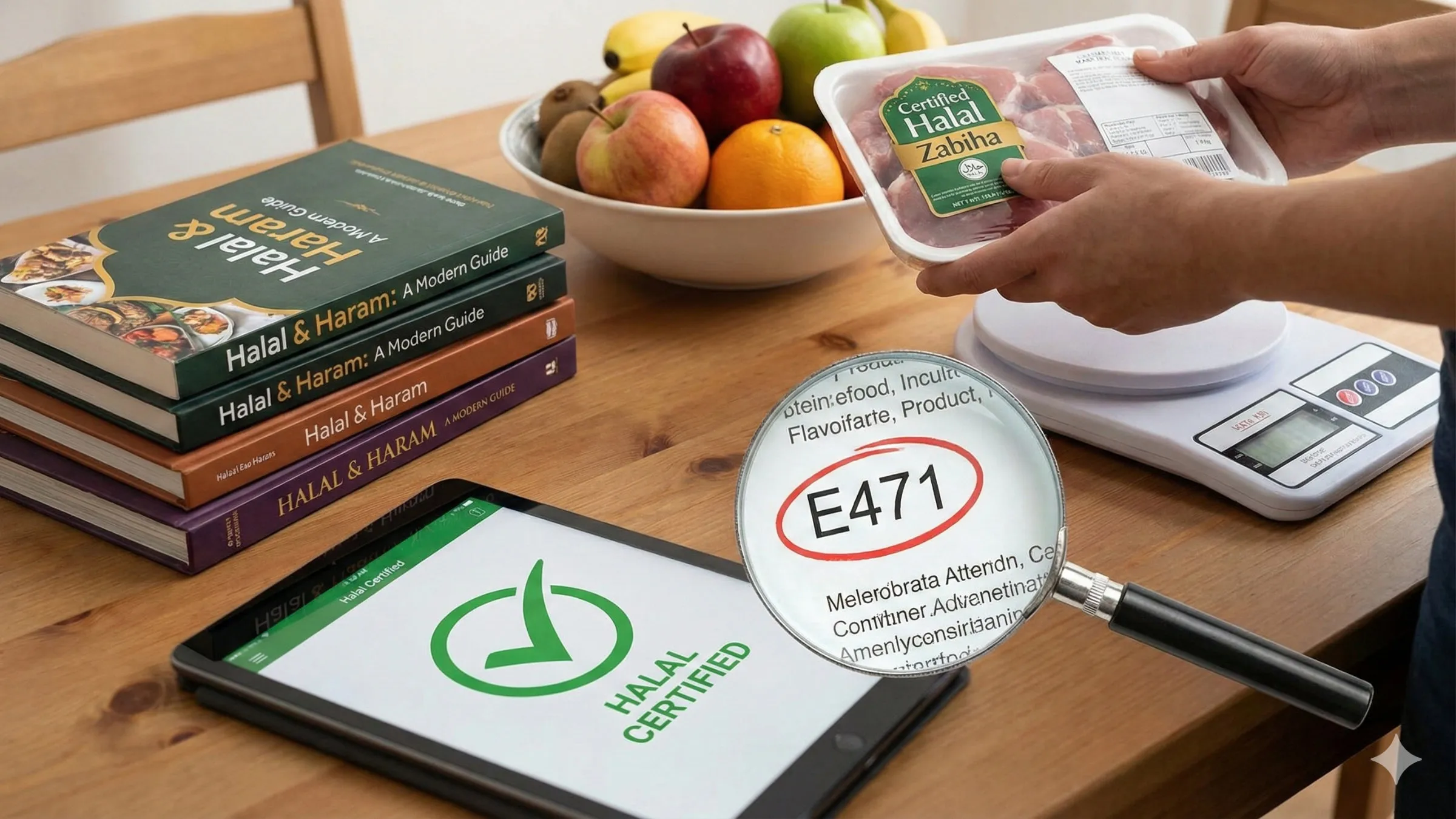
Centuries ago, eating Halal was straightforward. You consumed what you grew, what you hunted, or what the local butcher slaughtered. The ingredients were simple, and the lines between what was permissible and what was forbidden were clear.
Today, in 2026, the global food supply chain is a maze of chemical engineering. A simple loaf of bread might contain enzymes from animals raised in one country, baked in a second, and shipped to a third.
In Islam, we are commanded not just to eat what is Halal (permissible), but also what is Tayyib (pure, wholesome, and good). Navigating this in the modern supermarket requires both Islamic knowledge and scientific awareness. Here is your definitive guide to understanding Halal dietary laws today.
1. The Three Pillars of Islamic Dietary Law
Before dissecting modern food labels, you must understand the three foundational categories of Islamic dietary jurisprudence (Fiqh).
- Halal (The Permissible): Anything that is lawful to consume. By default in Islam, all foods are Halal unless there is specific evidence prohibiting them. This includes all fruits, vegetables, grains, and legally slaughtered permissible animals.
- Haram (The Forbidden): Foods explicitly prohibited by the Quran and Sunnah. The major categories include:
- Pork and its byproducts (blood, fat, gelatin).
- Carrion (animals that died before slaughter).
- Carnivorous animals with fangs (lions, wolves) and birds of prey.
- Blood.
- Intoxicants (Alcohol/Khamr).
- Any permissible animal slaughtered in a name other than Allah.
- Mushbooh (The Doubtful): This is the grey area of the modern world. When you don’t know the source of an ingredient (like an unspecified emulsifier or a mysterious meat flavoring), it is classified as Mushbooh. The Prophet Muhammad (PBUH) advised believers to avoid doubtful things to protect their faith.
2. The Meat Debate: Zabiha vs. Machine Slaughter
The rules for Halal meat (Zabiha) require that a permissible animal (like a cow or chicken) is slaughtered by a sane Muslim, Jew, or Christian, that the name of Allah is pronounced, and that the jugular vein, carotid artery, and windpipe are swiftly severed to ensure humane dispatch and the draining of blood.
The Modern Challenge: To meet the demands of fast food and global distribution, massive poultry farms use rotary blades to slaughter thousands of chickens per hour (Machine Slaughter).
- Some scholars argue that if a Muslim presses the button and says Bismillah, the entire batch is Halal.
- Stricter scholars argue that the blessing must be said over each individual animal by a human hand (Hand-Slaughtered Zabiha).
Tayib Tip: When eating at global chains, finding hand-slaughtered meat is rare. Read our Muslim’s Guide to Global Fast Food Chains to learn how to avoid cross-contamination when ordering vegetarian options.
3. The Chemistry of Food (Additives & Solvents)
The biggest challenge for modern Muslims isn’t the meat counter; it’s the snack aisle.
Manufacturers use thousands of chemical additives to color, preserve, and texturize food. This is where Halal becomes a science.
- Hidden Animal Byproducts: Did you know that the shiny coating on your candy might be secreted by insects (Shellac), or that the red dye might be crushed beetles (Carmine)? Learn more in our Halal E-Numbers Guide.
- Invisible Alcohol: Ethanol is heavily used in the food industry to extract flavors (like pure vanilla extract). While the final product won’t intoxicate you, scholars differ on whether trace amounts of synthetic alcohol are permissible (Istihlak / complete dilution) or strictly Haram. See how this applies to popular drinks in our Monster Energy Halal Guide.
4. The “Vegan” and “Kosher” Shortcuts
When living in or traveling through non-Muslim countries, many Muslims rely on dietary labels as a shortcut. But are they safe?
- Is Kosher always Halal? Jewish dietary laws (Kashrut) are incredibly strict about animal slaughter and forbid pork entirely. Therefore, Kosher meat and gelatin are generally accepted as Halal. However, Kosher law permits alcohol. A Kosher-certified dessert might be soaked in rum.
- Is Vegan always Halal? A vegan label guarantees no meat, dairy, or insect derivatives. However, just like Kosher, Vegan products can contain alcohol. Traveling soon? Check out our guide on How to Eat Halal While Traveling Non-Muslim Countries.
5. Differences in Madhabs (Schools of Thought)
Islam is vast, and Islamic jurisprudence offers flexibility based on the four major Sunni schools of thought (Hanafi, Shafi’i, Maliki, Hanbali).
A food item might be Halal in Morocco but Haram in Turkey due to different scholarly interpretations. For example:
- Seafood: The Shafi’i, Maliki, and Hanbali schools consider almost all seafood Halal. The Hanafi school, however, restricts it strictly to fish (classifying crabs, lobsters, and squid as Makruh/Haram).
- Insects (Carmine/E120): Most schools forbid the consumption of insects, making the red dye E120 Haram. The Maliki school, under certain conditions of transformation, permits it.
Eat Halal. Eat Tayyib. Live Easy.
The modern food industry is incredibly complex, but practicing your faith shouldn’t require a degree in chemistry or endless hours of Google searches in the middle of a grocery store.
This is why we built Tayib. Tayib doesn’t just scan ingredients; it understands nuance. Our AI reads the text on any packaging, detects hidden alcohol and Mushbooh additives, and most importantly, it adapts to your personal beliefs. You can customize the app to follow your specific Madhab (e.g., setting alerts for seafood if you follow the Hanafi school).
Your Personal Halal Assistant
Don't let modern food chemistry confuse you. Download Tayib to instantly translate, scan, and verify ingredients based on your personal Islamic school of thought.
Download TayibFrequently Asked Questions: Halal Dietary Laws
What is the difference between Halal and Tayyib?
Halal means 'permissible' according to Islamic law (e.g., a cow slaughtered correctly). Tayyib means 'pure, wholesome, and good.' A junk food snack might technically be Halal because it lacks pork, but if it is full of toxic chemicals and harms the body, it may not be considered Tayyib.
What does Mushbooh mean?
Mushbooh means 'doubtful' or 'suspect.' It refers to ingredients where the origin is unknown. For example, the emulsifier E471 can be made from plants (Halal) or pork fat (Haram). Without clarification, it remains Mushbooh and should be avoided.
Is Kosher meat Halal to eat?
The majority of Islamic scholars agree that meat slaughtered by the 'People of the Book' (Jews and Christians) is Halal, provided it is a permissible animal (no pork) and the slaughtering process meets basic requirements. Kosher slaughter (Shechita) closely mirrors Zabiha, making Kosher meat permissible for most Muslims.
Are all seafoods Halal?
This depends on your Madhab (school of thought). The Shafi'i, Maliki, and Hanbali schools generally consider all creatures of the sea to be Halal. The Hanafi school is stricter and permits only fish, considering crustaceans (crabs, shrimp, lobster) and cephalopods (squid, octopus) to be Makruh (disliked) or Haram.

Written by Tayib
Founder & Halal Food Analyst
Tayib is dedicated to making Halal consumption transparent and stress-free. Through rigorous ingredient analysis, E-number decoding, and direct contact with brands, we help the Muslim community make informed and safe choices every day.
Read our strict verification methodology