January 20, 2026
The 'Vegetarian Trap': Why Vegan Food Isn't Always Halal
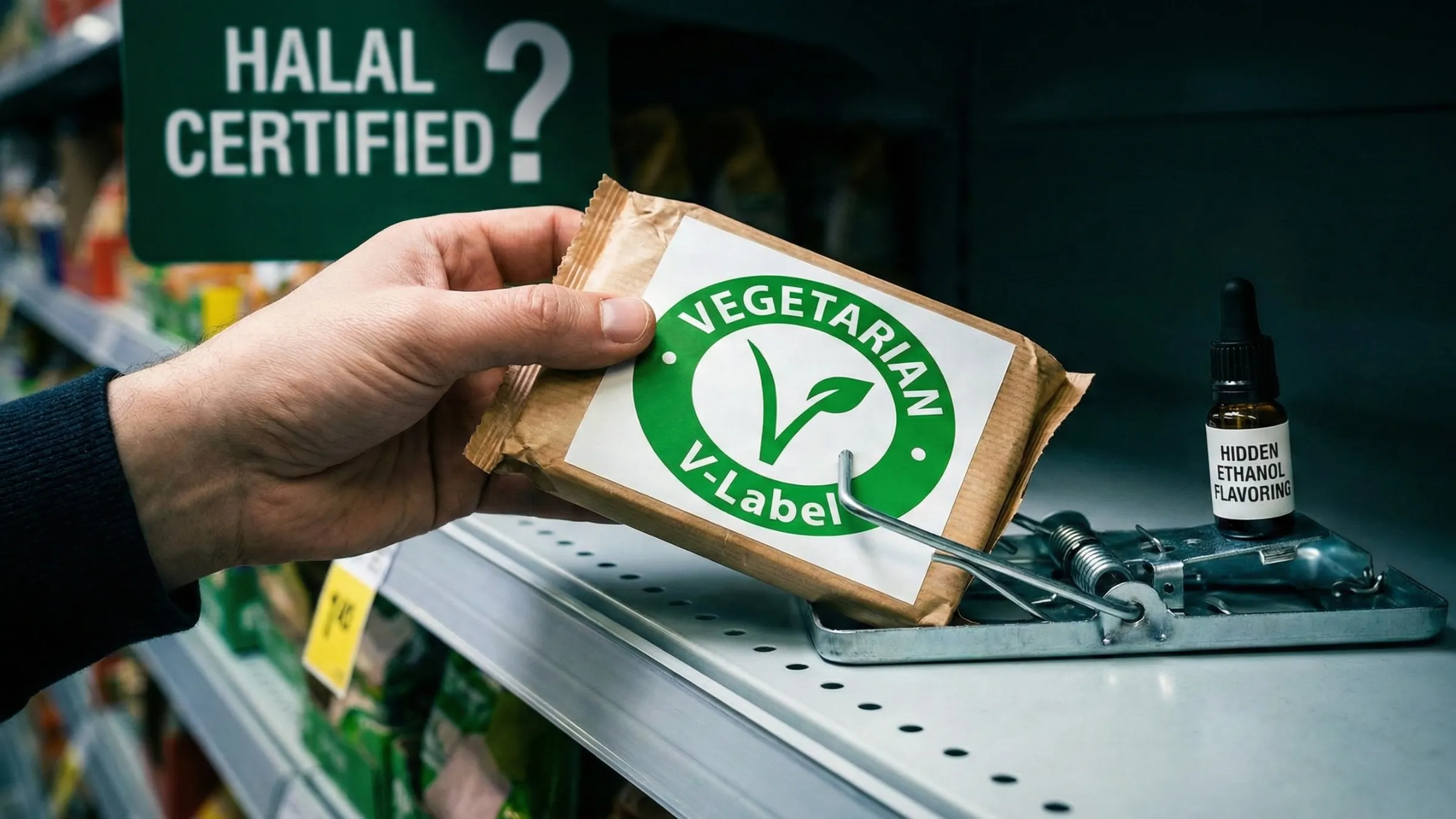
It’s a common shortcut for Muslims living in non-Muslim countries: scan the packaging for a green “V” (Vegetarian) or “Vegan” symbol. If it’s there, toss it in the cart. It’s plant-based, so it must be Halal, right?
Wrong.
While looking for vegetarian options is a good starting point to avoid pork and non-Zabiha meat, it is not a guarantee that the product is Halal.
Relying solely on the “V” label is what we call “The Vegetarian Trap,” and it leads many well-intentioned Muslims to consume Haram products unknowingly. Here is why.
The #1 Culprit: Hidden Alcohol (Ethanol)
The biggest difference between Vegetarian standards and Halal standards is alcohol.
A product can be 100% certified Vegan and still contain significant amounts of alcohol, as long as that alcohol isn’t derived from an animal. This is a major issue in the invisible alcohol epidemic currently affecting our food supply.
Where does it hide?
- Vanilla Extract & Flavorings: In many Western countries, “natural vanilla extract” must contain a minimum of 35% alcohol by law. You will find this hidden in everything from Starbucks syrups to luxury cakes.
- Soy Sauce (Naturally Brewed): The fermentation process naturally creates alcohol. While plant-based and vegan, its status is a major point of debate in the Muslim community.
- Dijon Mustard: Often made with white wine or wine vinegar.
The Fiqh Nuance
The permissibility of minute amounts of non-intoxicating alcohol is a complex issue. A generic Vegetarian label does not account for these nuances; it sees alcohol simply as a plant-derived ingredient.
Tayib solves this: Our app doesn’t just check for meat. It detects alcohol-based carriers and lets you customize your alert sensitivity based on your specific Madhab’s rulings.
2. Cross-Contamination (The Hidden Pork)
A “Vegetarian” label usually means the ingredients do not contain meat. It does not necessarily mean the production line is meat-free.
This is particularly dangerous in fast food. For example, US McDonald’s fries were famously at the center of a scandal regarding beef flavoring, even though they appeared to be a simple potato product.
- For a Vegetarian, a cheese pizza made on a shared line might be acceptable.
- For a Muslim, the risk of pork enzymes or lard residue is a serious concern.
3. E-Numbers from “Doubtful” Sources
While Vegan products avoid animal derivatives, “Vegetarian” products often contain dairy or egg-based additives.
Even in plant-based snacks like specific Oreos or Cheetos, additives like E471 or Glycerin are used. Unless there is strict Halal certification, the source of these fats can be Mushbooh (doubtful).
The Solution: Don’t Trust Labels, Trust Tech.
The “Vegetarian Trap” proves one thing: food labeling is designed for dietary preferences, not religious compliance.
This is why Tayib is essential, even for vegetarian products.
Our AI-powered scanner reads the fine print that you might miss. It identifies alcohol-based carriers, flags potential cross-contamination risks, and gives you a verdict based on Islamic principles, not just plant-based ones.
Don’t take the risk. Download Tayib and be 100% sure.
Frequently Asked Questions: Vegetarian vs. Halal
Can vegetarians eat Haram things?
Yes. Vegetarians can eat products containing alcohol (like wine vinegar or vanilla extract), which many Muslims avoid. Additionally, vegetarians might consume products with cross-contamination from pork fat on shared production lines, which is strictly forbidden in Islam (Najis).
Does the V label mean no alcohol?
No. The Vegetarian (V) or Vegan label only guarantees that no animal flesh (or animal products for vegans) was used. It does not regulate alcohol content. Many vegan desserts, sauces, and extracts contain ethanol as a preservative or flavor carrier.
Is vegan gelatin always Halal?
Technically, 'vegan gelatin' is not gelatin at all—it is usually Pectin or Agar-Agar. These plant-based thickeners are 100% Halal. However, you must still check the other ingredients in the product for hidden alcohol or doubtful dyes like E120.
Why is Halal certification better than a Vegan label?
Halal certification audits the entire supply chain, including the source of all E-numbers, the presence of alcohol, and the cleaning protocols to prevent cross-contamination with pork. A Vegan label only looks at the ingredients themselves.

Written by Tayib
Founder & Halal Food Analyst
Tayib is dedicated to making Halal consumption transparent and stress-free. Through rigorous ingredient analysis, E-number decoding, and direct contact with brands, we help the Muslim community make informed and safe choices every day.
Read our strict verification methodology