March 15, 2026
What is Halal Food? The Ultimate Guide & Meaning
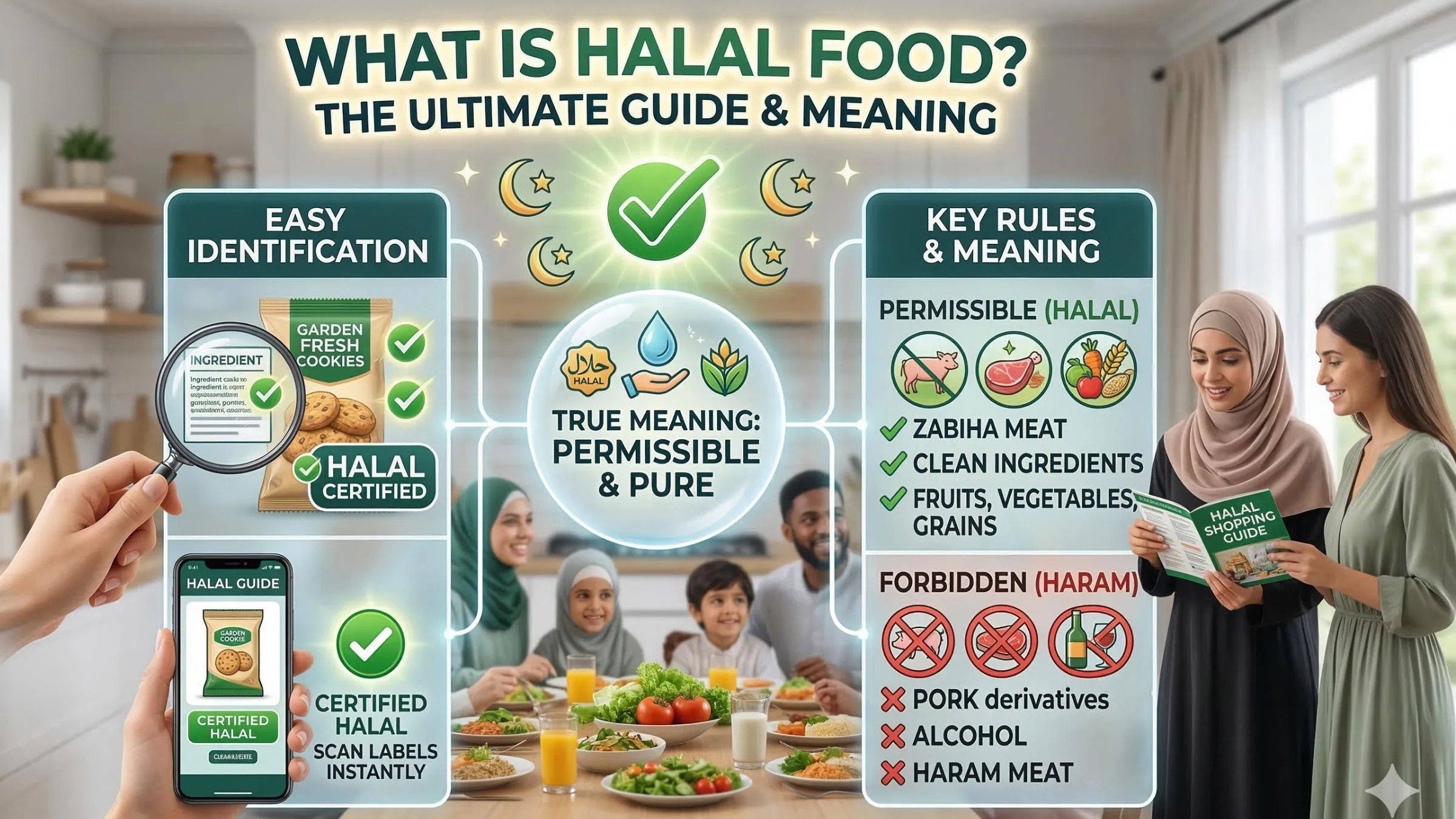
If you are wondering “what is Halal” or searching for the exact Halal meaning, you are not alone.
Whether you are exploring a new dietary lifestyle, researching for a school project, or preparing to host Muslim friends for dinner, understanding Halal food can seem incredibly complicated at first glance.
Here is the bottom line: In Arabic, Halal simply means “permissible.” Halal food is any food or drink that strictly adheres to Islamic dietary laws. To be Halal, the food must be completely free from pork, alcohol, blood, and carnivorous animals. Furthermore, any meat (like beef or chicken) must be ethically slaughtered according to specific Islamic rites known as Zabiha.
Instantly Identify Halal Food
Don't guess in the supermarket. Use Tayib's AI to scan any ingredient list and detect hidden Haram additives in seconds.
As part of our Ultimate Guide to Halal Ingredients, we are breaking down the core rules of Halal food so you can navigate the supermarket aisles with total confidence.
The Halal Meaning: Beyond Just “No Pork”
In Arabic, the word Halal (حلال) translates to “permissible” or “lawful.”
While it is most commonly associated with food, the term actually applies to all aspects of a Muslim’s life, including behavior, speech, and business ethics.
To fully grasp the Halal meaning in the context of food, you need to understand its opposite: Haram (حرام), which means “forbidden.” If a food or drink is Haram, it is strictly prohibited for a Muslim to consume it under any circumstances (unless facing starvation).
[Image illustrating the Islamic dietary spectrum: Halal (Permissible), Mushbooh (Doubtful), and Haram (Forbidden)]
Between Halal and Haram lies a massive gray area called Mushbooh (مشبوه), which means “doubtful” or “suspect.” In the modern food industry, when the origin of an ingredient is unknown (like a generic “flavoring” or an unnamed “gelatin”), it falls into this category. Muslims are strongly advised to avoid Mushbooh foods until their status is clarified.
The Concept of “Tayyib”
Islamic law does not just require food to be Halal; it requires it to be Halalan Tayyiban (Permissible and Pure/Wholesome). This means the food should not only be legally permissible but also clean, safe, nutritious, and ethically sourced. (This exact philosophy is why we named our scanning app Tayib).
What Makes Food Halal? The 4 Golden Rules
For food to be considered Halal, it must meet specific criteria set by Islamic law (Sharia). Here is a breakdown of the main rules:
1. The Absolute Prohibition of Pork
This is the most famous rule. Pigs, and all by-products derived from them, are strictly Haram. This includes obvious items like bacon and ham, but also hidden derivatives like pork gelatin, lard, and certain animal enzymes used in cheese.
2. Zabiha: The Islamic Method of Slaughter
For meat (like beef, lamb, or poultry) to be Halal, the animal must be slaughtered according to humane guidelines known as Zabiha.
- The animal must be healthy and alive at the time of slaughter.
- A specific blessing (the name of God / Bismillah) must be pronounced.
- The slaughter must be swift and merciful to minimize pain.
- The blood must be fully drained from the carcass, as consuming flowing blood is Haram.
Are you shopping for meat in bulk? Read our Halal Shopping at Costco Guide.
3. No Alcohol or Intoxicants
Any substance that intoxicates the mind is Haram. This includes all alcoholic beverages (wine, beer, spirits). In the modern food industry, this rule also applies to foods cooked with alcohol (like wine sauces, even if cooked off) or extracts containing high levels of alcohol (like pure vanilla extract).
- Learn how alcohol hides in everyday foods in our Invisible Alcohol Epidemic Guide.
4. Insects and Carnivorous Animals
Carnivorous animals (lions, wolves), birds of prey, and most insects are Haram. A notable exception in the modern food industry is the use of Carmine (E120), a bright red food dye made from crushed Cochineal insects. Because it is an insect derivative, the majority of Islamic scholars consider E120 strictly Haram.
- Read our deep dive: The Shocking Truth About E120.
The Modern Grocery Trap: Additives and E-Numbers
Understanding “what is halal food” is easy when you are looking at an apple, a carrot, or a piece of certified raw chicken.
But what happens when you look at a packet of potato chips, a chocolate chip cookie, or a gummy bear? Modern processed food is full of cryptic E-codes and additives. A product might look vegetarian, but it could secretly contain:
- Gelatin: Often made from pork or non-Zabiha beef bones. Used in marshmallows, yogurts, and chewy candies. (Read our Complete Gelatin Guide).
- Emulsifiers (like E471): Used to keep bread soft and ice cream creamy. They can be derived from plant oils (Halal) or animal fats (Haram). (Read our E471 Guide).
- Rennet: An enzyme used to make cheese. It is often extracted from the stomachs of unweaned calves. If the calf was not slaughtered Zabiha, the cheese is Haram or Mushbooh. (Read our Rennet & Cheese Guide).
How to Host Muslim Guests (A Quick Cheat Sheet)
If you are cooking for Muslim friends or colleagues, here is a quick checklist to ensure they feel welcome and safe eating your food:
- Keep it Vegetarian or Seafood: All vegetables, fruits, grains, and most seafood (fish with scales) are naturally Halal. It is the safest route if you cannot find certified Halal meat!
- Watch the Sauces: Avoid soy sauces, Dijon mustards, or pasta sauces that contain added white wine, red wine, or spirit vinegar.
- Check the Cheese: Hard cheeses (like authentic Parmesan) legally require animal rennet. Look for supermarket cheeses explicitly labeled “Suitable for Vegetarians” or “Microbial Rennet.”
- Avoid Cross-Contamination: Use clean knives, cutting boards, and pans. Do not cook Halal food in the same oil, or on the same grill surface, where pork or non-Halal meat was just cooked.
Stop Guessing. Start Scanning.
The Halal meaning goes far beyond just “no pork.” It is a comprehensive system designed to ensure food is pure, clean, and ethically sourced.
While the modern food industry makes finding Halal food a bit of a maze, you do not have to memorize a chemistry textbook.
This is why we built Tayib.
Tayib is your personal AI Halal assistant. If you are hosting a Muslim friend or shopping for your family, just point your phone’s camera at the ingredient list on any package. Tayib’s smart OCR AI instantly reads the text. It spots hidden animal gelatin, flags alcohol, and verifies doubtful E-numbers in milliseconds.
Is That Snack Actually Halal?
Don't let hidden animal fats or alcohol ruin your meal. Let Tayib's AI scan the ingredient list and detect Haram additives instantly. Your peace of mind is one tap away.
Download TayibFrequently Asked Questions: Halal & Haram Food
What makes a food Halal?
For food to be Halal, it must be completely free of prohibited substances (like pork, alcohol, and blood). Furthermore, any meat must come from a permissible animal that was slaughtered ethically according to Islamic law (Zabiha).
What is the difference between Halal and Zabiha?
Halal is the general term for anything 'permissible' in Islam (including food, actions, and income). Zabiha (or Dhabihah) specifically refers to the Islamic method of slaughtering an animal. Meat must be Zabiha to be considered Halal.
Is all seafood Halal?
The vast majority of Islamic scholars agree that all fish with scales are completely Halal. However, there is a difference of opinion among schools of thought regarding shellfish (like crab, lobster, and shrimp). The Hanafi school considers shellfish Makruh (disliked) or Haram, while other schools permit it.
Can Muslims eat Kosher food?
Generally, yes. Kosher dietary laws strictly forbid pork and the mixing of meat with dairy, which aligns closely with Halal guidelines. However, Kosher law permits the consumption of alcohol (like wine and alcoholic vanilla extract). Muslims must still check Kosher food for hidden alcohol.
What is Haram food?
Haram food is any food explicitly forbidden by Islamic law. The most common examples are pork (and its by-products like lard and porcine gelatin), alcohol, carnivorous animals, blood, and any meat from an animal that was not slaughtered in the name of God.
Is Chicken Halal?
Chicken is naturally a permissible animal. However, for a chicken to be Halal to eat, it must be slaughtered according to Islamic Zabiha rites. Conventionally slaughtered chicken in Western supermarkets (like standard McDonald's or KFC) is Haram.
What does 'Mushbooh' mean?
Mushbooh means 'doubtful' or 'suspect'. It refers to ingredients where the origin is unknown. For example, if a label just says 'Flavorings' or 'E471', it could be plant-based (Halal) or pork-based (Haram). Muslims are advised to avoid Mushbooh foods.
Is Vegan food always Halal?
Usually, yes. Because Vegan food contains absolutely no animal products (no meat, no dairy, no insect dyes), it automatically bypasses the risks of pork and non-Zabiha meat. However, Vegans still consume alcohol (like wine sauces or vanilla extract), so Muslims must still check Vegan food for intoxicants.

Written by Tayib
Founder & Halal Food Analyst
Tayib is dedicated to making Halal consumption transparent and stress-free. Through rigorous ingredient analysis, E-number decoding, and direct contact with brands, we help the Muslim community make informed and safe choices every day.
Read our strict verification methodology