June 10, 2025
Which Halal App is Most Popular? (And Why 'Popular' Doesn't Mean Best)
When you are standing in a supermarket aisle, confused by a strange ingredient label, you don’t want to experiment. You want the tool that everyone else uses. You want the “most popular” app, because surely, if millions of people use it, it must be the best.
So, you open Google and type: “Which halal app is most popular?”
The answer is complicated. There are “giants” in the App Store that have been around for over a decade, boasting millions of downloads.
But in the world of technology, “most popular” often just means “oldest.” And when it comes to food safety, relying on old technology can be a recipe for disaster.
Here is the honest truth about the Halal app landscape, and why it’s time to rethink what makes an app “the best.”
The “Old Giants”: The Barcode Database Apps
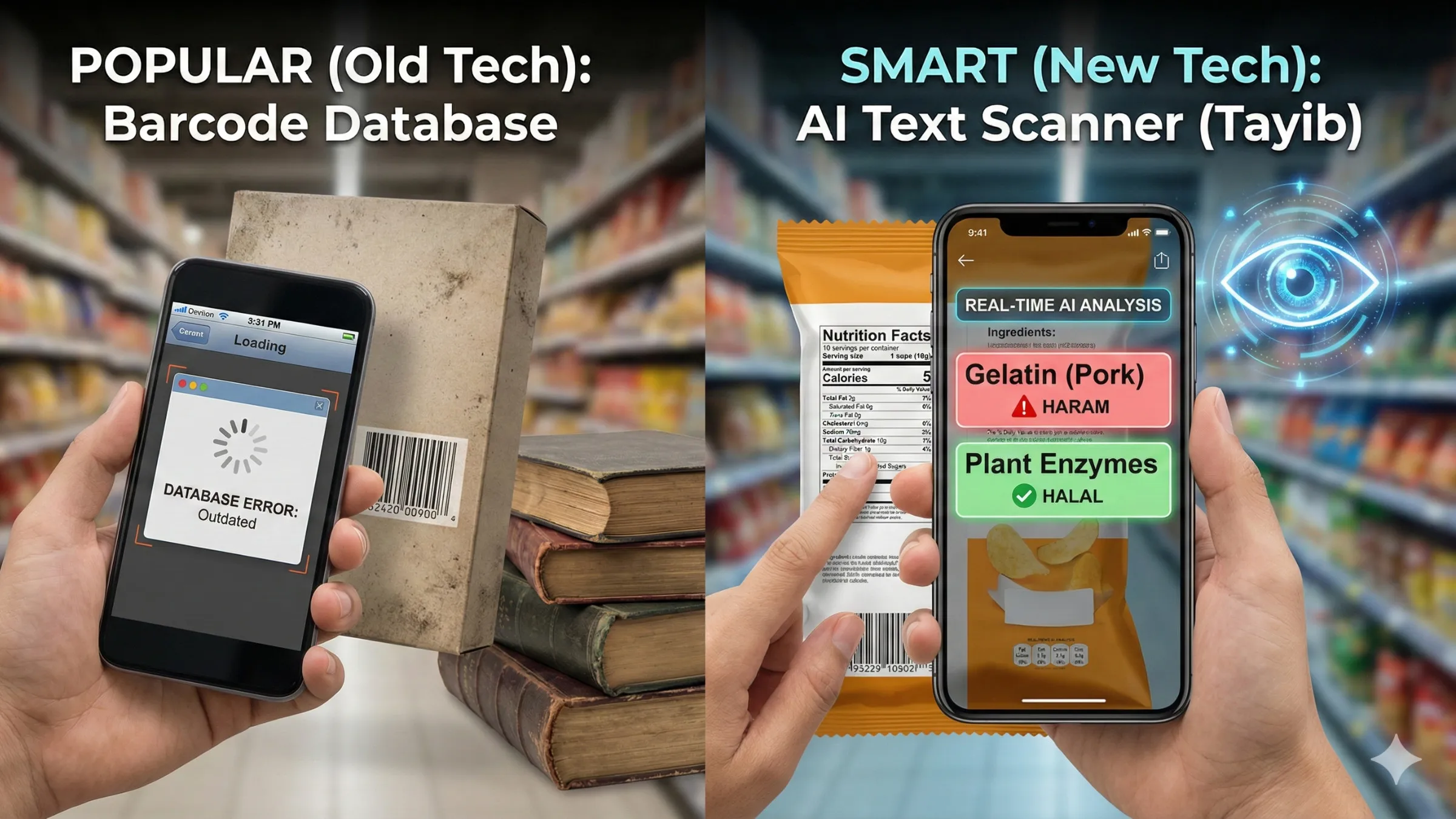
The apps that currently hold the title of “most popular” (by sheer download numbers) all work on the same premise: the barcode scanner.
Why they are popular: They were the first movers. Ten years ago, the idea of scanning a barcode to check a database was revolutionary. Over a decade, they have crowded-sourced massive lists of products in specific regions like the UK, USA, or France.
The hidden flaw in their popularity: A barcode app is only as good as its database. It’s like a printed encyclopedia—useful the day it’s published, but slowly becoming obsolete.
- They fail when you travel: The most popular US app is virtually useless in a Tokyo convenience store because its database doesn’t include Japanese barcodes.
- They miss silent recipe changes: If a manufacturer quietly adds gelatin to a yogurt but keeps the same barcode, the database will still tell you it’s “Halal” until someone manually updates it.
The most popular apps are great libraries of past information, but they struggle with the present.
The New Challenger: The AI Ingredient Reader
If the old apps are printed encyclopedias, the new generation of apps are live, intelligent translators.
Apps like Tayib represent a technological shift. They don’t rely on popularity or massive, aging databases. They rely on Artificial Intelligence (AI) and Optical Character Recognition (OCR).
Why this is the future: Instead of scanning a barcode and asking a server “Do you know this product?”, an AI app reads the actual ingredient list right in front of you.
It doesn’t matter if the product was launched yesterday, or if you are in Germany, America, or Singapore. If the app can read the text, it can identify the Haram ingredients in milliseconds.
It’s not about having the biggest list; it’s about having the smartest eyes.
Stop Relying on Outdated Databases
Join the new generation of Muslims using AI to scan what's actually in their food, right now.
Download the Tayib AI ScannerSummary: Popular vs. Smart
When choosing a Halal scanner, ask yourself what matters more: download counts from 2015, or accurate technology for 2026?
| Feature | The “Popular” Old Apps | The New AI Apps (Tayib) |
|---|---|---|
| Technology | Barcode Database Lookup | Real-time AI Text Scanning |
| Works Internationally? | No (Regional databases) | Yes (Reads ingredients anywhere) |
| Detects Recipe Changes? | No (Relies on manual updates) | Yes (Reads the current label) |
| Verdict | Good for local, well-known items. | Essential for travel, imported goods, and certainty. |
The most popular app is the one that has been around the longest. But the best app is the one that uses the most reliable technology to ensure your food is Halal today.

Written by Tayib
Founder & Halal Food Analyst
Tayib is dedicated to making Halal consumption transparent and stress-free. Through rigorous ingredient analysis, E-number decoding, and direct contact with brands, we help the Muslim community make informed and safe choices every day.
Read our strict verification methodology