December 19, 2025
The Great Meat Debate: Is "Halal" Meat Actually Zabiha? (Machine Slaughter Explained)
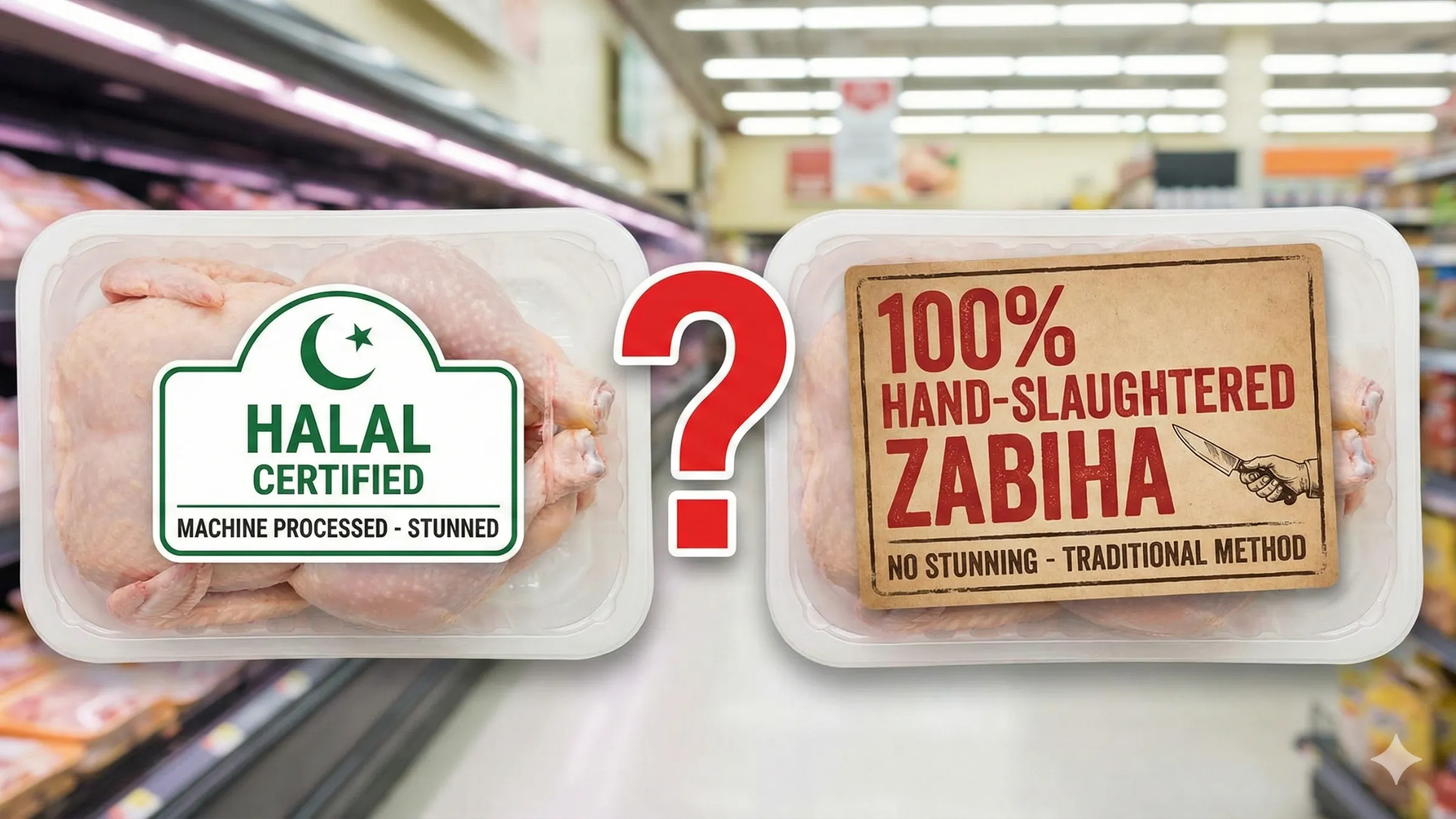
You are at a major supermarket chain. You see a package of chicken breasts with a small, generic sticker that says “Halal.”
Do you buy it?
For many Muslims, the answer is a hesitant “yes,” followed by a feeling of unease. For others, it’s a definite “no.”
Why the confusion? Because in our modern industrial food system, the word “Halal” on a label doesn’t always mean what you think it means. This is especially true when navigating Halal shopping at Costco or major US retailers. It brings us to the single biggest controversy in the Muslim food world: Zabiha (Hand Slaughter) vs. Machine Slaughter.
Here is the breakdown of why not all “Halal” meat is created equal.
What is true “Zabiha”?
Zabiha (or Dhabihah) is the gold standard. It is the traditional, undisputed method of Islamic slaughter that has existed for over 1,400 years.
For meat to be Zabiha, several conditions must be met simultaneously:
- The slaughterer must be a Muslim (or Person of the Book, which is why some wonder if Kosher symbols mean Halal).
- The name of Allah (Bismillah, Allahu Akbar) must be pronounced verbally over each individual animal at the time of slaughter.
- A sharp knife must be used by hand to swiftly cut the jugular veins, carotid arteries, and windpipe, ensuring a quick death and thorough bleeding.
Result: This meat is universally accepted as Halal by all scholars and all Madhabs.
The Modern Reality: Industrial “Halal”
To supply millions of chicken nuggets to fast-food chains and supermarkets daily, doing it by hand is too slow and expensive for big corporations. This is a common issue when evaluating global brands like McDonald’s or Starbucks meat sandwiches.
Enter Machine Slaughter. This is where the controversy explodes.
In many large-scale “Halal” certifiers, the process looks like this:
- Chickens are hung upside down on a conveyor belt.
- They pass through an electrified water bath to stun them (render them unconscious).
- A rotating mechanical blade cuts their necks.
- Sometimes, a tape recording plays “Bismillah” on a loop in the background.
Why is this a problem?
There are two major Islamic concerns with this industrial method:
1. The Stunning Issue (Is it alive?)
A fundamental requirement for meat to be Halal is that the animal must be alive at the moment of the cut. If the electric shock is too strong and kills the bird before the blade hits, that meat is considered Maytah (Carrion/Dead meat). This is just as critical as avoiding hidden pork enzymes or carmine bugs.
2. The “Bismillah” Issue
Can a tape recording fulfill the requirement of mentioning Allah’s name? Can one person say it once for 10,000 chickens? The vast majority of classical scholars require the Tasmiyah (saying Bismillah) to be said by a person over each animal.
The Madhab Factor
This affects whether your food is truly “Tayib” (pure). Your choice often depends on your school of thought:
- Hanafi followers are generally the strictest, requiring the slaughterer to be Muslim and the Tasmiyah to be said manually. Many Hanafis do not accept machine-slaughtered meat.
- Other schools may have different tolerances, but the issue of stunning remains universally problematic if it causes death before slaughter.
The Solution: You Can’t Interview the Butcher, But You Can Scan.
When you are eating out, you can’t always ask the chef about the slaughter method. The generic “Halal” sticker won’t tell you the full story of whether the meat is actually Zabiha.
This is why Tayib is crucial.
While Tayib cannot see inside the slaughterhouse, our database helps you identify specific brands and certifiers known for hand-slaughtered Zabiha vs. those that allow machine slaughter.
Don’t rely on guesswork. Download Tayib and take control of your diet.
Frequently Asked Questions: Zabiha & Machine Slaughter
Is machine-slaughtered chicken Halal?
This is a major point of disagreement among scholars. Some modern Halal certifiers permit machine slaughter if a Muslim starts the machine with 'Bismillah'. However, many leading Halal authorities and strict scholars reject it because they believe 'Bismillah' must be said over every individual bird and that mechanical blades can miss the proper veins, leading to Haram meat.
What is the Hanafi view on machine slaughter?
The Hanafi Madhab is generally very strict on this issue. Most Hanafi scholars rule that machine slaughter is not permissible (Haram) because the Tasmiyah (mentioning Allah's name) is a condition that must be fulfilled by a human being at the time of each individual slaughter. They typically advise only consuming hand-slaughtered Zabiha meat.
Does 'Halal' always mean 'Hand-Slaughtered'?
No. In the West, a 'Halal' label often only means that no pork was involved and that some form of Islamic prayer was associated with the process. It does not guarantee the traditional hand-slaughtered method. You must check the specific certification body (like HMC in the UK or HMS in the USA) to ensure it is Zabiha hand-slaughtered.
Is stunning animals permissible in Halal slaughter?
Stunning is allowed by some certifiers as long as it does not kill the animal before the knife reaches the neck. However, if the animal dies from the stun (electric shock or captive bolt) before slaughter, it is considered 'Maytah' (carrion) and is strictly Haram to eat.

Written by Tayib
Founder & Halal Food Analyst
Tayib is dedicated to making Halal consumption transparent and stress-free. Through rigorous ingredient analysis, E-number decoding, and direct contact with brands, we help the Muslim community make informed and safe choices every day.
Read our strict verification methodology