October 20, 2026
Is E631 Halal or Haram? (Disodium Inosinate Guide 2026)
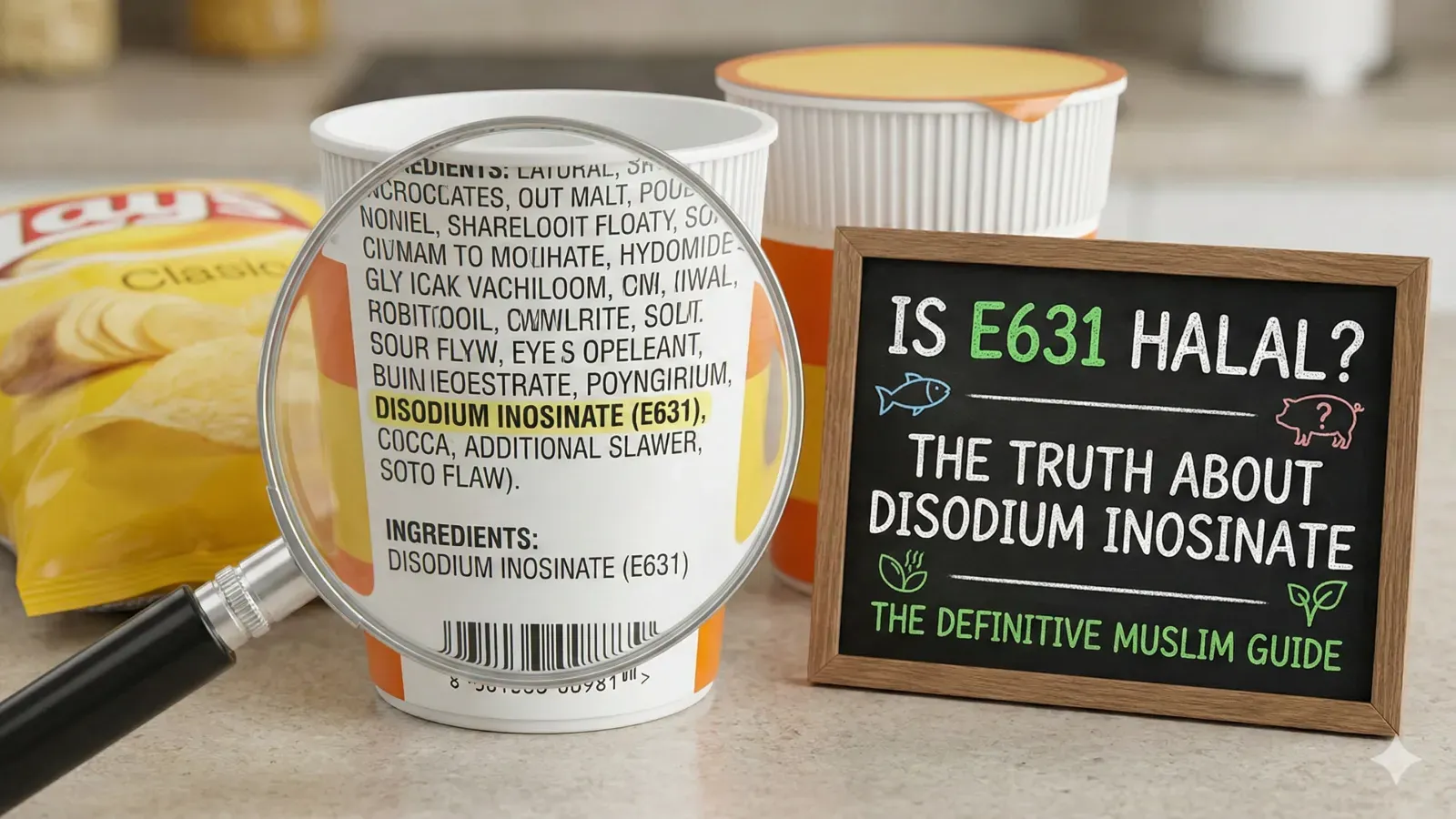
You are hungry. You grab a packet of instant ramen or a bag of savory chips. You check the back of the package and see a mysterious ingredient: E631.
Is E631 halal? No, it is classified as Mushbooh (doubtful).
E631 can be 100% Halal if derived from plants or fish. However, a massive portion of commercial E631 is extracted from uncertified meat, including pork fat. Without specific labels, it is highly dangerous for Muslim consumers.
As part of our Ultimate Guide to Halal E-Numbers, we are exposing exactly what this additive is. Here is how to know for sure if your snack is safe.
What is E631 in Food? (Disodium Inosinate)
People constantly search: what is E631 in food? What is the E631 food code meaning?
E631 is an industrial food additive. Its chemical name is Disodium Inosinate. Is disodium inosinate halal? The rule is identical to E631 because they are the exact same thing.
Because disodium inosinate is often blended with guanylate to create umami seasoning blends, you should also understand is E635 halal before buying seasoned packaged foods.
The E631 food additive is a powerful flavor enhancer. Food manufacturers use it to create a savory, meaty “umami” flavor in processed foods. You will frequently find it hiding in instant noodle seasoning packets, potato chips, and canned soups. Love spicy noodles? Read our guide: Is Buldak Ramen Halal?.
Disodium inosinate frequently appears in savory chip seasonings; read our comprehensive breakdown on whether Pringles are Halal to see which global flavors use plant-based enhancers.
Is E631 Halal or Haram?
So, is E631 halal or haram? Is INS 631 halal or haram?
It is Mushbooh (doubtful). To create this flavor enhancer, food scientists must extract inosinic acid. This acid comes from three very different sources.
- Halal (Fish): It is frequently extracted from sardines. Because all fish with scales are inherently Halal, this source is completely safe.
- Halal (Plants): Modern manufacturers can produce it by fermenting tapioca starch. The FDA regulates these extraction processes . When derived from plant fermentation, it is 100% Halal.
- Haram (Meat): It can be extracted from beef or pork. Unless the cow was slaughtered according to strict Islamic Zabiha rules, authorities like HMC UK consider it Haram.
Is E631 Made From Pig Fat? 🐷
This is the biggest fear in the snack aisle. Is E631 made from pig fat?
Yes, it often can be.
Historically, the cheapest way to extract inosinic acid in Western countries was from terrestrial meat, specifically pig meat and pork muscle tissue. Because extracting this additive from pork is extremely cheap, unlabeled E631 is highly dangerous for Muslims. If a product does not specify the source, you must assume the worst.
Scan E-Numbers Instantly
Don't guess with hidden animal derivatives. Let Tayib's AI scan the ingredient list to detect pork-based E631 in seconds.
Are Flavour Enhancers 627 & 631 Halal Together?
Food manufacturers rarely use E631 alone. You will almost always see it paired with another code.
Is flavour enhancer 627 631 halal? Is INS 627 INS 631 halal or haram?
The pairing is generally Mushbooh. E627 (Disodium Guanylate) is usually plant-based. It is extracted from dried seaweed or yeast. However, E631 remains the doubtful ingredient. Even if E627 is safe, the E631 ruins the Halal status of the entire snack.
The 2 Rules to Find Halal E631
You are standing in the supermarket. How do you know if the E631 came from a pig, a fish, or a plant? Use these two practical rules.
Rule 1: Look for Halal Certification If the product has an official Halal logo from a recognized body, the manufacturer has proven their E631 does not come from pigs or non-Zabiha beef.
Rule 2: Look for a “Vegetarian/Vegan” Logo This is your best shortcut. If a packet of noodles has a “Suitable for Vegetarians” logo, the E631 inside is guaranteed to be plant-based. Vegetarians do not eat pork or fish, which forces the manufacturer to use the safe tapioca fermentation method. Read our guide on 5 E-Numbers Muslims Should Avoid to spot more traps.
Stop Guessing. Start Scanning.
Memorizing which brands use plant-based E631 and which brands use pork-based E631 is impossible.
Companies change their recipes all the time. A chip brand that uses safe fish extracts in Asia might use pork extracts in America. You should not have to gamble with your faith in the snack aisle.
This is why you need Tayib.
Do not risk your diet on a doubtful seasoning packet. Just point your phone’s camera at the back of the box. Tayib’s advanced Optical Character Recognition (OCR) AI instantly reads the text. It scans complex E-numbers on the fly and cross-references them with vegetarian statuses. It detects hidden animal derivatives and flags them immediately.
Is That Seasoning Packet Safe?
Stop guessing. Let Tayib's AI scan the actual ingredient text and instantly detect if E631 is derived from pork, fish, or plants.


Frequently Asked Questions: Is E631 Halal?
Is E631 halal or haram?
E631 is classified as Mushbooh (doubtful). It is Halal if derived from tapioca starch (fermentation) or fish. It is Haram if derived from pork or non-Zabiha beef.
Is E631 made from pig fat?
It can be. Extracting E631 from pig meat is historically cheap in Western countries. If a product lacks a vegetarian or Halal logo, there is a high risk it contains pork derivatives.
What is E631 in food?
E631 is an industrial flavor enhancer. It is used in instant ramen and chips to create a savory, meaty taste.
Is flavour enhancer 627 631 halal?
Usually, no. While E627 is often plant-based (seaweed or yeast), the addition of E631 makes the pairing Mushbooh (doubtful) unless the product carries a vegetarian or Halal logo.
Is disodium inosinate halal?
Disodium inosinate is the chemical name for E631. Its Halal status depends entirely on its source. It can be plant-based (Halal) or derived from pork (Haram).
What is the E631 food code meaning?
E631 is the European food additive code for Disodium Inosinate, a chemical flavor enhancer.

Written by Tayib
Founder & Halal Food Analyst
Tayib is dedicated to making Halal consumption transparent and stress-free. Through rigorous ingredient analysis, E-number decoding, and direct contact with brands, we help the Muslim community make informed and safe choices every day.
Read our strict verification methodology