March 11, 2026
Is E635 Halal? The Truth About Disodium 5'-Ribonucleotides
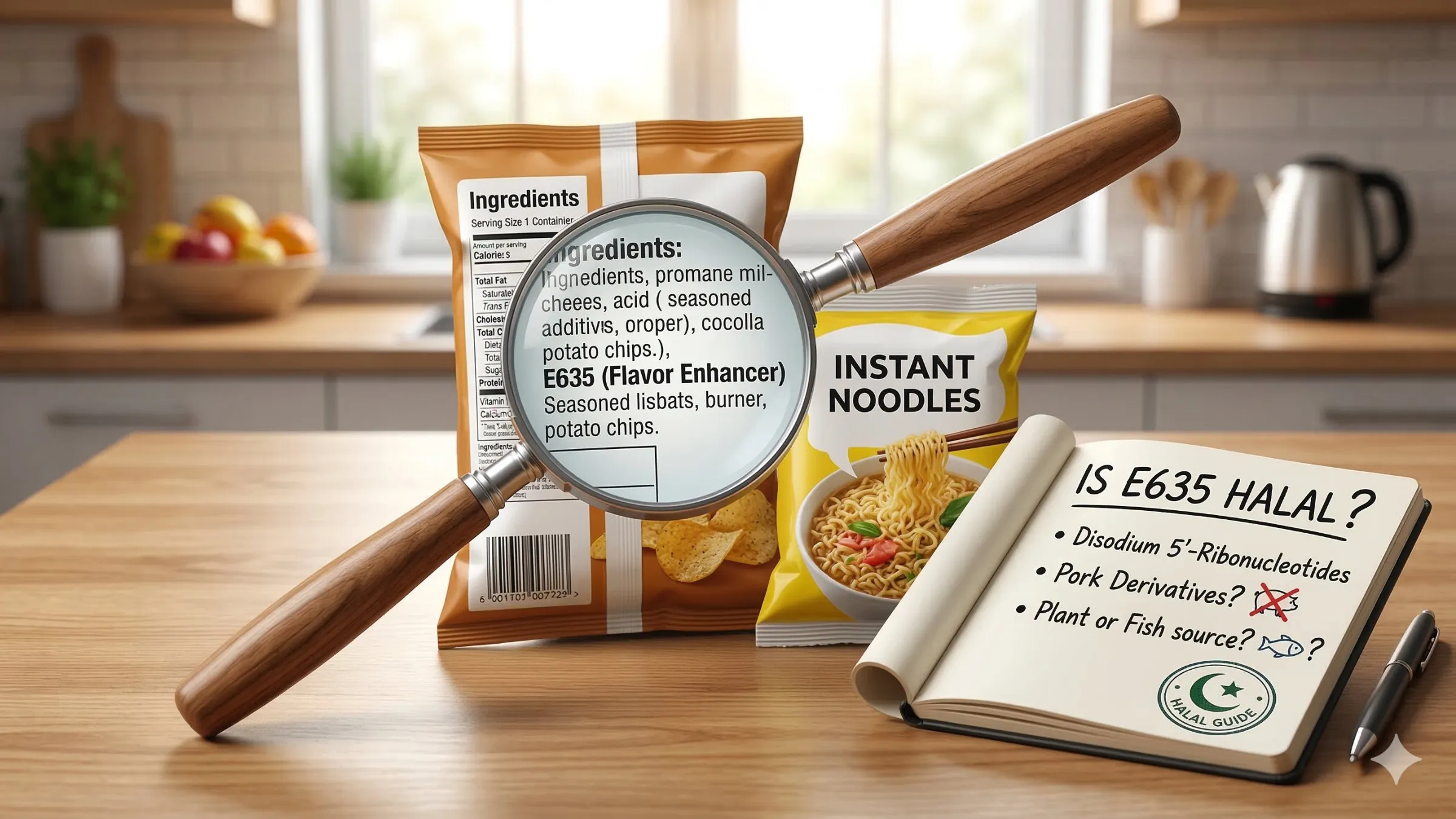
You pick up a bag of spicy chips or a packet of instant ramen. You check the back for Haram ingredients. You do not see any meat listed, but you see a strange code: Flavor Enhancer (E635).
Is this safe to eat? Or is it hiding animal fats?
Here is the bottom line: E635 is officially classified as Mushbooh (Doubtful).
While it can be made from plants or fish, it is frequently derived from pork or non-Zabiha beef. Unless the packet explicitly says it is Vegetarian or Halal certified, you should avoid it.
Scan E-Numbers Instantly
Tired of guessing? Use Tayib to scan the ingredient list and detect hidden animal extracts in seconds.
As part of our Ultimate Guide to Halal E-Numbers, we are exposing exactly what E635 is and how to avoid the pork trap.
What Actually is E635?
E635 is a food additive. Its scientific name is Disodium 5’-ribonucleotides.
It is a powerful flavor enhancer. Food companies use it to create a savory, meaty flavor known as “umami.” You will rarely see it used alone. It is almost always mixed with MSG (Monosodium Glutamate) to make cheap snacks taste addictive.
You will commonly find E635 in:
- Flavored potato chips and corn snacks.
- Instant noodles and ramen seasoning packets.
- Bouillon cubes and instant soups.
- Frozen savory meals.
The Secret: E635 is a Mixture
To understand why E635 is doubtful, you need to know a food industry secret.
E635 is not a single, unique ingredient. It is simply a 50/50 mixture of two other flavor enhancers:
- E627 (Disodium Guanylate): This is usually derived from dried seaweed or yeast extract. It is almost always plant-based and Halal.
- E631 (Disodium Inosinate): This is the massive red flag.
Because E635 contains E631, it carries the exact same Halal risks.
The Problem: Where Does It Come From?
The Halal status of E635 depends entirely on where the manufacturer sourced the inosinate (E631) portion of the mixture.
There are three possible sources.
1. The Animal Source (Haram) 🚫
Historically, extracting this flavor enhancer from meat was the cheapest method. If the E635 is extracted from pig meat, it is strictly Haram. If it is extracted from beef, the cow must be slaughtered according to Islamic rites. In Western supermarkets, this is rarely the case. Therefore, non-Zabiha beef extracts are also Haram. Recognized authorities like SANHA strongly advise avoiding unspecified flavor enhancers.
2. The Fish Source (Halal) 🐟
Sometimes, companies extract E635 from fish, particularly sardines. Because all fish is inherently Halal, this version is perfectly safe for Muslims to consume.
3. The Plant Source (Halal) 🌱
Today, many food brands use a modern fermentation process. They extract the flavor enhancer from tapioca starch or yeast using bacteria. This method is 100% plant-based, making the E635 Halal and Vegan.
Want a deeper dive into this chemical? Read our complete Guide to E631.
How to Check Your Snacks
You are standing in the supermarket holding a bag of chips. The label just says “E635”. How do you know if it came from a pig or a plant?
Rule 1: Look for the Vegetarian Logo. This is your easiest shortcut. If a product has a “Suitable for Vegetarians” or “Vegan” logo on the packaging, the E635 inside is guaranteed to be plant-based. Vegetarians do not eat pork or beef. Therefore, the additive is Halal.
Rule 2: Look for Halal Certification. If the snack has an official Halal stamp from a trusted body, the manufacturer has proven their E635 is safe.
Rule 3: Avoid Unlabeled E635. If the ingredient list simply says “E635” with no vegetarian logo or Halal stamp, it is completely Mushbooh. You must put it back on the shelf.
This same rule applies to hidden cheese powders. Read our Ultimate Guide to Cheese & Rennet.
Stop Guessing. Start Scanning.
Memorizing chemical names is exhausting. Trying to guess if a snack uses plant-based or meat-based enhancers takes too much time.
Recipes change constantly. A noodle brand might use Halal E635 in Malaysia, but switch to pork-based E635 in the UK.
This is why you need Tayib.
Tayib is your personal AI Halal scanner. Do not guess with your family’s food. Just point your phone’s camera at any ingredient list.
Tayib’s smart OCR AI reads the text instantly. It cross-references the E-numbers with our global database. It flags doubtful animal derivatives and verifies vegetarian statuses in milliseconds.
Frequently Asked Questions: Is E635 Halal?
Is E635 made from pork?
It can be. E635 is a mixture containing E631, which is often extracted from pig meat or non-Zabiha beef. If the product is not explicitly labeled as Vegetarian or Halal, there is a risk it contains pork derivatives.
What is E635 derived from?
E635 (Disodium 5'-ribonucleotides) is a mixture of E627 and E631. It can be derived from animal meat (pork or beef), fish (sardines), or plant fermentation (tapioca starch).
Is E635 Halal if the product is Vegetarian?
Yes! If a snack or noodle packet is officially labeled 'Suitable for Vegetarians' or 'Vegan', the E635 inside is guaranteed to be derived from plant fermentation. This makes it 100% Halal.
Why do instant noodles use E635?
E635 is a powerful flavor enhancer. It is used in ramen seasoning packets to create a savory, meaty flavor. It works in synergy with MSG to make the broth taste richer.
Are Maggi noodles Halal if they contain E635?
It depends on where you buy them. Maggi noodles sold in Muslim-majority countries (like the UAE or Malaysia) are Halal certified, meaning their E635 is safe. Maggi sold in Western supermarkets without a Halal or vegetarian label is considered Mushbooh (doubtful).
What is the difference between E631 and E635?
E631 is Disodium Inosinate. E635 is simply a 50/50 mixture of E631 and E627. Because E635 contains E631, they share the exact same Halal risks regarding animal derivatives.
Is flavor enhancer 635 Vegan?
Not always. E635 can be made from animals, fish, or plants. Vegans must verify that the specific brand uses the plant-based fermentation method to ensure it aligns with their diet.
How does the Tayib app know if E635 is safe?
Tayib uses an advanced OCR AI to scan the ingredient list. It analyzes the E-numbers and cross-references them against the product's vegetarian status and brand manufacturing data to flag any doubtful ingredients.

Written by Tayib
Founder & Halal Food Analyst
Tayib is dedicated to making Halal consumption transparent and stress-free. Through rigorous ingredient analysis, E-number decoding, and direct contact with brands, we help the Muslim community make informed and safe choices every day.
Read our strict verification methodology