November 1, 2026
Is Kellogg's Halal? The Definitive Cereal, Gelatin & Pop-Tarts Guide (2026)
Last updated on November 1, 2026
You are standing in the breakfast cereal aisle holding a box of Kellogg’s. You need a fast answer: is Kellogg’s Halal?
Here is the bottom line: Kellogg’s cannot receive a single blanket ruling. Plain grain cereals like Corn Flakes, regular Rice Krispies, and Frosted Flakes are Halal-suitable by ingredients. Their grain base is plant-derived, and their Vitamin D3 comes from sheep wool lanolin.
Here is the catch: Marshmallow treats and frosted pastries are strictly Haram in Western markets. Rice Krispies Treats, UK Rice Krispies Squares, Frosted Pop-Tarts, and Frosted Mini-Wheats contain animal gelatin derived from pork or non-Zabiha beef. Plain, unfrosted Pop-Tarts contain no gelatin and are Halal-suitable. In contrast, Kellogg’s lines made in Malaysia and Thailand carry full Halal certification.
Because snack favorites like Rice Krispies Treats rely on gelatin binders, it helps to know are marshmallows halal before packing sweet snacks for your family.
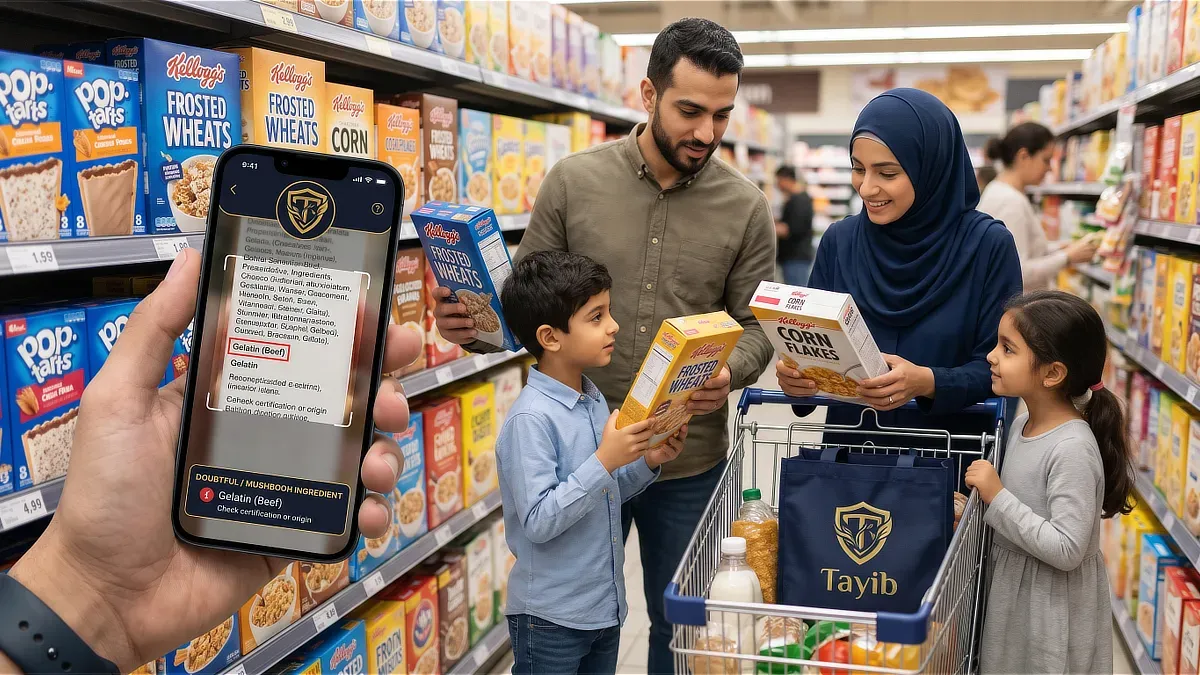
Supermarkets frequently mix uncertified Western boxes with certified imports on the same shelf. Use the Tayib OCR camera scanner to verify the ingredients on your box in real time.
As part of our Ultimate Muslim Guide to Popular Brands, we break down the food science, gelatin sources, and global supply chains behind Kellogg’s.
Quick Verdict: Kellogg’s Cereal & Snack Compliance Table (2026)
Need a fast answer before checkout? Use this quick reference guide to check your favorite Kellogg’s items:
| Kellogg’s Product | Western Market Status | Certified Market Status (SE Asia / SA) | Primary Reason |
|---|---|---|---|
| Kellogg’s Corn Flakes | ✅ Halal-Suitable | ✅ Certified Halal (JAKIM/CICOT) | Pure corn and grains. Lanolin-derived Vitamin D3. |
| Rice Krispies (Base Cereal) | ✅ Halal-Suitable | ✅ Certified Halal | Botanical rice grains; contains no animal derivatives. |
| Rice Krispies Treats (US) | 🚫 Strictly Haram | ⚠️ Market-Dependent | Marshmallow layer contains uncertified pork or beef gelatin. |
| Rice Krispies Squares (UK) | 🚫 Strictly Haram | ⚠️ Market-Dependent | Marshmallow binder contains uncertified non-Zabiha beef gelatin. |
| Frosted Flakes / Frosties | ✅ Halal-Suitable | ✅ Certified Halal | Pure sucrose frosting without animal gelatin binding. |
| Frosted Pop-Tarts | 🚫 Strictly Haram | ⚠️ Market-Dependent | Decorative icing uses uncertified Type B beef gelatin. |
| Unfrosted Pop-Tarts | ✅ Halal-Suitable | ✅ Certified Halal | 100% vegetable shortening base; zero gelatin in pastry. |
| Frosted Mini-Wheats | 🚫 Strictly Haram | ⚠️ Market-Dependent | Icing relies on industrial beef gelatin for binding. |
| Froot Loops (US) | ✅ Halal-Suitable | ✅ Certified Halal | Synthetic dyes (Red 40); check international SKUs for E120. |
| Coco Pops (Base Cereal) | ✅ Halal-Suitable | ✅ Certified Halal | Cocoa powder and grains; lanolin Vitamin D3. |
| Coco Pops Granola & Bars | ⚠️ Mushbooh | ✅ Certified Variants Exist | Contains lipid emulsifiers (E471) with unverified origins. |
| Special K (Original) | ✅ Halal-Suitable | ✅ Certified Halal | Simple wheat and rice flakes; avoid yogurt/marshmallow variants. |
Scan Any Cereal Box Instantly
Don't risk hidden pork or beef gelatin. Let Tayib's AI scan the ingredients on the back of the box to detect non-Halal additives in seconds.
The Core Product Taxonomy: Plain Flakes vs. Gelatin Novelties
Not all breakfast boxes carry the same dietary risk. Understanding how Kellogg’s manufactures these items helps you make safe choices.
Traditional Ready-to-Eat Flakes
Plain breakfast cereals like Corn Flakes and Rice Krispies represent the lowest dietary risk. They rely on simple milled corn, whole wheat, or rice grains combined with malt extract, sugar, and salt.
Under the Islamic legal principle of Al-Asl fi al-Ashya’ al-Ibahah (all things are fundamentally permissible unless proven forbidden), these simple cereals are clean. The only issue is that Western boxes do not carry third-party Halal logos.
Marshmallow Novelties and Frosted Pastries
The risk rises sharply when you enter the snack aisle. According to official corporate disclosures on the Kellogg’s Foodservice Ingredient Statements , gelatin is heavily used across dessert and pastry lines:
- North American Rice Krispies Treats: The marshmallow binder contains commercial gelatin derived interchangeably from pork or beef depending on commodity prices.
- Frosted Pop-Tarts (US & UK): The white decorative icing requires gelatin to stay firm at room temperature. Kellogg’s uses industrial Type B beef gelatin extracted from cattle slaughtered without Islamic rites (non-Zabiha).
- UK Rice Krispies Squares: The chewy marshmallow core uses uncertified bovine collagen.
Because this animal gelatin comes from pigs or unslaughtered cattle, these products are strictly Haram. Learn more about hidden animal binders in our Halal Candy and Snacks Guide.
Granola and Filled Cereal Lines
Filled and coated cereals like Krave or Coco Pops Granola introduce secondary additives. They often use emulsifiers like E471 and whey milk solids that require extra verification.
Food Science & Islamic Jurisprudence (Fiqh)
Why do scholars treat gelatin and vitamins differently? Let us look at the food chemistry.
Gelatin Sourcing and the Istihalah Debate
Gelatin is an animal protein extracted from collagen through industrial processing:
- Type A Gelatin (Porcine): Extracted from pig skin using acid treatment. It is categorically Haram (Najis al-Ayn) across all Islamic schools of thought.
- Type B Gelatin (Bovine): Extracted from cattle hides and bones using alkali processing. It is permissible only if the cow underwent Islamic slaughter (Zabiha). In Western industrial supply chains, it is treated as non-permissible carrion (Maytah).
Some people claim that chemical processing purifies animal collagen.
Here is the truth: Leading Halal certification authorities like JAKIM and MUI reject this claim. Industrial processing does not qualify as complete Islamic transformation (Istihalah Tammah). Uncertified gelatin remains strictly forbidden.
Vitamin D3 (Cholecalciferol) and Lanolin
Most Kellogg’s cereals are fortified with Vitamin D3.
Manufacturers produce Vitamin D3 by extracting 7-dehydrocholesterol from lanolin, a natural grease found in raw sheep wool. Islamic scholars widely agree that lanolin-derived Vitamin D3 is Halal. Shearing wool causes no harm to the sheep and involves no slaughter or spilled blood.
Mono- and Diglycerides (E471) & Carmine (E120)
- E471 Emulsifiers: Used in cereal bars and pastry crusts to bind fats and water. These fatty acids can come from palm oil or animal tallow. Without an explicit vegetarian or Halal mark, unverified E471 remains doubtful (Mushbooh).
- E120 Carmine: A red food coloring extracted from crushed female cochineal insects. The European Food Safety Authority (EFSA) permits its use, but Islamic schools differ. It is forbidden in the Hanafi school, but allowed by Maliki scholars. Learn more in our E120 Carmine Guide.
Global Supply Chains: Why a Malaysian Box Differs from a UK Box
A box of Kellogg’s Corn Flakes in London is not the same as one in Kuala Lumpur.
Southeast Asia (JAKIM & CICOT Gold Standard)
Kellogg’s operates dedicated manufacturing plants in Bandar Enstek, Malaysia (Kellogg Asia Products Sdn Bhd) and Thailand. These regional facilities are audited and certified by JAKIM Malaysia and CICOT Thailand. They use 100% plant-based ingredients and certified bovine sources.
South Africa (NIHT Certification)
Kellogg’s production lines in South Africa hold official Halal certificates from the National Independent Halaal Trust (NIHT). These domestic formulas avoid uncertified animal gelatins.
United States and United Kingdom
Supermarkets in the US and UK sell cereals produced without religious audits. While plain flakes are plant-based, you cannot assume an Asian Halal certificate applies to a box bought in London, Chicago, or Toronto. Read why Vegetarian is Not Always Halal to understand uncertified processing risks.
Australia & New Zealand
In 2016, Kellogg’s chose to discontinue third-party Halal certification for its domestic Australian cereal range. While the recipes remain mostly plant-based, external religious audits have stopped. Compare this with other brands in our KitKat Halal Guide and Cadbury Halal Guide.
How to Verify Any Kellogg’s Product Instantly with Tayib
Cereal recipes change frequently, and supermarkets often stock imported boxes. Traditional barcode database apps fail on these foreign boxes, returning “Product Not Found” or displaying outdated ingredient information.
This is why you need Tayib.
Tayib is an AI-powered Halal food scanner. It does not rely on barcodes. Just point your phone camera at the physical ingredient list on any cereal box or Pop-Tarts pack.
Tayib’s Optical Character Recognition (OCR) reads the real text directly from the cardboard. It detects hidden pork or beef gelatin, flags doubtful E-numbers like E471 and E120, and translates foreign packaging from 11 languages.
Best of all, Tayib lets you customize your Madhab (Hanafi, Shafi’i, Maliki, or Hanbali) to adjust rulings on ingredients like insect-derived Carmine automatically. If an item scans as Haram, Tayib immediately suggests certified Halal or vegan alternatives on local shelves.
Take the Guesswork Out of Breakfast
Scan any Kellogg's cereal box, Pop-Tarts pack, or snack bar with Tayib to detect pork gelatin, beef collagen, and unverified additives in one second.


Frequently Asked Questions: Is Kellogg's Halal?
Are Kellogg's Corn Flakes halal?
Yes, Kellogg's Corn Flakes are generally permissible by ingredient analysis across North America, the UK, and Europe. They consist of milled corn, sugar, malt flavoring, salt, and vitamins. The Vitamin D3 comes from sheep's wool lanolin, which Islamic scholars permit. However, standard Western retail boxes do not carry an official Halal logo.
Are Kellogg's Rice Krispies Treats halal?
No. Standard commercial Rice Krispies Treats sold in the US and Canada are not Halal. The manufacturer confirms the marshmallow binder contains gelatin derived interchangeably from pork or non-Zabiha beef. In the UK, Rice Krispies Squares use uncertified beef gelatin.
Do Pop-Tarts contain pork gelatin?
In the US and UK, frosted Pop-Tarts contain gelatin extracted from beef collagen in their decorative icing, rather than pork. However, because the cattle are not slaughtered according to Islamic rites (Zabihah), frosted Pop-Tarts are Haram. Plain, unfrosted Pop-Tarts contain no gelatin and use vegetable shortening, making them Halal-suitable.
Are Frosted Flakes (Frosties) halal?
Yes. Unlike marshmallow treats or frosted pastries, the sweet coating on Frosted Flakes (Frosties) is made from pure sugar and sucrose, without animal gelatin.
Is Vitamin D3 in cereal Halal?
Yes. Industrial Vitamin D3 is synthesized from lanolin, a natural wax extracted from the sheared wool of living sheep. Because wool is harvested without harming or slaughtering the animal, Islamic scholars widely consider lanolin-derived Vitamin D3 clean and Halal.
Is Kellogg's halal certified in Malaysia and Thailand?
Yes. Manufacturing plants in Bandar Enstek (Malaysia) and Thailand hold official Halal certifications from JAKIM and CICOT, respectively. These certifications apply strictly to units produced in those audited facilities.
Are Froot Loops halal?
In the US, standard Froot Loops are Halal-suitable as they use synthetic petroleum-based food dyes (like Red 40). However, international variants sometimes use Carmine (E120), a red dye extracted from insects, which is impermissible in the Hanafi school.
How can I check if a Kellogg's product contains gelatin?
Use the Tayib app. Point your smartphone camera at the ingredient list on the back of the box. Tayib's OCR technology instantly identifies hidden pork or beef gelatin, unverified E-codes, and animal stabilizers.

Written by Tayib
Founder & Halal Food Analyst
Tayib is dedicated to making Halal consumption transparent and stress-free. Through rigorous ingredient analysis, E-number decoding, and direct contact with brands, we help the Muslim community make informed and safe choices every day.
Read our strict verification methodology