September 16, 2026
Why Halal Barcode Scanners Fail (And Why AI OCR Text Scanners Are the Future)
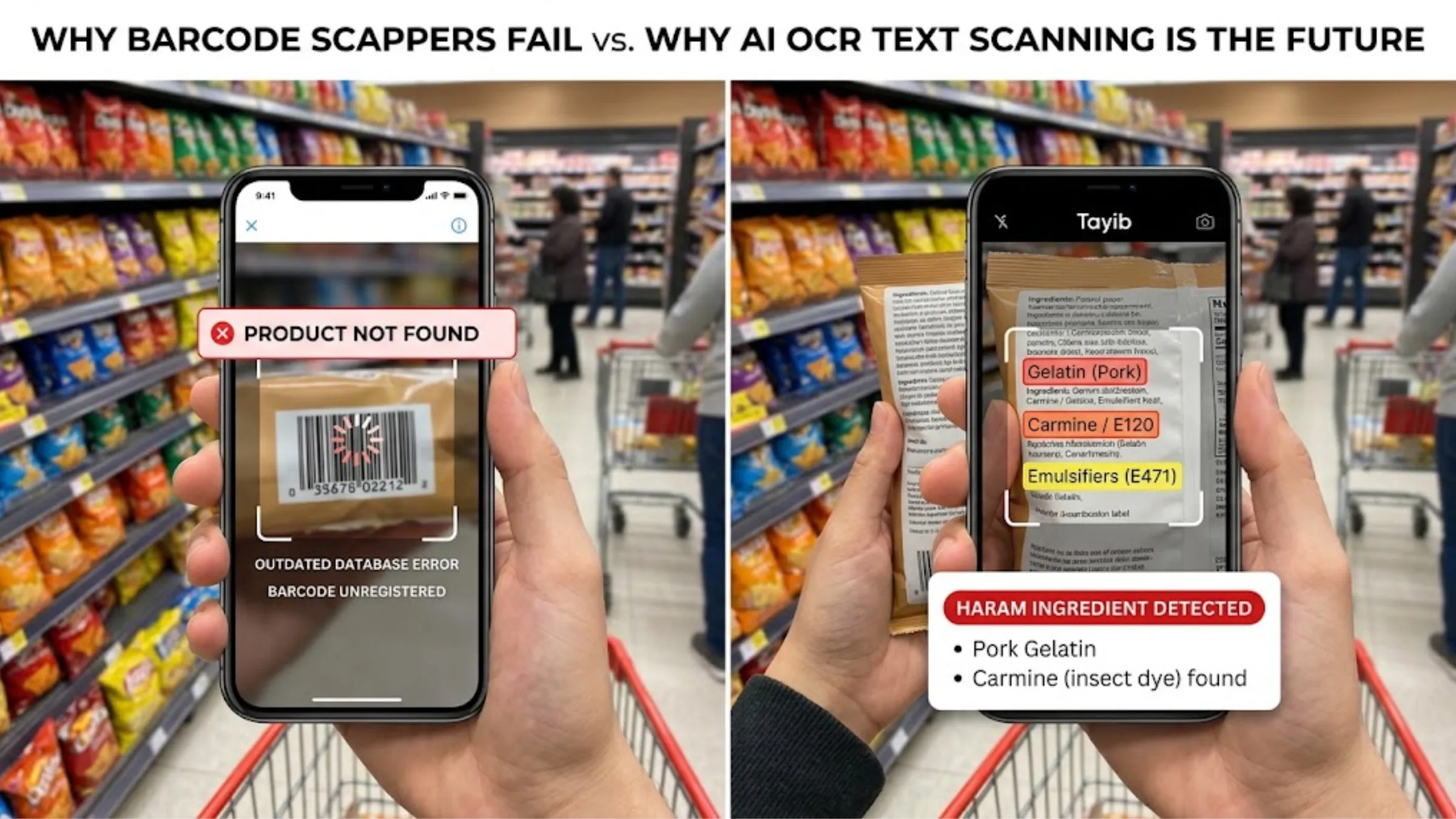
Halal barcode scanners fail because barcodes do not store ingredient data; they only link to static databases that quickly become outdated or missing.
Picture this: You are standing in the middle of a busy supermarket aisle. You flip over a box of imported cookies, line up the red camera laser over the black lines, and wait.
Instead of a clear answer, your screen flashes: “Product Not Found.”
You are left standing there holding the package, squinting at tiny font, and guessing whether that strange additive is plant oil or pork fat.
Here is the truth: In 2026, relying on a basic barcode scanner to verify your food is like using a phone book to search the internet.
Tired of 'Product Not Found' errors?
Scan actual ingredients with Tayib's AI camera. Ad-free and instant.
As part of our Modern Muslim Lifestyle Tech Guide, we are pulling back the curtain on how retail barcodes work. Here is why legacy scanner apps keep letting you down, and how optical character recognition (OCR) fixes the problem forever.
How Barcodes Actually Work (The Technical Reality)
Most shoppers believe a barcode holds a digital list of ingredients.
It does not.
A UPC (Universal Product Code) or EAN (European Article Number) is simply a 12-digit or 13-digit identification number. Think of it like a license plate on a car.
A license plate does not tell you how many people are sitting inside the vehicle. It simply identifies the car in a government registry.
When you scan a barcode with an older Halal app, the app does not read your package. It takes that number, sends it over the internet to a central database, and asks: “Do we have this number on file?”
If a volunteer or developer never manually typed that barcode into the system, the server returns an error. Relying on static barcode libraries is a 1990s solution to a modern grocery shopping problem.
The 4 Big Reasons Traditional Scanners Let You Down
Why do traditional barcode tools fail so often in real supermarkets?
Here are the four major flaws built into every barcode-only system.
1. Recipe Reformulation Without New Barcodes
Food manufacturers update their recipes all the time.
A brand might use vegetable oil in their chips for months. Then, palm oil prices rise, and they quietly switch to animal fats or pork-derived emulsifiers like E471 (Mono- and Diglycerides).
Because the product name, weight, and price stay identical, the manufacturer keeps the exact same barcode on the bag. The FDA regulations on food labeling require brands to update the ingredient text, but they do not require a new UPC code.
If your app relies on a database entry created three years ago, it will tell you the snack is safe when the package in your hands is actually Haram.
2. Store Brands & Regional Suppliers
Have you ever tried scanning store-brand items at Aldi, Lidl, or Trader Joe’s?
Private-label brands do not make their own food. They hire regional third-party factories.
A package of store-brand cheese crackers in Texas might use plant-based enzymes, while the exact same box in New York uses calf rennet from non-Zabiha cows. Both boxes share the same barcode. Static barcode apps cannot handle regional supplier differences.
Learn how to navigate private supermarket labels in our Muslim Shopper’s Guide to Trader Joe’s.
3. Imported Goods & Global Travel
International aisles are packed with incredible snacks from Japan, Korea, Turkey, and France.
However, standard apps built in the US or UK do not carry overseas retail codes. When you scan an imported treat, the server has no record of it.
Even worse, food rules change across borders. European sweets frequently use natural bug dye like E120 (Carmine) to replace synthetic colors. If your barcode app only knows the American formula, you will end up eating ingredients you want to avoid.
4. Old, Unverified Crowdsourced Info
Many older apps keep their servers full by letting random users submit products.
A user uploads a photo of a cookie, taps “Halal,” and moves on. Nobody verifies whether that user understood the difference between plant-based pectin and pork gelatin.
Consuming Haram additives because an unverified internet stranger checked the wrong box years ago is a massive risk.
Why AI OCR Text Scanning Changes Everything
Optical Character Recognition (OCR) changes everything.
Instead of searching for a retail number in a static database, an AI OCR scanner uses your smartphone camera as a digital eye.
You point your camera directly at the printed ingredient list on the back of the box. The phone reads the physical letters printed on the package in real time.
Why does this matter?
Because the physical label on the box reflects the exact batch you are holding in your hand right now.
How AI Brains Process Labels
Basic scanner apps only look for exact keyword matches. If an app only searches for the word “pork,” it will miss:
- Hidden Animal Rennet: Unspecified animal enzymes inside cheese powders and savory chips. Read our Ultimate Guide to Cheese and Rennet.
- Alcohol Carriers: Vanilla extracts or “Natural Flavors” extracted using ethanol.
- Cryptic E-Numbers: Over 300 industrial food codes that change between animal, plant, and synthetic origins.
Modern AI models do not just match words. They understand context. An AI reads the full sentence, recognizes whether an emulsifier is labeled “from soy” or left unspecified, and applies Islamic dietary rules instantly.
Legacy Scanners vs. AI OCR Text Scanners
Here is how traditional barcode apps compare against modern AI text readers:
| Feature | Legacy Barcode Scanners | AI OCR Text Scanners (Tayib) |
|---|---|---|
| New & Imported Products | ❌ Constant “Not Found” errors | ✅ Works on any printed label |
| Silent Recipe Changes | ❌ Blind to formula updates | ✅ Analyzes the exact batch in hand |
| Store Brands (Aldi, Trader Joe’s) | ❌ Fails on private label UPCs | ✅ Reads the actual printed text |
| Scan Success Rate | ⚠️ 50% to 70% | ✅ 99% on legible labels |
| Fiqh Transparency | ❌ Simple binary label | ✅ Breaks down every suspicious code |
| Speed & User Experience | ⚠️ Often bloated with video ads | ✅ Clean, fast, and native |
The Best of Both Worlds: How Modern Shoppers Use Tayib
You should not have to spend your Saturday grocery trip typing chemical numbers into a search engine.
This is why we built Tayib.
Tayib does not force you to pick between speed and accuracy. It uses a dual engine:
- Instant Barcode Lookup: If you are buying a common everyday staple, scan the barcode for a lightning-fast answer.
- Instant AI Camera OCR: If the product is imported, store-branded, or unlisted, point your camera at the ingredients list. Tayib reads the printed text, highlights doubtful additives, and delivers a clear verdict in one second.
No frozen cameras. No unskippable 30-second video ads in the snack aisle. Just clear, honest food transparency that respects your time and your faith.
Want to see how your smartphone hardware handles scanning? Read Can a Phone Be Used as a Halal Scanner?.
Never Guess an Ingredient Again
Stop getting 'Product Not Found' errors at the grocery store. Download Tayib to scan ingredients directly with AI camera precision.


Frequently Asked Questions: Barcode Scanners & AI OCR
Why do halal barcode apps say 'Product Not Found'?
Barcode scanner apps say 'Product Not Found' when the item's specific UPC or EAN code is missing from their central database. This happens frequently with newly released snacks, private supermarket store brands, and imported products.
Can an AI scanner read ingredients in different languages?
Yes. Advanced AI computer vision models can detect and read ingredients printed in multiple foreign languages, including French, German, Spanish, and Arabic, translating and checking the food additives in real time.
How does OCR detect hidden pork derivatives?
Optical Character Recognition (OCR) reads the printed text on the package and feeds the words into an AI engine. The AI identifies technical chemical names and E-numbers commonly derived from swine (such as porcine enzymes, pork gelatin, or animal glycerin) even when the word 'pork' is not explicitly written.
Do I have to pay to scan ingredients with Tayib?
Tayib lets you scan barcodes and read ingredient lists with fast, modern AI tools without forcing you to sit through intrusive 30-second video ads while standing in grocery store aisles.
Is optical character recognition accurate on curved cans or bottles?
Yes. Modern mobile AI cameras use advanced text-detection algorithms that easily recognize and piece together curved or distorted text on round soda cans, chip canisters, and flexible snack pouches.
What should I do if a barcode scanner disagrees with the label text?
Always trust the physical label printed on the package. Manufacturers update ingredient lists on the physical box whenever a recipe changes, but they rarely notify external third-party barcode databases.
Can Tayib tell the difference between bovine and porcine gelatin?
Yes. If the packaging specifies the source (such as 'beef gelatin' or 'pork gelatin'), Tayib highlights the exact animal origin. If the label simply says 'gelatin' without a Halal stamp, Tayib flags it as doubtful or Haram because commercial gelatin in Western markets is predominantly pork.
Why do food brands change ingredients without changing barcodes?
Applying for and registering new retail barcodes costs money and creates logistical friction with supermarket inventory systems. As long as the product size, name, and retail price remain the same, brands routinely tweak raw ingredient suppliers while keeping the original barcode.
Do AI text scanners work without an internet connection?
On-device OCR can recognize text locally on your phone. However, verifying complex food additives against updated scholarly rulings and global chemical databases typically requires a fast cellular or Wi-Fi data connection.
Can an AI scanner recognize insect-based food dyes?
Yes. Tayib's AI recognizes all synonyms for insect dyes, including Carmine, Cochineal Extract, Natural Red 4, Crimson Lake, and E120, warning you immediately that the dye comes from crushed beetles.

Written by Tayib
Founder & Halal Food Analyst
Tayib is dedicated to making Halal consumption transparent and stress-free. Through rigorous ingredient analysis, E-number decoding, and direct contact with brands, we help the Muslim community make informed and safe choices every day.
Read our strict verification methodology